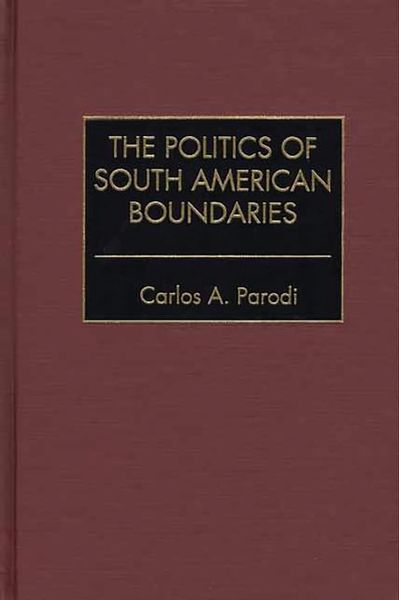
The Politics of South American Boundaries
Fr. 103.90
inkl. gesetzl. MwSt.Beschreibung
Produktdetails
Format
Kopierschutz
Ja
Family Sharing
Nein
Text-to-Speech
Nein
Altersempfehlung
ab 7 Jahr(e)
Erscheinungsdatum
30.04.2002
Verlag
Bloomsbury eBooks USSeitenzahl
176 (Printausgabe)
Auflage
1. Auflage
Sprache
Englisch
EAN
9780313010705
Parodi shows that boundary disputes have and continue to play a major role in creating tensions in South America. Of the 25 international territorial boundaries that exist in South America, eight were marked with major wars, eight with lesser wars, and five with some level of violence. As recently as 1995, the armies of Ecuador and Peru were at war to define a boundary. In 1982 Argentina went to war, inspired by the call to restore a piece of its mutilated national territory. Venezuela and Guyana, Guyana and Suriname, and Suriname and French Guiana have not completed boundary demarcation agreements. Bolivia's insistence on its right for sovereign access to the Pacific Ocean is a source of tension with Chile and Peru. Colombia and Venezuela have unresolved boundary issues in the Gulf of Venezuela. Clearly, boundary disputes have and continue to play a major role in creating larger conflicts within South America.
Territorial boundaries are marks on the ground, but, as Parodi shows, their staying power or stability depends on their grip on consciousness. By examining the boundary theory of South American states and its implementation, he also explains how the symbolic system of South American boundaries is used to instill national identity, mobilize people to war, and control population and territory. This text will be of particular interest to scholars, students, and researchers involved with Latin American politics, diplomacy, and international relations.
Territorial boundaries are marks on the ground, but, as Parodi shows, their staying power or stability depends on their grip on consciousness. By examining the boundary theory of South American states and its implementation, he also explains how the symbolic system of South American boundaries is used to instill national identity, mobilize people to war, and control population and territory. This text will be of particular interest to scholars, students, and researchers involved with Latin American politics, diplomacy, and international relations.
Kundinnen und Kunden meinen
Verfassen Sie die erste Bewertung zu diesem Artikel
Helfen Sie anderen Kund*innen durch Ihre Meinung