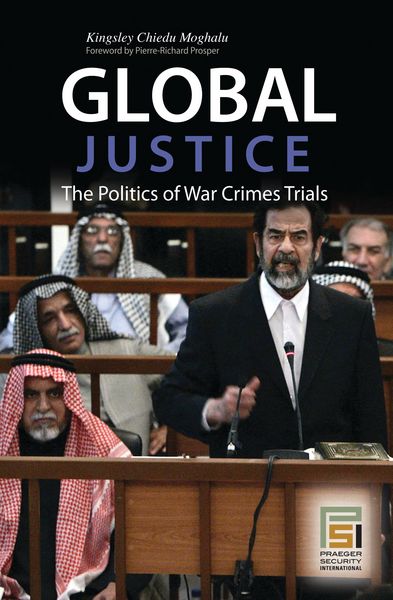
Global Justice The Politics of War Crimes Trials
-
- Hardcover
- Taschenbuch
- eBook ausgewählt
-
Form:Einzelkauf Download
-
Sprache:Englisch
Fr. 60.90
inkl. gesetzl. MwSt.Beschreibung
Produktdetails
Format
Kopierschutz
Ja
Family Sharing
Nein
Text-to-Speech
Nein
Altersempfehlung
ab 7 Jahr(e)
Erscheinungsdatum
30.10.2006
Verlag
Bloomsbury eBooks USSeitenzahl
240 (Printausgabe)
Auflage
1. Auflage
Sprache
Englisch
EAN
9780313087127
After a controversial war in which he was ousted and captured by United States forces, Saddam Hussein was arraigned before a war crimes tribunal. Slobodan Milosevic died midway through his contentious trial by an international war crimes tribunal at The Hague. Calls for intervention and war crimes trials for the massacres and rapes in Sudan's Darfur region have been loud and clear, and the United States remains fiercely opposed to the permanent International Criminal Court. Are war crimes trials impartial, apolitical forums? Has international justice for war crimes become an entrenched aspect of globalization? In Global Justice, Moghalu examines the phenomenon of war crimes trials from an unusual, political perspective-that of an anarchical international society.
After a controversial war in which he was ousted and captured by United States forces, Saddam Hussein was arraigned before a war crimes tribunal. Slobodan Milosevic died midway through his contentious trial by an international war crimes tribunal at The Hague. Calls for intervention and war crimes trials for the massacres and rapes in Sudan's Darfur region have been loud and clear, and the United States remains fiercely opposed to the permanent International Criminal Court. Are war crimes trials impartial, apolitical forums? Has international justice for war crimes become an entrenched aspect of globalization?
In Global Justice, Moghalu examines the phenomenon of war crimes trials from an unusual, political perspective-that of an anarchical international society. He argues that, contrary to conventional wisdom, war crimes trials are neither motivated nor influenced solely by abstract notions of justice. Instead, war crimes trials are the product of the interplay of political forces that have led to an inevitable clash between globalization and sovereignty on the sensitive question of who should judge war criminals. From Germany's Kaiser Wilhelm to the Japanese Emperor Hirohito, from the trials of Milosevic, Saddam Hussein, and Charles Taylor to Belgium's attempts to enforce the contested doctrine of universal jurisdiction, Moghalu renders a compelling tour de force of one of the most controversial subjects in world politics. He argues that, necessary though it was, international justice has run into a crisis of legitimacy. While international trials will remain a policy option, local or regional responses to mass atrocities will prove more durable.
After a controversial war in which he was ousted and captured by United States forces, Saddam Hussein was arraigned before a war crimes tribunal. Slobodan Milosevic died midway through his contentious trial by an international war crimes tribunal at The Hague. Calls for intervention and war crimes trials for the massacres and rapes in Sudan's Darfur region have been loud and clear, and the United States remains fiercely opposed to the permanent International Criminal Court. Are war crimes trials impartial, apolitical forums? Has international justice for war crimes become an entrenched aspect of globalization?
In Global Justice, Moghalu examines the phenomenon of war crimes trials from an unusual, political perspective-that of an anarchical international society. He argues that, contrary to conventional wisdom, war crimes trials are neither motivated nor influenced solely by abstract notions of justice. Instead, war crimes trials are the product of the interplay of political forces that have led to an inevitable clash between globalization and sovereignty on the sensitive question of who should judge war criminals. From Germany's Kaiser Wilhelm to the Japanese Emperor Hirohito, from the trials of Milosevic, Saddam Hussein, and Charles Taylor to Belgium's attempts to enforce the contested doctrine of universal jurisdiction, Moghalu renders a compelling tour de force of one of the most controversial subjects in world politics. He argues that, necessary though it was, international justice has run into a crisis of legitimacy. While international trials will remain a policy option, local or regional responses to mass atrocities will prove more durable.
Kundinnen und Kunden meinen
Verfassen Sie die erste Bewertung zu diesem Artikel
Helfen Sie anderen Kund*innen durch Ihre Meinung