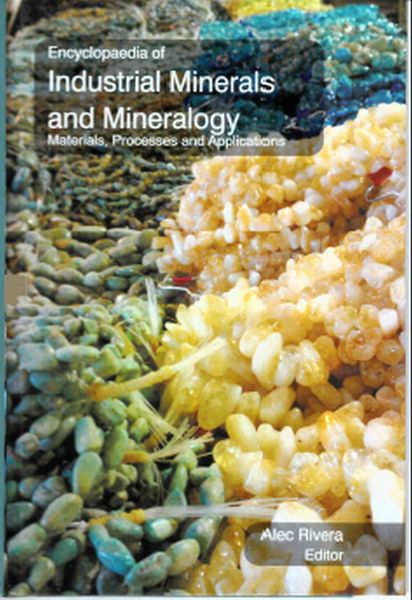
Encyclopaedia of Industrial Minerals and Mineralogy Materials, Processes and Applications (Introduction to Industrial Minerals)
-
- Einzelkauf Download ausgewählt
-
Sprache:Englisch
Fr. 402.90
inkl. gesetzl. MwSt.Beschreibung
Produktdetails
Format
Kopierschutz
Ja
Family Sharing
Ja
Text-to-Speech
Nein
Erscheinungsdatum
30.06.2013
Verlag
Anmol Publications PVT LTDSeitenzahl
260 (Printausgabe)
Dateigröße
15395 KB
Sprache
Englisch
EAN
9789390313143
Industrial minerals include both common and uncommon minerals and some rocks. Construction raw materials such as aggregates are included. Industrial minerals can be categorized according to their market characteristics as bulk minerals, either within or outside a vertically integrated industry, national or regional commodities, internationally traded commodities, dual-purpose metal ores, or very high-value minerals. Bulk minerals are almost entirely used for construction. Industrial minerals are geological materials which are mined for their commercial value, which are not fuel and are not sources of metals. They are used in their natural state or after beneficiation either as raw materials or as additives in a wide range of applications. The evaluation of raw materials to determine their suitability for use as industrial minerals requires technical task-work, mineral processing trials and end-product evaluation; free to download evaluation manuals are available for the following industrial minerals: limestone, flake graphite, diatomite, kaolin, bentonite and construction materials. Typical examples of industrial rocks and minerals are limestone, clays, sand, gravel, diatomite, kaolin, bentonite, silica, barite, gypsum, and talc. Some examples of applications for industrial minerals reconstruction, ceramics, paints, electronics, filtration, plastics, glass, detergents and paper. In some cases, even organic materials (peat) and industrial products or by-products are categorized under industrial minerals, as well as metallic compounds mainly utilized in nonmetallic form. In some cases, organic substances (such as peat) are categorized as industrial minerals. This case, however, violates the technical definition of a mineral. A substance must be a mineral before it may be categorized as an industrial mineral. Peat is a geologic substance mined for its economic value but that does not mandate that it be referred to as a mineral or as an industrial mineral. This encyclopaedia covers the entire spectrum of mineralogy and consolidates its applications in various fields.
Kundinnen und Kunden meinen
Verfassen Sie die erste Bewertung zu diesem Artikel
Helfen Sie anderen Kund*innen durch Ihre Meinung