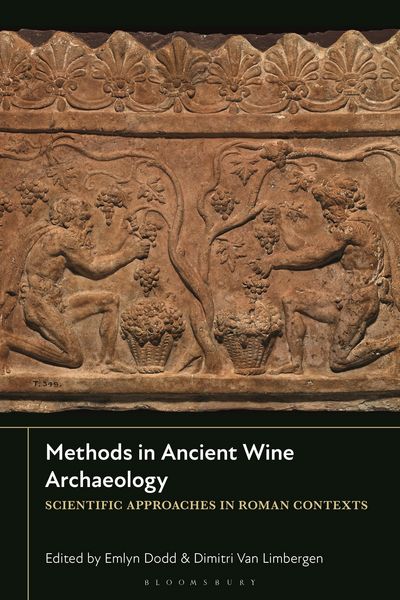
Produktbild: Methods in Ancient Wine Archaeology

Methods in Ancient Wine Archaeology Scientific Approaches in Roman Contexts

Fr. 153.00

inkl. gesetzl. MwSt., Versandkostenfrei


Beschreibung

Produktdetails

Einband

Gebundene Ausgabe

Erscheinungsdatum

08.02.2024

Herausgeber

Emlyn Dodd + weitere

Verlag

Bloomsbury Academic

Seitenzahl

336

Maße (L/B/H)

23.4/15.6/2.5 cm

Gewicht

640 g

Sprache

Englisch

ISBN

978-1-350-34664-2

Beschreibung

Produktdetails

Einband

Gebundene Ausgabe

Erscheinungsdatum

08.02.2024

Herausgeber

Verlag

Bloomsbury Academic

Seitenzahl

336

Maße (L/B/H)

23.4/15.6/2.5 cm

Gewicht

640 g

Sprache

Englisch

ISBN

978-1-350-34664-2

Kundinnen und Kunden meinen

0 Bewertungen

Informationen zu Bewertungen

Zur Abgabe einer Bewertung ist eine Anmeldung im Konto notwendig. Die Authentizität der Bewertungen wird von uns nicht überprüft. Wir behalten uns vor, Bewertungstexte, die unseren Richtlinien widersprechen, entsprechend zu kürzen oder zu löschen.

Die Bewertungen sind nach Format, Anzahl Sterne und Datum sortiert.

Verfassen Sie die erste Bewertung zu diesem Artikel

Helfen Sie anderen Kund*innen durch Ihre Meinung

Kundinnen und Kunden meinen

0 Bewertungen filtern

Weitere Artikel finden Sie in

Die Leseprobe wird geladen.
  • Produktbild: Methods in Ancient Wine Archaeology
  • List of Figures
    List of Tables
    List of Contributors
    Acknowledgements
    List of Abbreviations

    1. Scientific Approaches to Ancient Wine: Developments, Challenges, and Future Perspectives, Emlyn Dodd (Institute of Classical Studies, University of London, UK/British School at Rome, Italy), and Dimitri Van Limbergen (Ghent University, Belgium)
    2. Ancient Viniculture: A Multidisciplinary Holistic Perspective, Patrick E. McGovern (University of Pennsylvania, USA)
    3. Approaching Palaeo-terroir: Thoughts on How to Study the Geography of Wine in the Roman World, Dimitri Van Limbergen (Ghent University, Belgium) and Pieter Gurdebeke (Ghent University, Belgium)

    Part I. Biomolecular Archaeology and Chemical Analysis

    4. Archaeology and Grape aDNA, Andrea Zifferero (University of Siena, Italy)
    5. Wine Production, Trade, and Consumption in the Roman World: The Potential of Organic Residue Analysis, Alessandra Pecci (University of Barcelona, Spain)
    6. A Case Study in the Importance of Residue Analysis for the Interpretation of the Estate Economy: The Villa of Santa Marina (Istria, Croatia), Corinne Rousse (Aix-Marseille University, France), Nicolas Garnier (Independent Scholar), Gaetano Bencic (Independent Scholar) and Davor Munda (Independent Scholar)

    Part II. Archaeobotany and Palynology

    7. Archaeobotany in the Archaeology of Wine: Current Approaches and Future Possibilites, Patrizia Basso (University of Verona, Italy) and Diana Dobreva (University of Verona, Italy)
    8. Applicability and Use of Archaeobotany for the Study of Vine Cultivation and Winemaking in the Roman Period, Marco Marchesini (Independent Scholar), Silvia Marvelli (C.A.A. Giorgio Nicoli, Italy), Anna Chiara Muscogiuri (C.A.A. Giorgio Nicoli, Italy) and Elisabetta Rizzoli (C.A.A. Giorgio Nicoli, Italy)
    9. Grapevines Under the Lens: A Methodological Approach to the Study of Seed Assemblage from Villamagna (Urbisaglia, Marche, Italy), Riccardo Carmenati (University of Macerata, Italy), Francesco Breglia (University of Salento, Italy) Roberto Perna (University of Macerata, Italy) and Girolamo Fiorentino (University of Salento, Italy)
    10. Roman Viticulture from Palynology: A Review and New Data in the British Isles, Antony G. Brown (University of Southampton, UK), Ian Meadows (Independent Scholar) and Simon D. Turner (University College London, UK)

    Part III. Vineyard and Landscape Archaeology

    11. Studying Roman Viticulture in Baetica with GIS Modelling and Geophysical Survey, Pedro Trapero Fernández (University of Cádiz, Spain), Isabel Rondán Sevilla (University of Cádiz, Spain) and Lázaro Lagóstena Barrios (Univeristy of Cádiz, Spain)
    12. New High-Resolution Approaches for Vineyard Archaeology: Evidence from the Region of Pompeii, Florian Seiler (German Archaeological Institute, Berlin)
    13. Employing Remote Sensing and Multispectral Satellite Data to Measure the Extent of Grapevine and Olive Vegetation: A Case Study in the Landscape of Western Rough Cilicia, Turkey, Christopher D. Dore (University of Arizona, USA) and Nicholas K. Rauh (Purdue University, USA)

    Part IV. Modelling and Experimental Archaeology

    14. Quantifying Roman Wine Production: New Approaches to Vineyard Sizes and Wine Yields in the Ager Barcinonensis, Antoni Martín i Oliveras (University of Barcelona, Spain)
    15. Reconstructing Vineyard Geography, Yields and the Profitability of Wine Production in the Roman Empire: New Insights from Spatial-Analysis, and Agent-Based and Climate-Vegetation Modelling, Nicolas Bernigaud (Independent Scholar), Alberte Bondeau (Aix-Marseille University, France), Joël Guiot (Aix-Marseille University, France), Laurent Bouby (Institute of Evolutionary Science of Montpellier, France), Frédérique Bertoncello ( University Côte d'Azur, France) and Marie-Jeanne Ouriachi (University of Côte d'Azur, France)
    16. Modelling Viticulture in the Adriatic Region: A Quantification of Agricultural Suitability, Andrew McLean (University of Edinburgh, UK)
    17. Linking Experimental Archaeology and Winemaking: From the Dig to the Winery, Mkrtich Harutyunyan (University of Lisbon, Portugal), Manuel Malfeito Ferreira (Univeristy of Lisbon, Portugal) and Mario Indelicato (University of Catania, Italy)

    Notes
    Index
    Bibliography