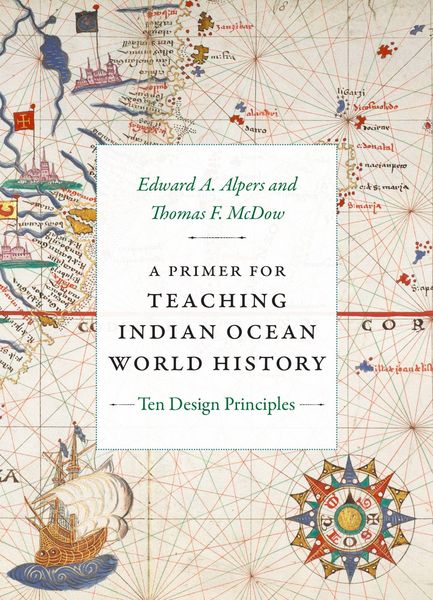
Produktbild: A Primer for Teaching Indian Ocean World History

A Primer for Teaching Indian Ocean World History Ten Design Principles

Fr. 142.00

inkl. gesetzl. MwSt., Versandkostenfrei


Beschreibung

Produktdetails

Einband

Gebundene Ausgabe

Erscheinungsdatum

17.05.2024

Verlag

Duke University Press

Seitenzahl

216

Maße (L/B/H)

16/22.4/1.8 cm

Gewicht

431 g

Sprache

Englisch

ISBN

978-1-4780-2606-8

Beschreibung

Rezension

"Edward A. Alpers and Thomas F. McDow provide a multidimensional map to guide educators in their Indian Ocean World history teaching journey. Thematically organized and pedagogically innovative, the student-centered digital technology assignment ideas are designed to bring the Indian Ocean World to life. These design principles will make Indian Ocean history accessible for educators seeking to go boldly beyond conventional world history or area studies by incorporating or recentering their teaching on this fascinating and cosmopolitan region." - Kerry Ward, Associate Professor of History, Rice University "The importance and prominence of the Indian Ocean World for research and teaching is growing exponentially. The region offers countless opportunities to enhance and challenge students' normative understanding of subjects such as slavery, empire, and the social and physical geographies of space. With this in mind, Edward A. Alpers and Thomas F. McDow have produced a vital guide that offers innovative teaching strategies with which to engage students." - Pedro Machado, author of (Ocean of Trade: South Asian Merchants, Africa, and the Indian Ocean, c.1750-1850) "This is an accessible and very well-thought-out book. . . . Educators in North America will find that A Primer for Teaching Indian Ocean World History is a valuable resource for developing innovative syllabi in Indian Ocean World history moving forwards." - Philip Gooding (Journal of Indian Ocean World Studies) "Alpers and McDow are to be congratulated on providing a well-developed primer that is a reference work in its own right, particularly for the eastern and northern shores of the Indian Ocean." - Peter Ridgway (The Great Circle: Journal of the Australian Association of Maritime History) "A thoughtful and practical guide for educators looking to enhance their teaching of this complex and fascinating region and for students who wish take up this region as their study or research subject. Alpers and McDow provide a valuable framework that can help educators in North America create engaging and informative curricula/lessons and teaching techniques while fostering a deeper understanding of the Indian Ocean World's historical significance." - Pravin Kumar Jha (Africa Review)

Produktdetails

Einband

Gebundene Ausgabe

Erscheinungsdatum

17.05.2024

Verlag

Duke University Press

Seitenzahl

216

Maße (L/B/H)

16/22.4/1.8 cm

Gewicht

431 g

Sprache

Englisch

ISBN

978-1-4780-2606-8

Herstelleradresse

Libri GmbH
Europaallee 1
36244 Bad Hersfeld
DE

Email: gpsr@libri.de

Kundinnen und Kunden meinen

0 Bewertungen

Informationen zu Bewertungen

Zur Abgabe einer Bewertung ist eine Anmeldung im Konto notwendig. Die Authentizität der Bewertungen wird von uns nicht überprüft. Wir behalten uns vor, Bewertungstexte, die unseren Richtlinien widersprechen, entsprechend zu kürzen oder zu löschen.

Die Bewertungen sind nach Format, Anzahl Sterne und Datum sortiert.

Verfassen Sie die erste Bewertung zu diesem Artikel

Helfen Sie anderen Kund*innen durch Ihre Meinung

Kundinnen und Kunden meinen

0 Bewertungen filtern

Weitere Artikel finden Sie in

  • Produktbild: A Primer for Teaching Indian Ocean World History
  • Acknowledgments  vii
    Introduction. Initial Thoughts  1
    Part I. Foundations and Sources  7
    1. Mapping the Indian Ocean  9
    2. Beyond Eurocentrism  21
    3. Beyond the Text  33
    Part II. Global Themes  45
    4. Indian Ocean Commodities: The Life of Spice  47
    5. People on the Move  59
    6. Rethinking Slavery  73
    7. Empire and Its Aftermath  87
    8. Disease and Environment  101
    Part III. Teaching Strategies  117
    9. Teaching Technologies: Some Classroom Strategies  119
    10. Teaching Technologies: Research Projects for Student Engagement  131
    Conclusion. Final Thoughts  147
    Notes  149
    Selected Bibliography  185
    Index