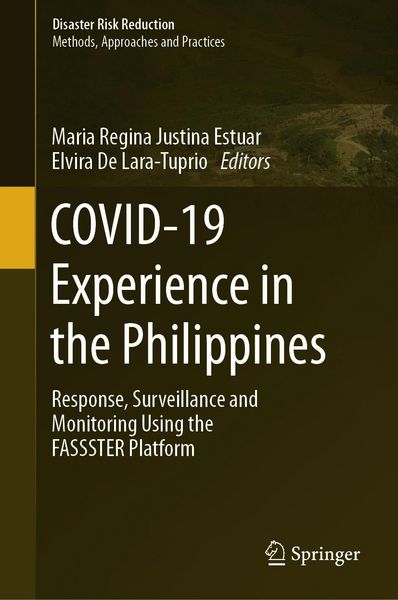
COVID-19 Experience in the Philippines Response, Surveillance and Monitoring Using the FASSSTER Platform
Aus der Reihe
Disaster Risk Reduction
-
- Hardcover
- Taschenbuch
- eBook ausgewählt
-
Form:Einzelkauf Download
-
Sprache:Englisch
Fr. 125.90
inkl. gesetzl. MwSt.Beschreibung
Produktdetails
Format
Kopierschutz
Nein
Family Sharing
Nein
Text-to-Speech
Nein
Erscheinungsdatum
07.08.2023
Herausgeber
Maria Regina Justina Estuar + weitereVerlag
Springer Nature SingaporeSeitenzahl
159 (Printausgabe)
Dateigröße
4245 KB
Sprache
Englisch
EAN
9789819931538
This book provides an overview of the extensive work that has been done on the design and implementation of the COVID-19 Philippines Local Government Unit Monitoring Platform, more commonly known as Feasibility Analysis of Syndromic Surveillance Using Spatio-Temporal Epidemiological Modeler for Early Detection of Diseases (FASSSTER). The project began in 2016 as a pilot study in developing a multidimensional approach in disease modeling requiring the development of an interoperable platform to accommodate input of data from various sources including electronic medical records, various disease surveillance systems, social media, online news, and weather data. In 2020, the FASSSTER platform was reconfigured for use in the COVID-19 pandemic. Using lessons learned from the previous design and implementation of the platform toward its full adoption by the Department of Health of the Philippines, this book narrates the story of FASSSTER in two main parts.Part I provides a historical perspective of the FASSSTER platform as a modeling and disease surveillance system for dengue, measles and typhoid, followed by the origins of the FASSSTER framework and how it was reconfigured for the management of COVID-19 information for the Philippines. Part I also explains the different technologies and system components of FASSSTER that paved the way to the operationalization of the FASSSTER model and allowed for seamless rendering of projections and analytics. Part II describes the FASSSTER analytics and models including the Susceptible-Exposed-Infected-Recovered (SEIR) model, the model for time-varying reproduction number, spatiotemporal models and contact tracing models, which became the basis for the imposition of restrictions in mobility translated into localized lockdowns.
Kundinnen und Kunden meinen
Verfassen Sie die erste Bewertung zu diesem Artikel
Helfen Sie anderen Kund*innen durch Ihre Meinung