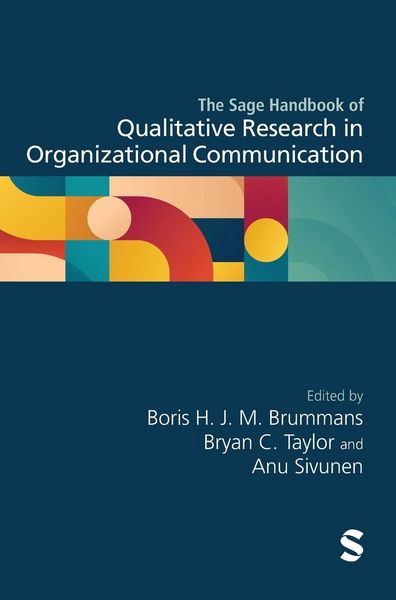
• Produktbild: The Sage Handbook of Qualitative Research in Organizational Communication
  • Produktbild: The Sage Handbook of Qualitative Research in Organizational Communication

The Sage Handbook of Qualitative Research in Organizational Communication

Fr. 243.00

inkl. gesetzl. MwSt., Versandkostenfrei


Beschreibung

Produktdetails

Einband

Gebundene Ausgabe

Erscheinungsdatum

27.01.2024

Herausgeber

Boris H. J. M. Brummans + weitere

Verlag

Sage Publications

Seitenzahl

744

Maße (L/B/H)

25/17.5/4.4 cm

Gewicht

1380 g

Sprache

Englisch

ISBN

978-1-5297-9463-2

Beschreibung

Rezension

Organizational communication is not only a discipline, but also a community. It has its meeting places, such as the annual conventions of the National and International Communication Associations. It has its rituals, such as business meetings and award ceremonies during these conferences. Unfortunately, however, the field has few outlets to showcase its research. Management Communication Quarterly is the field s only flagship journal. Moreover, for a long time, The Sage Handbook of Organizational Communication (Putnam & Mumby, 2013), which has gone through several editions, was the only comprehensive volume presenting the discipline s state of the art. Recently, this has started to change. In 2017, Craig Scott and Laurie Lewis edited the impressive International Encyclopedia of Organization Communication (Scott & Lewis, 2017). In 2021, Francois Cooren and Peter Stucheli- Herlach edited the Handbook of Management Communication (de Gruyter) (Cooren & Stucheli-Herlach, 2021). And in 2022, Joelle Basque, Nicolas Bencherki, and Timothy Kuhn edited The Routledge Handbook of the Communicative Constitution of Organization (Basque et al., 2022). In addition, Vernon Miller and Marshall Scott Poole are about to publish a new Handbook of Organizational Communication (in press).
So, do we need another handbook? The Sage Handbook of Qualitative Research in Organizational Communication shows that the answer to this question is unequivocally yes.

Read the full review here: https://academic.oup.com/ct/article-abstract/34/2/106/7634749 Nicolas Bencherki

Produktdetails

Einband

Gebundene Ausgabe

Erscheinungsdatum

27.01.2024

Herausgeber

Verlag

Sage Publications

Seitenzahl

744

Maße (L/B/H)

25/17.5/4.4 cm

Gewicht

1380 g

Sprache

Englisch

ISBN

978-1-5297-9463-2

EU-Ansprechpartner

Zeitfracht Medien GmbH
Ferdinand-Jühlke-Straße 7
99095 Erfurt
DE
produktsicherheit@zeitfracht.de

Herstelleradresse

SAGE Publications
1 Oliver's Yard 55 City Road
EC1Y 1SP London
GB
orders@sagepub.co.uk

Kundinnen und Kunden meinen

0 Bewertungen

Informationen zu Bewertungen

Zur Abgabe einer Bewertung ist eine Anmeldung im Konto notwendig. Die Authentizität der Bewertungen wird von uns nicht überprüft. Wir behalten uns vor, Bewertungstexte, die unseren Richtlinien widersprechen, entsprechend zu kürzen oder zu löschen.

Die Bewertungen sind nach Format, Anzahl Sterne und Datum sortiert.

Verfassen Sie die erste Bewertung zu diesem Artikel

Helfen Sie anderen Kund*innen durch Ihre Meinung

Kundinnen und Kunden meinen

0 Bewertungen filtern

Die Leseprobe wird geladen.
  • Produktbild: The Sage Handbook of Qualitative Research in Organizational Communication
  • Produktbild: The Sage Handbook of Qualitative Research in Organizational Communication
  • Foreword - James R. Barker
    Introduction: Toward a Methodological Lingua Franca for Qualitative Research in Organizational Communication - Boris H. J. M. Brummans, Bryan C. Taylor, and Anu Sivunen
    Part 1: Approaches to Qualitative Organizational Communication Research
    Chapter 1: From Mixed Methods to Mixed Research Approaches for Qualitative Organizational Communication Research - Jody L. S. Jahn and Karen K. Myers
    Chapter 2: Ethnographic Approaches to Qualitative Organizational Communication Research - Angela N. Gist-Mackey and Cristin A. Compton
    Chapter 3: Rhetorical Approaches to Qualitative Organizational Communication Research - Charles Conrad and George Cheney
    Chapter 4: Pragmatist Approaches to Qualitative Organizational Communication Research - François Cooren, Philippe Lorino, and Daniel Robichaud
    Chapter 5: Phenomenological Approaches to Qualitative Organizational Communication Research - Rebecca J. Meisenbach and Madeline S. Pringle
    Chapter 6: Approaches to Qualitative Research on the Communicative Constitution of Organizations - Theresa Castor
    Chapter 7: Feminist Approaches to Qualitative Organizational Communication Research - Patrice M. Buzzanell, Spencer Margulies, Evgeniya Pyatovskaya, and Patricia K. Abijah
    Chapter 8: Critical Race Theory and Intersectional Approaches to Qualitative Organizational Communication Research - Jasmine T. Austin and Tianna L. Cobb
    Chapter 9: Postcolonial Qualitative Research in Organizational Communication - Mahuya Pal, Beatriz Nieto-Fernandez, and Silpa Satheesh
    Chapter 10: Queer Approaches to Qualitative Organizational Communication Research - Jamie McDonald and Elizabeth K. Eger
    Chapter 11: Ethnography of Communication Approaches to Qualitative Organizational Communication Research - Trudy Milburn and Sunny Lie Owens
    Chapter 12: Autoethnography and Organizational Communication: Tracing their Convergence and Divergence - Kurt Lindemann and Yea-Wen Chen
    Chapter 13: Engaged Scholarship Approaches to Qualitative Organizational Communication Research - J. Kevin Barge and Anna W. Wolfe
    Part 2: Data Collection in Qualitative Organizational Communication Research: Methods and Issues
    Chapter 14: Research Design in Qualitative Organizational Communication Studies - Bryan C. Taylor and Ryan S. Bisel
    Chapter 15: Challenges Faced by Qualitative Researchers in Negotiating Access to Organizational Communication Settings - Keri K. Stephens, Craig R. Scott, and Nancy H. Carlson
    Chapter 16: Interviews and Focus Groups in Qualitative Organizational Communication Research - Brenda L. Berkelaar
    Chapter 17: Participatory Methods in Qualitative Organizational Communication Research - Rebecca Gill and Joshua B. Barbour
    Chapter 18: Collecting Digital Data in Qualitative Organizational Communication Research - Jennifer L. Gibbs and Salla-Maaria Laaksonen
    Chapter 19: Collecting Visual Data in Qualitative Organizational Communication Research - Elizabeth Wilhoit Larson
    Part 3: Data Analysis and Representation in Qualitative Organizational Communication Research: Methods and Issues
    Chapter 20: Phronetic Iterative Qualitative Data Analysis (PIQDA) in Organizational Communication Research - Sarah J. Tracy, Angela Gist-Mackey, and Marco Dehnert
    Chapter 21: Narrative Analysis in Qualitative Organizational Communication Research - Stephanie L. Dailey, Larry Davis Browning, and Jan-Oddvar Sørnes
    Chapter 22: Rhetorical Analysis in Qualitative Organizational Communication Research - Chantal Benoit-Barné and Mathieu Chaput
    Chapter 23: Conversation Analysis in Qualitative Organizational Communication Research - Jonathan Clifton and Jakob Rømer Barfod
    Chapter 24: Ventriloquial Analysis in Qualitative Organizational Communication Research - Ellen Nathues, François Cooren, and Mark van Vuuren
    Chapter 25: Analysis of Sociomateriality and Affect in Qualitative Organizational Communication Research - Jennifer J. Mease and Scott E. Branton
    Chapter 26: Critical Discourse Analysis in Qualitative Organizational Communication Research - Debbie S. Dougherty and Blessing Okafor
    Chapter 27: Past, Present, and Future Analysis of Digital Work in Qualitative Organizational Communication Research - Luisa Ruge-Jones, William C. Barley, and Jeffrey W. Treem
    Chapter 28: Analysis of Tensions and Paradoxes in Qualitative Organizational Communication Research - Gail T. Fairhurst and Linda L. Putnam
    Chapter 29: A Process Ontology Perspective on Qualitative Analysis in Organizational Communication Research - Consuelo Vásquez, Viviane Sergi, and Anthony Hussenot
    Chapter 30: Positionings: Toward a Relational Understanding of Representation and Writing in Organizational Communication Research - Oana Brindusa Albu, Boukje Cnossen, and Chahrazad Abdallah
    Part 4: The Future of Qualitative Organizational Communication Research
    Chapter 31: Digital Forensics: A Guide to Conducting Qualitative Research on Organizational Communication and Digital Technology - Mikkel Flyverbom, Paul M. Leonardi, and Nitzan Navick
    Chapter 32: Hybridity, Visibility, and Organizing: Globalization and Qualitative Methods in Organizational Communication Research - Shiv Ganesh, Cynthia Stohl, and Samantha James
    Chapter 33: Organizing Post-qualitative Research in Organizational Communication - Kate Lockwood Harris
    Chapter 34: Qualitative Research in Organizational Communication Post-COVID-19 - Kirstie McAllum, Stephanie Fox, Laura Ginoux, Heather Zoller, Andrea Zorn, and Theodore E. Zorn
    Afterword from the Perspective of a Management Scholar - Silvia Gherardi
    Afterword from the Perspective of Two Organizational Communication Scholars - Eric M. Eisenberg and Patricia Geist-Martin