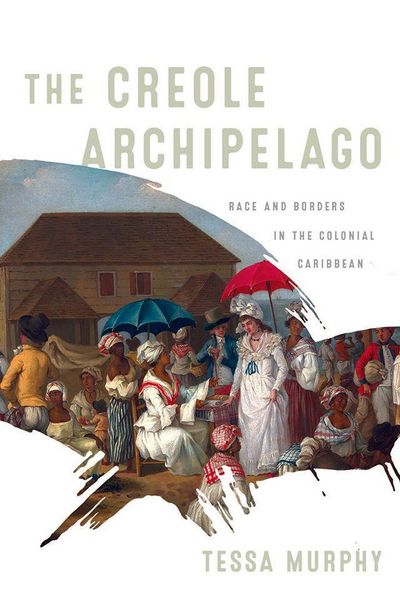
"
Remarkable...Murphy has found, in one ofthemosttrafficked(byshipsandhistorians alike) corners of the Americas, what feels like a new world. Through her active reframing of space in the eastern Caribbean, and by paying attention to Indigenous geographies and interimperial borderlands, Murphy has written a timely and important study...For historians of the Caribbean of any period,
The Creole Archipelagowill be a must-read.
" (H-Early America) "Setting an ambitious research agenda while offering a rich and nuanced look into an understudied section of the Caribbean Sea, Tessa Murphy's book is both meticulously researched and compellingly written - and should prove to be hought-provoking reading for any historian of the early modern Atlantic World." (Journal of Maritime History) "[I]mpressive...[A] riveting study...The Creole Archipelagoimagines alternative histories-creolized histories-of the early modern Caribbean, providing stories as history and history as stories...Murphy dilates on terraqueous zones that find Indigenous and African peoples converging and diverging in their encounters with, and resistance to, colonization efforts in the Lesser Antilles during the seventeenth and eighteenth centuries." (American Literary History) "Characterised by meticulous research, perspective plurality, and an ultimately transformative vision of the Americas as a relational space, the book manages to break through barriers of continental methodologies, which themselves often represent instruments of colonialism. As a significant contribution to the field of Caribbean studies, the book unravels intricate and often unexpected dynamics of Creolised societies...The Creole Archipelago deepens our understanding of historically submerged vectors of spatial identity and provides a valuable resource and catalyst for future research." (Connections) "Essential...This well-researched account, which thoughtfully includes transatlantic archival work, posits a new way of thinking about the archipelago linked by travel, settlement, race, and culture. This truly insightful study adds to a number of historical fields and is a must-read for those interested in colonial, regional, or Caribbean history." (Choice) "[The Creole Archipelago] offers a meticulous and original analysis of the political, economic, and social processes that shaped thecomplexworldoftheinhabitantsofthe "Creole Archipelago,"...Murphy not only approaches the Caribbean as a body of water that allowed for exchange, interactions, and mobility to different communities but, more importantly, she focuses on a region that has often been neglected by the historiography." - Cristina Soriano (Forum for Inter-American Research) "Thisbookrepresentsalandmarkinthe historyofarchipelagos...Murphy's book will surely inform future scholarship in this area and provide a model for scholars of archipelagos in other regions. Her analytical framework both recognizes the reality of life in the seventeenth and eighteenth centuries and provides a model for the study of island groups elsewhere in the Caribbean and around the world. In that sense, this book ought to be seen as a vital contribution to our understanding of the Windward Islands, but it should also be read by all scholars interested in relationships between indigenous communities and invading powers, and by those exploring the role of islands in world history." - Douglas Hamilton (Forum for Inter-American Research) "Murphy's intriguing book sheds considerable light on the value of looking to the edges and off the beaten path to appreciate the limits of imperialism. The contestations that shaped the Creole Archipelago are a lesson in the sorts of worlds peoples and communities were able to craft beyond the bounds of empire and in the face of considerable efforts to impose the rules and strictures of far-off authorities. Throughout The Creole Archipelago, Murphy argues for the importance of giving primacy to local realities and the determined efforts of people to govern their own lives regardless of the broader political and economic realities of the Atlantic world. This book should add considerable texture and nuance to the way scholars think about and frame the history of the eastern Caribbean." (New West Indian Guide) "The transimperial and multiracial historical geographies of the seventeenth- and eighteenth-century Lesser Antilles come to life in page after page of this exquisitely crafted and richly researched study. The Creole Archipelago places the eastern Caribbean's Indigenous people, enslaved Africans and Afro-creoles, free people of color, and French and British colonists at the center of epic hemispheric struggles over enslavement, freedom, and the plantation complex." (Melanie Newton, University of Toronto) "In this exceptionally rich and persuasive book, Tessa Murphy transforms our understanding of the early modern Caribbean. Murphy looks beyond the major sugar islands and uncovers a complex social world connecting Tobago, Grenada, St. Vincent, St. Lucia, and Dominica. Linked by Indigenous travel and settlement centuries before Europeans arrived, these islands remained entwined throughout the eighteenth century as they became home to thousands of rogue settlers of European and African descent. Shaped by persistent Kalinago influence, and existing on the margins of competing European empires, Murphy's 'Creole Archipelago' reveals both the limits and the destructive influence of colonialism." (Brett Rushforth, University of Oregon)