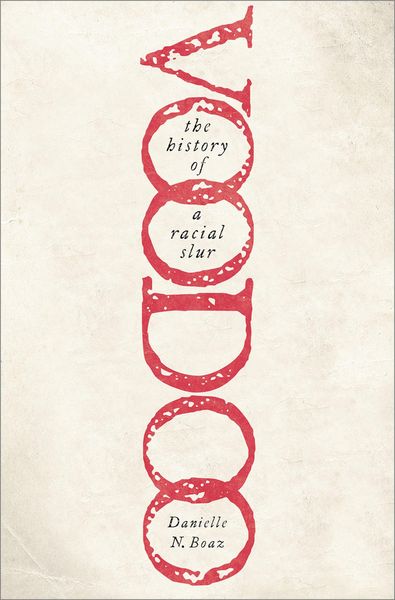
Voodoo: The History of a Racial Slur
-
- Hardcover
- Taschenbuch
- eBook ausgewählt
-
Form:Einzelkauf Download
-
Sprache:Englisch
-
eBook Format:ePUB
- PDF Fr. 21.90
- ePUB Fr. 21.90 ausgewählt
Fr. 21.90
inkl. gesetzl. MwSt.Beschreibung
Produktdetails
Format
ePUB
Kopierschutz
Ja
Family Sharing
Nein
Text-to-Speech
Ja
Erscheinungsdatum
29.08.2023
Verlag
OUP eBookSeitenzahl
(Printausgabe)
Dateigröße
1327 KB
Sprache
Englisch
EAN
9780197689424
Coined in the middle of the nineteenth century, the term "voodoo" has been deployed largely by people in the U.S. to refer to spiritual practices--real or imagined--among people of African descent. "Voodoo" is one way that white people have invoked their anxieties and stereotypes about Black people--to call them uncivilized, superstitious, hypersexual, violent, and cannibalistic.
In this book, Danielle Boaz explores public perceptions of "voodoo" as they have varied over time, with an emphasis on the intricate connection between stereotypes of "voodoo" and debates about race and human rights. The term has its roots in the U.S. Civil War in the 1860s, especially following the Union takeover of New Orleans, when it was used to propagate the idea that Black Americans held certain "superstitions" that allegedly proved that they were unprepared for freedom, the right to vote, and the ability to hold public office. Similar stereotypes were later extended to Cuba and Haiti in the late nineteenth and early twentieth centuries. In the 1930s, Black religious movements like the Moorish Science Temple and the Nation of Islam were derided as "voodoo cults." More recently, ideas about "voodoo" have shaped U.S. policies toward Haitian immigrants in the 1980s, and international responses to rituals to bind Nigerian women to human traffickers in the twenty-first century. Drawing on newspapers, travelogues, magazines, legal documents, and books, Boaz shows that the term "voodoo" has often been a tool of racism, colonialism, and oppression.
In this book, Danielle Boaz explores public perceptions of "voodoo" as they have varied over time, with an emphasis on the intricate connection between stereotypes of "voodoo" and debates about race and human rights. The term has its roots in the U.S. Civil War in the 1860s, especially following the Union takeover of New Orleans, when it was used to propagate the idea that Black Americans held certain "superstitions" that allegedly proved that they were unprepared for freedom, the right to vote, and the ability to hold public office. Similar stereotypes were later extended to Cuba and Haiti in the late nineteenth and early twentieth centuries. In the 1930s, Black religious movements like the Moorish Science Temple and the Nation of Islam were derided as "voodoo cults." More recently, ideas about "voodoo" have shaped U.S. policies toward Haitian immigrants in the 1980s, and international responses to rituals to bind Nigerian women to human traffickers in the twenty-first century. Drawing on newspapers, travelogues, magazines, legal documents, and books, Boaz shows that the term "voodoo" has often been a tool of racism, colonialism, and oppression.
Kundinnen und Kunden meinen
Verfassen Sie die erste Bewertung zu diesem Artikel
Helfen Sie anderen Kund*innen durch Ihre Meinung