Gutscheinbedingungen

*Gültig bis 07.06.2026 auf (fast) alles. Ausgeschlossen sind Smartboxen, Zeitschriften, Tickets, Lebensmittel, Gaming-Elektroartikel, Tinte/Toner, Gutscheine, Geschenkkarten, Blumen und Abos | Einlösbar in allen Buchhandlungen von Orell Füssli, Barth Bücher, Buchladen Rapunzel, Schuler Orell Füssli, Stauffacher und ZAP unter Vorweisung des Gutscheins, auf www.orellfüssli.ch durch Eingabe des Gutscheincodes. Beim Service „eBooks verschenken“ und bei eBook-Käufen via eReader nicht einlösbar | Mindesteinkaufswert: Fr. 100.- | Nicht mit anderen Rabatten kumulierbar.

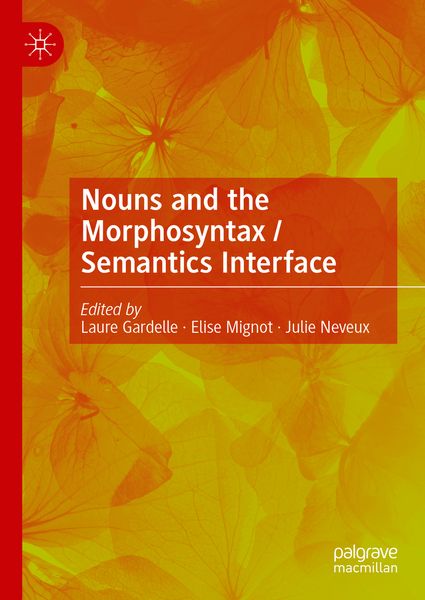
  • Produktbild: Nouns and the Morphosyntax / Semantics Interface
  • Produktbild: Nouns and the Morphosyntax / Semantics Interface

Nouns and the Morphosyntax / Semantics Interface

Fr. 191.00

inkl. gesetzl. MwSt., Versandkostenfrei


Beschreibung

Produktdetails

Einband

Gebundene Ausgabe

Erscheinungsdatum

22.03.2024

Herausgeber

Laure Gardelle + weitere

Verlag

Springer

Seitenzahl

482

Maße (L/B/H)

21.6/15.3/3.2 cm

Gewicht

730 g

Sprache

Englisch

ISBN

978-3-031-44560-6

Beschreibung

Portrait

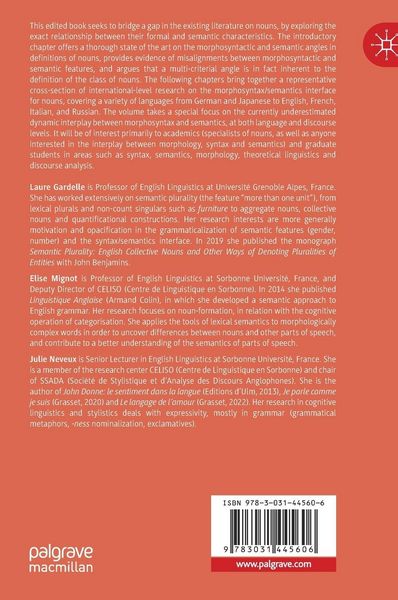
Laure Gardelle  is Professor of English Linguistics and Dean of the doctoral school of languages and literature (ED LLSH) at Grenoble Alpes University, France, and Chair of the French society for English linguistics (ALAES). Her research interests include the morphosyntax/semantics interface in the grammatical categories of gender and number, especially the tension between transparency and the opacification caused by language-internal parameters (such as grammaticisation or morphological attraction).  

Elise Mignot  is Professor of English Linguistics and Head of the research centre CELISO (Centre de Linguistique en Sorbonne) at Sorbonne University, France. Her research focuses on the morpho-syntax /semantics interface in processes of noun-formation, studied in relation with the cognitive operation of categorization.  

Julie Neveux  is a Senior lecturer in English Linguistics at Sorbonne University, France, and chair of the French association of English stylistics (SSA). Initially trained in philosophy, she develops a phenomenological approach of language, semantics and style, defining style as a phenomenon whose effects rely on the perceptibility, in discourse, of the speaker’s motivation (embodied cognition). 

Produktdetails

Einband

Gebundene Ausgabe

Erscheinungsdatum

22.03.2024

Herausgeber

Verlag

Springer

Seitenzahl

482

Maße (L/B/H)

21.6/15.3/3.2 cm

Gewicht

730 g

Sprache

Englisch

ISBN

978-3-031-44560-6

Herstelleradresse

Springer-Verlag GmbH
Tiergartenstr. 17
69121 Heidelberg
DE

Email: ProductSafety@springernature.com

Kundinnen und Kunden meinen

0 Bewertungen

Informationen zu Bewertungen

Zur Abgabe einer Bewertung ist eine Anmeldung im Konto notwendig. Die Authentizität der Bewertungen wird von uns nicht überprüft. Wir behalten uns vor, Bewertungstexte, die unseren Richtlinien widersprechen, entsprechend zu kürzen oder zu löschen.

Die Bewertungen sind nach Format, Anzahl Sterne und Datum sortiert.

Verfassen Sie die erste Bewertung zu diesem Artikel

Helfen Sie anderen Kund*innen durch Ihre Meinung

Kundinnen und Kunden meinen

0 Bewertungen filtern

  • Produktbild: Nouns and the Morphosyntax / Semantics Interface
  • Produktbild: Nouns and the Morphosyntax / Semantics Interface
  • Ch. 1 – Laure Gardelle, Elise Mignot & Julie Neveux, “Why the morphosyntax / semantics interface matters for nouns”.- Part 1 – Combining syntax and semantics for new insights into the definition of nouns.- Ch. 2 – Paolo Acquaviva, “Nouns, names, and abstract kinds”.- Ch. 3 – Manon Philippe, “Proper names and the ‘noun’ / ‘name’ categories: pseudo-nouns, real names”.- Ch. 4 – Yayoi Nakamura-Delloye, “The noun class in Japanese: Morphosyntactic and semantic properties”.- Ch. 5 – Peter Lauwers, “Conversion vs coercion in the nominal field: two phenomena at the lexis-grammar interface”.- Part 2 – Interactions between the interpretation of nouns and their syntactic and semantic environment.- Ch. 6 – Wiltrud Mihatsch & Désirée Kleineberg, “The interaction of morphosyntax and semantics in Romance object mass nouns”.- Ch. 7 – Evelien Keizer & Elnora ten Wolde, “Of birds of prey and men of honour: head-classifier constructions in English”.- Ch. 8 – Laure Gardelle, “A swarm of helicopters, the last couple of weeks: a constructional analysis of the syntax/semantics interface for the classification of N1 as ‘collective’ or ‘quantificational’”.- Ch. 9 – Anne Jugnet & Philip Miller, “Polar nouns and Polar Concealed Questions”.- Ch. 10 – Olivia Reneaud-Jensen & Elise Mignot, “God, it’s amazing the junk people will buy! When a construction impacts lexical choices: The case of nouns in concealed exclamations”.- Part 3 - Nouns as syntactic and semantic organisers at phrase and discourse level.- Ch. 11 – Jan Rijkhoff, “Nouns and Iconicity of Distance: when syntactic proximity to the noun mirrors semantic closeness”.- Ch. 12 – John Flowerdew, “Resumptive post-modification as a cohesive feature of signalling nouns”.- Ch. 13 – Marie Turlais, “Influence of the headnoun and integration of the dependent in near-compound nominals such as high executive”.- Part 4 - Alignments and mismatches between morphology and lexical or contextual semantics.- Ch. 14 – Laurie Bauer, “The semantics of English nominalizations: How much is usage?”.- Ch. 15 – Julie Neveux, “From productive -ness word-formation to creative suffix -iness: the case of truthiness”.- Ch. 16 – Chris A. Smith, “How is stickage different from sticking? A study of the semantic behaviour of V-age and V-ing nominalisations (on monomorphemic bases)”.