KI-Beratung Beta

  • Produktbild: Quantum Optics for Engineers
  • Produktbild: Quantum Optics for Engineers

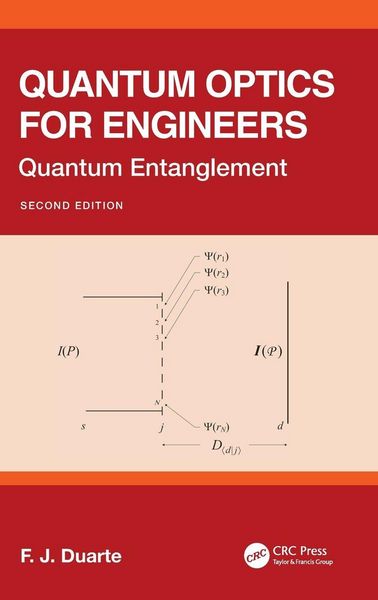
Quantum Optics for Engineers Quantum Entanglement

Fr. 272.00

inkl. gesetzl. MwSt., Versandkostenfrei


Beschreibung

Produktdetails

Einband

Gebundene Ausgabe

Erscheinungsdatum

29.02.2024

Abbildungen

190 SW-Abb., 2 SW-Fotos, 188 SW-Zeichn., 5 Tabellen

Verlag

Taylor & Francis

Seitenzahl

424

Maße (L/B/H)

24/16.1/2.7 cm

Gewicht

798 g

Auflage

2. Auflage

Sprache

Englisch

ISBN

978-1-03-249934-5

Herstelleradresse

Taylor and Francis
Taylor & Francis Verlag GmbH, Kaufingerstraße 24
80331 München
DE
gpsr@taylorandfrancis.com

Noch keine Bewertungen vorhanden

Verfassen Sie die erste Bewertung zu diesem Artikel

Helfen Sie anderen Kundinnen und Kunden durch Ihre Meinung.

Kundinnen und Kunden meinen

Bewertungen (0)

Die Leseprobe wird geladen.
  • Produktbild: Quantum Optics for Engineers
  • Produktbild: Quantum Optics for Engineers
  • Preface

    Author's Biography

    Chapter 1 Introduction

    • 1.1 Introduction
    • 1.2 Brief Historical Perspective
    • 1.3 The Principles of Quantum Mechanics
    • 1.4 The Feynman Lectures on Physics
    • 1.5 The Photon
    • 1.6 Quantum Optics
    • 1.7 Quantum Optics for Engineers
    • 1.7.1 Quantum Optics for Engineers: Quantum Entanglement, Second Edition
    • References

    Chapter 2 Planck's Quantum Energy Equation

    • 2.1 Introduction
    • 2.2 Planck's Equation and Wave Optics
    • 2.3 Planck's Constant h
    • 2.3.1 Back to E = h
    • Problems
    • References

    Chapter 3 The Uncertainty Principle

    • 3.1 Heisenberg's Uncertainty Principle
    • 3.2 The Wave-Particle Duality
    • 3.3 The Feynman Approximation
    • 3.1.1 Example
    • 3.4 The Interferometric Approximation
    • 3.5 The Minimum Uncertainty Principle
    • 3.6 The Generalized Uncertainty Principle
    • 3.7 Equivalent Versions of Heisenberg's Uncertainty Principle
    • 3.7.1 Example
    • 3.8 Applications of the Uncertainty Principle in Optics
    • 3.8.1 Beam Divergence
    • 3.8.2 Beam Divergence in Astronomy
    • 3.8.3 The Uncertainty Principle and the Cavity Linewidth Equation
    • 3.8.4 Tuning Laser Microcavities
    • 3.8.5 Nanocavities
    • Problems
    • References

    Chapter 4 The Dirac-Feynman Quantum Interferometric Principle

    • 4.1 Dirac's Notation in Optics
    • 4.2 The Dirac-Feynman Interferometric Principle
    • 4.3 Interference and the Interferometric Probability Equation
    • 4.3.1 Examples: Double-, Triple-, Quadruple-, and Quintuple-Slit Interference
    • 4.3.2 Geometry of the N-Slit Quantum Interferometer
    • 4.3.3 The Diffraction Grating Equation
    • 4.3.4 N-Slit Interferometer Experiment
    • 4.4 Coherent and Semi-Coherent Interferograms
    • 4.5 The Interferometric Probability Equation in Two and Three Dimensions
    • 4.6 Classical and Quantum Alternatives
    • Problems
    • References

    Chapter 5 Interference, Diffraction, Refraction, and Reflection via Dirac's Notation

    • 5.1 Introduction
    • 5.2 Interference and Diffraction
    • 5.2.1 Generalized Diffraction
    • 5.2.2 Positive Diffraction
    • 5.3 Positive and Negative Refraction
    • 5.3.1 Focusing
    • 5.4 Reflection
    • 5.5 Succinct Description of Optics
    • 5.6 Quantum Interference and Classical Interference
    • Problems
    • References

    Chapter 6 Dirac's Notation Identities

    • 6.1 Useful Identities
    • 6.1.1 Example
    • 6.2 Linear Operations
    • 6.2.1 Example
    • 6.3 Extension to Indistinguishable Quanta Ensembles
    • Problems
    • References

    Chapter 7 Interferometry