Gutscheinbedingungen

*Gültig bis 07.06.2026 auf (fast) alles. Ausgeschlossen sind Smartboxen, Zeitschriften, Tickets, Lebensmittel, Gaming-Elektroartikel, Tinte/Toner, Gutscheine, Geschenkkarten, Blumen und Abos | Einlösbar in allen Buchhandlungen von Orell Füssli, Barth Bücher, Buchladen Rapunzel, Schuler Orell Füssli, Stauffacher und ZAP unter Vorweisung des Gutscheins, auf www.orellfüssli.ch durch Eingabe des Gutscheincodes. Beim Service „eBooks verschenken“ und bei eBook-Käufen via eReader nicht einlösbar | Mindesteinkaufswert: Fr. 100.- | Nicht mit anderen Rabatten kumulierbar.

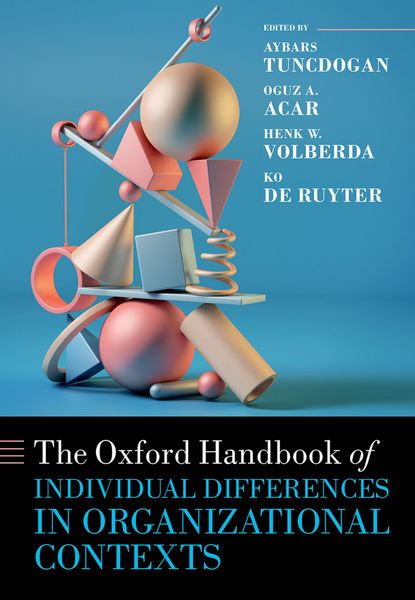
Produktbild: The Oxford Handbook of Individual Differences in Organizational Contexts

The Oxford Handbook of Individual Differences in Organizational Contexts

Fr. 223.00

inkl. gesetzl. MwSt., Versandkostenfrei


Beschreibung

Produktdetails

Einband

Gebundene Ausgabe

Erscheinungsdatum

15.05.2024

Verlag

Oxford Academic

Seitenzahl

512

Maße (L/B/H)

23.6/17.5/3.6 cm

Gewicht

1052 g

Sprache

Englisch

ISBN

978-0-19-289711-4

Beschreibung

Produktdetails

Einband

Gebundene Ausgabe

Erscheinungsdatum

15.05.2024

Verlag

Oxford Academic

Seitenzahl

512

Maße (L/B/H)

23.6/17.5/3.6 cm

Gewicht

1052 g

Sprache

Englisch

ISBN

978-0-19-289711-4

Herstelleradresse

Libri GmbH
Europaallee 1
36244 Bad Hersfeld
DE

Email: gpsr@libri.de

Kundinnen und Kunden meinen

0 Bewertungen

Informationen zu Bewertungen

Zur Abgabe einer Bewertung ist eine Anmeldung im Konto notwendig. Die Authentizität der Bewertungen wird von uns nicht überprüft. Wir behalten uns vor, Bewertungstexte, die unseren Richtlinien widersprechen, entsprechend zu kürzen oder zu löschen.

Die Bewertungen sind nach Format, Anzahl Sterne und Datum sortiert.

Verfassen Sie die erste Bewertung zu diesem Artikel

Helfen Sie anderen Kund*innen durch Ihre Meinung

Kundinnen und Kunden meinen

0 Bewertungen filtern

Die Leseprobe wird geladen.
  • Produktbild: The Oxford Handbook of Individual Differences in Organizational Contexts
    • Part 1

    • 1: The editors: Introduction

    • Part 2 The Role of Psychological Traits and Individual Differences in Organizational Contexts

    • 2: Cameron J. Borgholthaus and Peter D. Harms: Scaling the Ivory Tower: The Organizational Consequences of CEO Personality

    • 3: Mallory A. McCord and Bethany Westerberg: The Perceived Controllability of the Big Five Personality Traits at Work

    • 4: Thomas G. Reio, Jr.: Individual Differences in Curiosity: Learning, Adaptation, and Work-Related Outcomes

    • 5: The editors: IQ, EQ, and Multiple Intelligences: A Brief Review of the Discussion

    • 6: Thomas Rockstuhl, Kok Yee Ng and Soon Ang: Cultural Intelligence and Personality: Differential Effects of Plasticity and Stability Meta-Traits

    • 7: Aybars Tuncdogan, Paavo Ritala and Päivi Karhu: Managers' Regulatory Focus, Exploration-Exploitation and Temporal Ambidexterity: Towards a Conceptual Model of the Dynamic Relationship

    • 8: Abraham P. Buunk: Individual Differences in Social comparison in Organizations

    • 9: Peter D. Harms, Karen Landay and Tyler Fezzey: Explorations of the Shadow Realm: Examining the Role of Dark Personality in the Workplace

    • 10: Destiny R. Hemsey and Jason J. Dahling: Moderating Machiavelli: How do Situational Characteristics Shape the Expression of Machiavellianism in the Workplace?

    • 11: Aybars Tuncdogan, Frans van den Bosch and Henk Volberda: Prevention Focus as an Overlooked Benefactor: An Investigation into its Role as an Antecedent of Management Team Accountability

    • Part 3 Biological/Physiological Traits and Individual Differences in Organizational Contexts

    • 12: Julie Aitken Schermer and Kristi Baerg MacDonald: Sex Differences in Vocational Interests: An Analysis of Cohorts

    • 13: Katharina G. Kugler, Julia A. M. Reif and Jens Mazei: Gender Differences in Negotiations

    • 14: Angela Shakeri and Michael S. North: Always at Greater Risk for More Discrimination? Comparing Older Women with Older Men in the Workplace Context

    • 15: Terrance W. Fitzsimmons, Victor J. Callan, Miriam S. Yates and Ree Jordan: Why we still have gendered organisational progression of individuals into leadership roles and what can be done about it

    • 16: Dawn L. Eubanks: Leadership Faces: Overlooking Good Leaders

    • 17: Udari Ekanayake and Mariano Heyden: What do Celebrity CEOs Look Like?

    • 18: William J. Becker, Kristina Cechova and Angela M. Passarelli: A Neuroscience Perspective on Individual Differences in Organizations

    • 19: Wen-Dong Li, Zhaoli Song, and Richard Arvey: Organizational Research, Genetics, and the Possible Coming Era of Organizational Genomics

    • Part 4 Individual Differences in the Age of Technological and Social Disruption

    • 20: Joanne Hinds: Digital data and personality - challenges and opportunities for organisations

    • 21: Gerald Matthews, Peter Hancock, James Szalma, Jinchao Lin and April Rose Panganiban: Individual Differences in Teaming with Artificial Intelligence, Robots, and Virtual Agents in the Workplace

    • 22: Christine Anderl: Individual Differences in Teleworking Outcomes

    • 23: Uzay Dural and Selin Kudret: Self-Monitoring Personality Trait in Organisations: A Research Agenda for Self-Monitoring Effects in Remote Work, Leadership Diversity, and Beyond

    • 24: Claudia Buengeler and Christoph Reinert: Diversity in Organizations: Understanding and Managing its Effects

    • 25: Daniel A. Lerner, Carlina Conrad and Asya Karabayeva: Neurodiversity at work - the Illustrating case of ADHD in organizational behavior

    • 26: Sandra E. Cha, Patricia Faison Hewlin and Laura Morgan Roberts: Fostering True Self-Expression in Organizations: A Metaphor-based Framework of Leader Authenticity Tensions