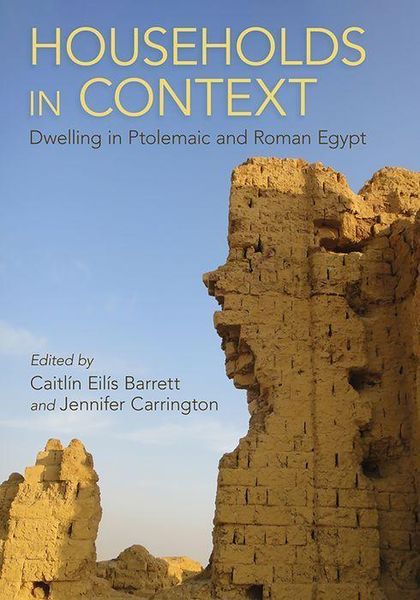
Households in Context Dwelling in Ptolemaic and Roman Egypt
-
- Taschenbuch ausgewählt
- eBook
-
Sprache:Englisch
Fr. 51.90
inkl. gesetzl. MwSt.,
Beschreibung
Produktdetails
Einband
Taschenbuch
Erscheinungsdatum
15.01.2024
Herausgeber
Jennifer Carrington + weitereVerlag
Cornell University PressSeitenzahl
368
Maße (L/B/H)
17.8/25.5/2.5 cm
Gewicht
772 g
Sprache
Englisch
ISBN
978-1-5017-7130-9
Households in Context shifts the focus from monumental temples, tombs, and elite material and visual culture to households and domestic life to provide a crucial new perspective on everyday dwelling practices and the interactions of families and individuals with larger social and cultural structures. A focus on households reveals the power of the everyday: the critical role of quotidian experiences, objects, and images in creating the worlds of the people who live with them. The contributors to this book share contemporary research on houses and households in both Ptolemaic and Roman Egypt to reshape the ways we think about ancient people's lived experiences of family, community, and society. Households in Context places the archaeology and history of Greco-Roman Egypt in dialogue with research on dwelling, daily practice, and materiality to reveal how ancient households functioned as laboratories for social, political, economic, and religious change. Contributors: Youssri Abdelwahed, Richard Alston, Anna Lucille Boozer, Paola Davoli, David Frankfurter, Jennifer Gates-Foster, Melanie Godsey, Darlene L. Brooks Hedstrom, Sabine R. Huebner, Gregory Marouard, Miriam Müller, Lisa Nevett, Bérangère Redon, Bethany Simpson, Ross I. Thomas, Dorothy J. Thompson
Noch keine Bewertungen vorhanden
Verfassen Sie die erste Bewertung zu diesem Artikel
Helfen Sie anderen Kundinnen und Kunden durch Ihre Meinung.