Gutscheinbedingungen

*Gültig bis 07.06.2026 auf (fast) alles. Ausgeschlossen sind Smartboxen, Zeitschriften, Tickets, Lebensmittel, Gaming-Elektroartikel, Tinte/Toner, Gutscheine, Geschenkkarten, Blumen und Abos | Einlösbar in allen Buchhandlungen von Orell Füssli, Barth Bücher, Buchladen Rapunzel, Schuler Orell Füssli, Stauffacher und ZAP unter Vorweisung des Gutscheins, auf www.orellfüssli.ch durch Eingabe des Gutscheincodes. Beim Service „eBooks verschenken“ und bei eBook-Käufen via eReader nicht einlösbar | Mindesteinkaufswert: Fr. 100.- | Nicht mit anderen Rabatten kumulierbar.

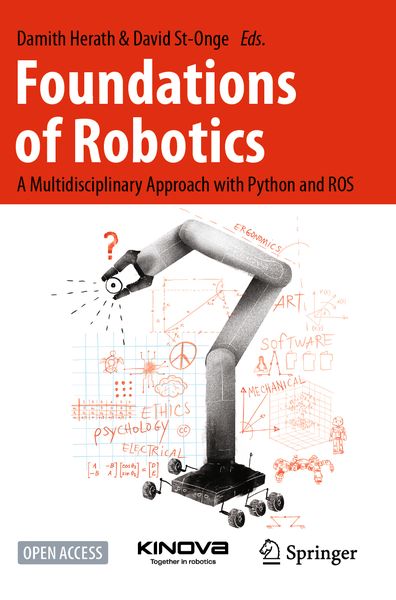
Produktbild: Foundations of Robotics

Foundations of Robotics A Multidisciplinary Approach with Python and ROS

Fr. 58.90

inkl. gesetzl. MwSt., Versandkostenfrei


Beschreibung

Produktdetails

Einband

Taschenbuch

Erscheinungsdatum

28.09.2023

Herausgeber

Damith Herath + weitere

Verlag

Springer Singapore

Seitenzahl

543

Maße (L/B/H)

23.5/15.5/2.9 cm

Auflage

1st ed. 2022

Sprache

Englisch

ISBN

978-981-19-1985-5

Beschreibung

Portrait

Damith Herath (Ph.D., Robotics) is an Associate Professor in Robotics and Art at the University of Canberra. Damith is a multi-award winning entrepreneur and a roboticist with extensive experience leading multidisciplinary research teams on complex robotic integration, industrial and research projects for over two decades. He founded Australia’s first collaborative robotics startup in 2011 and was named one of the most innovative young tech companies in Australia in 2014. Teams he led in 2015 and 2016 consecutively became finalists and, in 2016, a top-ten category winner in the coveted Amazon Robotics Challenge - an industry-focussed competition amongst the robotics research elite. In addition, Damith has chaired several international workshops on Robots and Art and is the lead editor of the book "Robots and Art: Exploring an Unlikely Symbiosis" - the first significant work to feature leading roboticists and artists together in the field of Robotic Art.

David St-Onge (Ph.D., Mech. Eng.) is an Associate Professor in the Mechanical Engineering Department at the École de technologie supérieure and director of the INIT Robots Lab (initrobots.ca). David’s research focuses on human-swarm collaboration more specifically with respect to operators’ cognitive load and motion-based interactions. He has over 10 years’ experience in the field of interactive media (structure, automatization and sensing) as workshop production director and as R&D engineer. He is an active member of national clusters centered on human-robot interaction (REPARTI) and art-science collaborations (Hexagram). He participates in national training programs for highly qualified personnel for drone services (UTILI), as well as for the deployment of industrial cobots (CoRoM). He led the team effort to present the first large-scale symbiotic integration of robotic art at the IEEE International Conference on Robotics and Automation (ICRA 2019).

Produktdetails

Einband

Taschenbuch

Erscheinungsdatum

28.09.2023

Herausgeber

Verlag

Springer Singapore

Seitenzahl

543

Maße (L/B/H)

23.5/15.5/2.9 cm

Auflage

1st ed. 2022

Sprache

Englisch

ISBN

978-981-19-1985-5

Herstelleradresse

Springer-Verlag GmbH
Tiergartenstr. 17
69121 Heidelberg
DE

Email: ProductSafety@springernature.com

Kundinnen und Kunden meinen

0 Bewertungen

Informationen zu Bewertungen

Zur Abgabe einer Bewertung ist eine Anmeldung im Konto notwendig. Die Authentizität der Bewertungen wird von uns nicht überprüft. Wir behalten uns vor, Bewertungstexte, die unseren Richtlinien widersprechen, entsprechend zu kürzen oder zu löschen.

Die Bewertungen sind nach Format, Anzahl Sterne und Datum sortiert.

Verfassen Sie die erste Bewertung zu diesem Artikel

Helfen Sie anderen Kund*innen durch Ihre Meinung

Kundinnen und Kunden meinen

0 Bewertungen filtern

  • Produktbild: Foundations of Robotics
  • PART I: Contextual Design.- Chapter 1 - Genealogy of artificial beings: from ancient automata to modern robotics (Nicolas Reeves and David St-Onge).- Chapter 2 - Teaching and learning robotics: A pedagogical perspective(Eleni Petraki and Damith Herath).- Chapter 3 - Design Thinking: from Empathy to Ideation(Fanke Peng).-Chapter 4 - Software building blocks: From Python to Version control (Damith Herath, Adam Haskard and Niranjan Shukla).- Chapter 5 - The Robot Operating System (ROS1&2): programming paradigms and deployment(David St-Onge and Damith Herath).- Chapter 6 - Mathematical building blocks: From geometry to quaternions to Bayesian(Rebecca Stower, Bruno Belzile and David St-Onge).-PART II: Embedded Design.- Chapter 7 - What makes robots? Sensors, Actuators and Algorithms (Jiefei Wang and Damith Herath).- Chapter 8 - Mobile robots: Controlling, Navigating and path planning( Jiefei Wang and Damith Herath).- Chapter 9 - Lost in space! Localisation and Mapping (Damith Herath).-Chapter 10 - How to manipulate? Kinematics, dynamics and architecture of robot arms (Bruno Belzile and David St-Onge).- Chapter 11 - Get together! Multi-robot systems: bio-inspired concepts and deployment challenges (Vivek Shankar Varadharajan and Giovanni Beltrame).- Chapter 12 - The Embedded design process: CAD/CAM and prototyping (Eddi Pianca).- PART III: Interaction Design.- Chapter 13 - Social robots: Principles of interaction design and user studies (Janie Busby Grant & Damith Herath).- Chapter 14 - Safety first: On the safe deployment of robotic systems (Bruno Belzile and David St-Onge).- Chapter 15 - Managing the world complexity: from linear regression to deep learning (Yann Bouteiller).- Chapter 16 - Robot ethics: Ethical design considerations (Dylan Cawthorne).- Chapter 17 - Robot Hexapod Build Labs (David Hinwood and Damith Herath).- Chapter 18 - ROS Mobile Manipulator labs (David St-Onge, Corentin Boucher and Bruno Belzile).