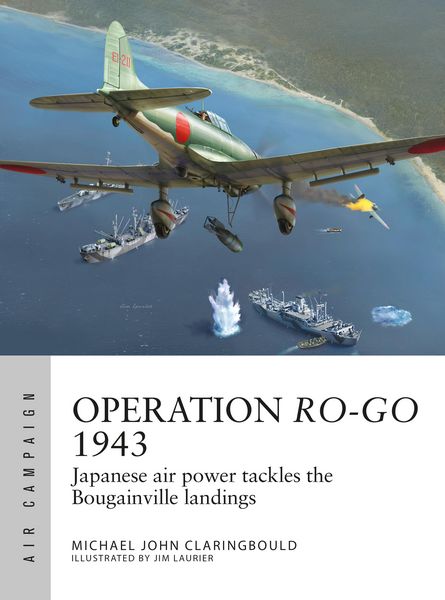
Operation Ro-Go 1943 Japanese air power tackles the Bougainville landings
Aus der Reihe
Air Campaign
-
- Taschenbuch
- eBook ausgewählt
-
Form:Einzelkauf Download
-
Sprache:Englisch
-
eBook Format:ePUB
- PDF Fr. 18.90
- ePUB Fr. 18.90 ausgewählt
Fr. 18.90
inkl. gesetzl. MwSt.Beschreibung
Produktdetails
Format
ePUB
Kopierschutz
Ja
Family Sharing
Nein
Text-to-Speech
Ja
Erscheinungsdatum
23.11.2023
Illustriert von
Jim Laurier
Verlag
Bloomsbury eBooks UKSeitenzahl
96 (Printausgabe)
Auflage
1. Auflage
Sprache
Englisch
EAN
9781472855565
A compelling account of the failure of Imperial Japan's Operation Ro-Go, intended to take the offensive in the Solomons theater of the Pacific War, but which became Japan's first line of defense against the Allies' Rabaul raids and Bougainville landings.
By the midpoint of World War II in the Pacific, Japan was on the defensive. At the end of 1943, after a year of tumultuous air combat around Rabaul and the Solomons, 173 Japanese aircraft were sent to Rabaul. The plan was for them to participate in Ro-Go Sakusen (known as Operation Ro, Ro-Go, or B) to strike Allied air power and shipping in the Solomons and to slow the American advance by severing Allied supply chains. However, instead of challenging Allied air and sea power on their own terms, the operation became unexpectedly embroiled in defensive combat and counterattacks, first to defend Rabaul from Allied air raids, and then to challenge the Allied landings at Bougainville. In one fell swoop, Operation Ro-Go was turned on its head, and transformed into a defensive battle for the Japanese.
In this book, the first in English to focus on Operation Ro-Go, Michael John Claringbould uses rare Japanese primary source material to explain how the Japanese planned and fought the campaign, and corrects enduring myths often found in books that rely only on Western sources. He traces the unexpected and tremendous pressures placed on the operation's units at Rabaul as the Japanese dealt with massive, surprise raids from Fifth Air Force bombers, and later US Navy carrier aircraft, concluding with the strategic upset of the Bougainville landings.
Packed with previously unpublished photos, spectacular original illustrations, 3D recreations of specific missions, maps and explanatory diagrams, this study tells the previously untold but significant story of Japan's air war in the Solomons.
By the midpoint of World War II in the Pacific, Japan was on the defensive. At the end of 1943, after a year of tumultuous air combat around Rabaul and the Solomons, 173 Japanese aircraft were sent to Rabaul. The plan was for them to participate in Ro-Go Sakusen (known as Operation Ro, Ro-Go, or B) to strike Allied air power and shipping in the Solomons and to slow the American advance by severing Allied supply chains. However, instead of challenging Allied air and sea power on their own terms, the operation became unexpectedly embroiled in defensive combat and counterattacks, first to defend Rabaul from Allied air raids, and then to challenge the Allied landings at Bougainville. In one fell swoop, Operation Ro-Go was turned on its head, and transformed into a defensive battle for the Japanese.
In this book, the first in English to focus on Operation Ro-Go, Michael John Claringbould uses rare Japanese primary source material to explain how the Japanese planned and fought the campaign, and corrects enduring myths often found in books that rely only on Western sources. He traces the unexpected and tremendous pressures placed on the operation's units at Rabaul as the Japanese dealt with massive, surprise raids from Fifth Air Force bombers, and later US Navy carrier aircraft, concluding with the strategic upset of the Bougainville landings.
Packed with previously unpublished photos, spectacular original illustrations, 3D recreations of specific missions, maps and explanatory diagrams, this study tells the previously untold but significant story of Japan's air war in the Solomons.
Kundinnen und Kunden meinen
Verfassen Sie die erste Bewertung zu diesem Artikel
Helfen Sie anderen Kund*innen durch Ihre Meinung