KI-Beratung Beta

Gutscheinbedingungen

*Gültig bis 06.10.2026 auf alle Bücher. Ausgeschlossen sind Zeitschriften, Prozentbücher und Abos | Einlösbar in allen Buchhandlungen von Orell Füssli (ausser Transa Books), Barth Bücher, Buchladen Rapunzel, Papeterie Köhler, Schuler Orell Füssli, Stauffacher und ZAP unter Vorweisung des Gutscheins, auf www.orellfüssli.ch durch Eingabe des Gutscheincodes. Beim Service „eBooks verschenken“ und bei eBook-Käufen via eReader nicht einlösbar | Mindesteinkaufswert: Fr. 30.- | Nicht mit anderen Rabatten kumulierbar.

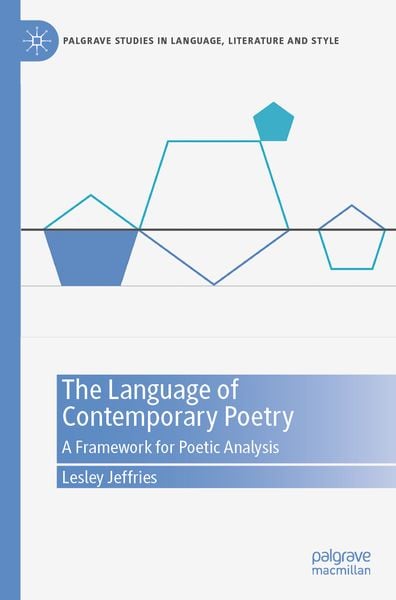
  • Produktbild: The Language of Contemporary Poetry
  • Produktbild: The Language of Contemporary Poetry

The Language of Contemporary Poetry A Framework for Poetic Analysis

Fr. 137.00

inkl. gesetzl. MwSt., Versandkostenfrei


Beschreibung

Produktdetails

Einband

Taschenbuch

Erscheinungsdatum

02.10.2023

Verlag

Springer

Seitenzahl

282

Maße (L/B/H)

23.5/15.5/1.7 cm

Gewicht

470 g

Auflage

1st ed. 2022

Sprache

Englisch

ISBN

978-3-031-09751-5

Beschreibung

Produktdetails

Einband

Taschenbuch

Erscheinungsdatum

02.10.2023

Verlag

Springer

Seitenzahl

282

Maße (L/B/H)

23.5/15.5/1.7 cm

Gewicht

470 g

Auflage

1st ed. 2022

Sprache

Englisch

ISBN

978-3-031-09751-5

Herstelleradresse

Springer-Verlag GmbH
Tiergartenstr. 17
69121 Heidelberg
DE

Email: ProductSafety@springernature.com

Noch keine Bewertungen vorhanden

Verfassen Sie die erste Bewertung zu diesem Artikel

Helfen Sie anderen Kundinnen und Kunden durch Ihre Meinung.

Kundinnen und Kunden meinen

Bewertungen (0)

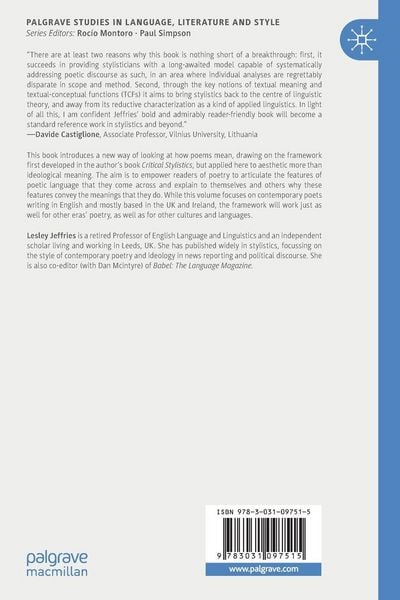
  • Produktbild: The Language of Contemporary Poetry
  • Produktbild: The Language of Contemporary Poetry
  • Chapter 1. Contemporary poetry and textual meaning.- Part 1: Core Features Of Textual Meaning.- Chapter 2. Naming and Describing: people, places and things in poems.- Chapter 3. Representing processes: actions, states and events in poetry .- Chapter 4. Prioritising: Subordination and information structure in poems.- Chapter 5. Representing time, space and society: constructing the world of the poem.- Part 2: Intermittent Features Of Textual Meaning.- Chapter 6. Equating and Contrasting: Constructing equivalence and opposition in poems.- Chapter 7. Enumerating and Exemplifying: Lists and open meaning in poems.- Chapter 8. Negating: Poetic construction of what is not.- Chapter 9. Hypothesising: Possible Worlds, hypothetical scenarios and wish fulfilment in poems.-  Chapter 10. Alluding: Implying and Assuming in poems.- Chapter 11. Presenting others’ speech and thought: Multiple voices in poems.- Chapter 12. Evoking: experiencing the poem’s world.- Part Three: Conclusions.- Chapter 13. Putting it all together: Integrated analysis of poems.- Chapter 14. Textual meaning, linguistic theory and the stylistics of poetry.