• Produktbild: Reparative Futures and Transformative Learning Spaces
  • Produktbild: Reparative Futures and Transformative Learning Spaces

Reparative Futures and Transformative Learning Spaces

Fr. 201.00

inkl. gesetzl. MwSt., Versandkostenfrei


Beschreibung

Produktdetails

Einband

Gebundene Ausgabe

Erscheinungsdatum

20.01.2024

Herausgeber

Melanie Walker + weitere

Verlag

Springer

Seitenzahl

281

Maße (L/B/H)

21.6/15.3/2.1 cm

Gewicht

508 g

Auflage

1st ed. 2023

Sprache

Englisch

ISBN

978-3-031-45805-7

Beschreibung

Portrait

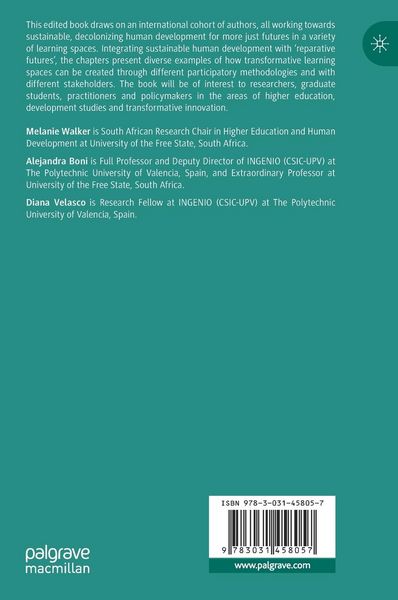
Melanie Walker is South African Research Chair in Higher Education and Human Development at University of the Free State, South Africa.

Alejandra Boni  is Full Professor and Deputy Director of INGENIO (CSIC-UPV) at The Polytechnic University of Valencia, Spain, and Extraordinary Professor at University of the Free State, South Africa.

Diana Velasco  is Research Fellow at INGENIO (CSIC-UPV) at The Polytechnic University of Valencia, Spain.


Produktdetails

Einband

Gebundene Ausgabe

Erscheinungsdatum

20.01.2024

Herausgeber

Verlag

Springer

Seitenzahl

281

Maße (L/B/H)

21.6/15.3/2.1 cm

Gewicht

508 g

Auflage

1st ed. 2023

Sprache

Englisch

ISBN

978-3-031-45805-7

Herstelleradresse

Springer-Verlag GmbH
Tiergartenstr. 17
69121 Heidelberg
DE

Email: ProductSafety@springernature.com

Kundinnen und Kunden meinen

0 Bewertungen

Informationen zu Bewertungen

Zur Abgabe einer Bewertung ist eine Anmeldung im Konto notwendig. Die Authentizität der Bewertungen wird von uns nicht überprüft. Wir behalten uns vor, Bewertungstexte, die unseren Richtlinien widersprechen, entsprechend zu kürzen oder zu löschen.

Die Bewertungen sind nach Format, Anzahl Sterne und Datum sortiert.

Verfassen Sie die erste Bewertung zu diesem Artikel

Helfen Sie anderen Kund*innen durch Ihre Meinung

Kundinnen und Kunden meinen

0 Bewertungen filtern

  • Produktbild: Reparative Futures and Transformative Learning Spaces
  • Produktbild: Reparative Futures and Transformative Learning Spaces
  • 1. Reparative futures through transformative learning spaces: An intersectional approach for decolonised and sustainable human development (Melanie Walker, Alejandra Boni and Diana Velasco).- 2. Difficult knowledge, post-truth, and reparative futures: Nurturing affective solidarity for transformative learning spaces (Michalinos Zembylas).- 3. Youth voices on social justice: Doing repair work in a South African higher education space  (Melanie Walker).- 4. Epistemic resilience: Articulating struggles and dreams from the co-production of knowledge from below between universities and community researchers (Monique Leivas Vargas and Alvaro Fernández-Baldor).- 5. Towards a decolonial and capabilities-based conceptualisation of sustainable educational futures in the Pan-African university: Perspectives from student activists (C. Martinez-Vargas, M. Mathebula, F. Mkwananzi, B. Kibona, T. Malatji, T. Mahlatsi, P. Mmula, N. Khoza, S. Nkosi, B. Ndimba, B. Oamen, A. Buthelezi, M. Maubane, Y. Ngwabeni, and S. Dlamini).- 6. Fostering a reparative international development cooperation system: Transformative learning in a master’s degree in development cooperation (Carlos Delgado-Caro, Carola Calabuig-Tormo, and Marta Maicas-Pérez).- 7. The Latin American Hub of Transformative Innovation: A collaborative space promoting collective learning towards more just and sustainable futures (Paloma Bernal-Hernández and Martha Liliana Marín).- 8. Imagining and realising futures in Catalonia: Shared Agendas for just sustainability transitions (Diana Velasco, Míriam Acebillo-Baqué, Alejandra Boni, and Tatiana Fernández).- 9. Peacebuilding as democratic political education: From archive to repertoire (Stephen Esquith and Weloré Tamboura).- 10. Reparative threads that open change futures: Experiences of sexual and gender diversity (Fernando Altamira Basterretxea, Esther Canarias Fernández-Cavada, Ricardo Fernández Quintana and Nelsy Elizabeth Sandoval Díaz).- 11. Philosophical inquiry and the childness of communities: Connective capabilities for flourishing education (Marina Santi and Elisabetta Ghedin).- 12. Transformative learning spaces and capabilities for reimagined and reparative futures in multiple systems (Alejandra Boni, Melanie Walker, and Diana Velasco).