Gutscheinbedingungen

*Gültig bis 07.06.2026 auf (fast) alles. Ausgeschlossen sind Smartboxen, Zeitschriften, Tickets, Lebensmittel, Gaming-Elektroartikel, Tinte/Toner, Gutscheine, Geschenkkarten, Blumen und Abos | Einlösbar in allen Buchhandlungen von Orell Füssli, Barth Bücher, Buchladen Rapunzel, Schuler Orell Füssli, Stauffacher und ZAP unter Vorweisung des Gutscheins, auf www.orellfüssli.ch durch Eingabe des Gutscheincodes. Beim Service „eBooks verschenken“ und bei eBook-Käufen via eReader nicht einlösbar | Mindesteinkaufswert: Fr. 100.- | Nicht mit anderen Rabatten kumulierbar.

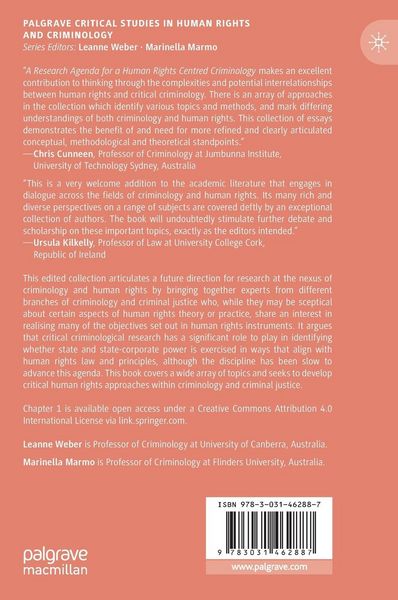
  • Produktbild: A Research Agenda for a Human Rights Centred Criminology
  • Produktbild: A Research Agenda for a Human Rights Centred Criminology

A Research Agenda for a Human Rights Centred Criminology

Fr. 161.00

inkl. gesetzl. MwSt., Versandkostenfrei


Beschreibung

Produktdetails

Einband

Gebundene Ausgabe

Erscheinungsdatum

04.02.2024

Herausgeber

Leanne Weber + weitere

Verlag

Springer

Seitenzahl

246

Maße (L/B/H)

21.6/15.3/1.9 cm

Gewicht

458 g

Auflage

1st ed. 2024

Sprache

Englisch

ISBN

978-3-031-46288-7

Beschreibung

Rezension

“This book is very well-rounded in its collection of very meaningful research done to explore this change in criminology. Each of the chapters brings new concepts to the agreement for a human rights centered criminology.  … This book allows future researchers to have a good understanding of what a human rights centered criminology should be and allows researchers to move in the right direction.” (Hannah Sinkko, International Criminal Justice Review, Vol. 36 (1), March, 2026)


“This edited volume is a vital read for anyone concerned with the intersection of criminology, human rights, and societal hierarchies. Its contributions span approaches, and it includes cutting-edge research on new frontiers of human rights and criminology—including contexts like aged care and public health. The editors have successfully and skillfully bridged both human rights and criminology, and this is a necessary read for anyone studying human rights, incarceration, or structural hierarchies more broadly.” (Matthew Rains, International Criminology, October 31, 2025)

Portrait

Leanne Weber  is Professor of Criminology at University of Canberra, Australia.

Marinella Marmo  is Professor of Criminology at Flinders University, Australia.   


Produktdetails

Einband

Gebundene Ausgabe

Erscheinungsdatum

04.02.2024

Herausgeber

Verlag

Springer

Seitenzahl

246

Maße (L/B/H)

21.6/15.3/1.9 cm

Gewicht

458 g

Auflage

1st ed. 2024

Sprache

Englisch

ISBN

978-3-031-46288-7

Herstelleradresse

Springer-Verlag GmbH
Tiergartenstr. 17
69121 Heidelberg
DE

Email: ProductSafety@springernature.com

Kundinnen und Kunden meinen

0 Bewertungen

Informationen zu Bewertungen

Zur Abgabe einer Bewertung ist eine Anmeldung im Konto notwendig. Die Authentizität der Bewertungen wird von uns nicht überprüft. Wir behalten uns vor, Bewertungstexte, die unseren Richtlinien widersprechen, entsprechend zu kürzen oder zu löschen.

Die Bewertungen sind nach Format, Anzahl Sterne und Datum sortiert.

Verfassen Sie die erste Bewertung zu diesem Artikel

Helfen Sie anderen Kund*innen durch Ihre Meinung

Kundinnen und Kunden meinen

0 Bewertungen filtern

  • Produktbild: A Research Agenda for a Human Rights Centred Criminology
  • Produktbild: A Research Agenda for a Human Rights Centred Criminology
  • Chapter 1. Introduction: A research agenda for a human rights centred criminology (Leanne Weber and Marinella Marmo).- Chapter 2. Criminological research for human rights ( Elizabeth Stanley ) .- Chapter 3. Speaking rights to power or governing through rights?: Making rights matter in the security field ( Claire Hamilton ).- Chapter 4. Researching policing from the perspective of the policed : studying human rights from below ( Will Jackson ).- Chapter 5. Criminology, humanitarianism, and the right to life at the border ( Katja Franko ).- Chapter 6. The promise and pitfalls of human rights in immigration detention ( Mary Bosworth and Andriani Fili).- Chapter 7.  An anticolonial, abolitionist, and feminist lens to interrogate human rights penalty ( Silvana Tapia Tapia).- Chapter 8. Human rights for Southern Criminology: Neoliberal colonialism and rights from below ( Pablo Ciocchini and Joe Greener ).- Chapter 9. Actioning the Human Rights Agenda and Issues of Access to Justice ( Danielle Watson, Julie Berg and Lamese Laponi ).-  Chapter 10. Developing a kaupapa Māori rights-focused research agenda ( Stella Black, Dave Burnside, Jess Hastings, and Katey Thom ).- Chapter 11. Queer Criminology through the Lens of the Global South and its Impact on Human Rights ( George B. Radics ).- Chapter 12. Are victim stories human rights stories? Towards an ethics and politics of listening and seeing for victimology ( Sandra Walklate).- Chapter 13. Gendered violence: A human rights agenda for criminology ( Nancy A. Wonders and Sydney Shevat).- Chapter 14. Towards a Human Rights Criminology of Public Health ( Raymond Michalowski and Rebecca Annorbah).- Chapter 15. Carceral Spaces and OPCAT: resisting the temptation of human rights? ( Claire Loughnan and Steven Caruana)