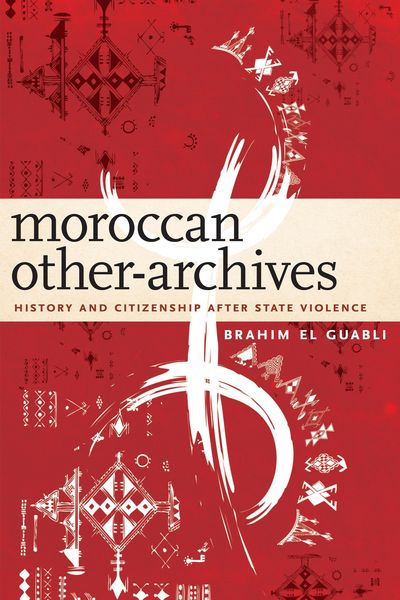
Moroccan Other-Archives
-
- Hardcover
- Taschenbuch
- eBook ausgewählt
-
Form:Einzelkauf Download
-
Sprache:Englisch
-
eBook Format:PDF
- PDF Fr. 43.90 ausgewählt
- ePUB Fr. 43.90
Fr. 43.90
inkl. gesetzl. MwSt.Beschreibung
Produktdetails
Format
Kopierschutz
Ja
Family Sharing
Ja
Text-to-Speech
Nein
Erscheinungsdatum
25.04.2023
Verlag
Fordham University PressSeitenzahl
(Printausgabe)
Dateigröße
11095 KB
Sprache
Englisch
EAN
9781531501471
Moroccan Other-Archives investigates how histories of exclusion and silencing are written and rewritten in a postcolonial context that lacks organized and accessible archives. The book draws on cultural production concerning the "e;years of lead"e;-a period of authoritarianism and political violence between Morocco's independence in 1956 and the death of King Hassan II in 1999-to examine the transformative roles memory and trauma play in reconstructing stories of three historically marginalized groups in Moroccan history: Berbers/Imazighen, Jews, and political prisoners.The book shows how Moroccan cultural production has become an other-archive: a set of textual, sonic, embodied, and visual sites that recover real or reimagined voices of these formerly suppressed and silenced constituencies of Moroccan society. Combining theoretical discussions with close reading of literary works, the book reenvisions both archives and the nation in postcolonial Morocco. By producing other-archives, Moroccan cultural creators transform the losses state violence inflicted on society during the years of lead into a source of civic engagement and historiographical agency, enabling the writing of histories about those Moroccans who have been excluded from official documentation and state-sanctioned histories.The book is multilingual and interdisciplinary, examining primary sources in Amazigh/Berber, Arabic, Darija, and French, and drawing on memory studies, literary theory, archival studies, anthropology, and historiography. In addition to showing how other-archives are created and operate, El Guabli elaborates how language, gender, class, race, and geographical distribution are co-constitutive of a historical and archival unsilencing that is foundational to citizenship in Morocco today.
Kundinnen und Kunden meinen
Verfassen Sie die erste Bewertung zu diesem Artikel
Helfen Sie anderen Kund*innen durch Ihre Meinung