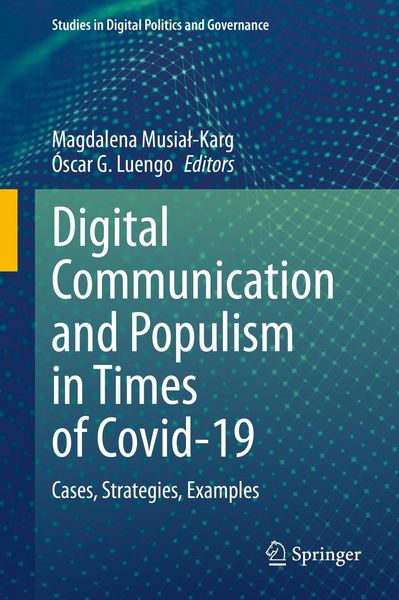
Digital Communication and Populism in Times of Covid-19 Cases, Strategies, Examples
Aus der Reihe
Studies in Digital Politics and Governance
-
- Hardcover
- Taschenbuch
- eBook ausgewählt
-
Form:Einzelkauf Download
-
Sprache:Englisch
Fr. 175.90
inkl. gesetzl. MwSt.Beschreibung
Produktdetails
Format
Kopierschutz
Nein
Family Sharing
Nein
Text-to-Speech
Nein
Erscheinungsdatum
13.09.2023
Herausgeber
Magdalena Musial-Karg + weitereVerlag
Springer Nature SwitzerlandSeitenzahl
207 (Printausgabe)
Dateigröße
5797 KB
Sprache
Englisch
EAN
9783031337161
This book examines different dimensions of digital communication and populism in times of the COVID-19 pandemic. While doing so, it discusses views, opinions, and research results regarding the conditions, experiences, constraints, benefits, and challenges related to the topic - not only using theoretical and methodological approaches but also practical perspectives. The COVID-19 (SARS-CoV-2) pandemic significantly accelerated the technological revolution presenting many social, economic, and political challenges, as it pushed the world into cyberspace to ensure social distancing. At the same time, many populist protests expressed in the digital public sphere massively gained importance during the lockdowns. As a result, one of the most significant consequences of using electronic tools is not only greater e-participation of citizens, but - especially evident through elections during a pandemic - even greater transfer of political communication and election campaigns into the space of new media. The book broadly analyses various contexts of digitalization of communication processes and populist politics from both theoretical and empirical perspectives in various case studies on the digitalization of information, communication, or participation processes during the COVID-19 pandemic in selected European countries and beyond. This book will appeal to students, researchers, and scholars of political communication, political science, electoral studies, digital politics, and democracy, as well as policy-makers interested in a better understanding of digital communication and populism during the Covid-19 pandemic.
Kundinnen und Kunden meinen
Verfassen Sie die erste Bewertung zu diesem Artikel
Helfen Sie anderen Kund*innen durch Ihre Meinung