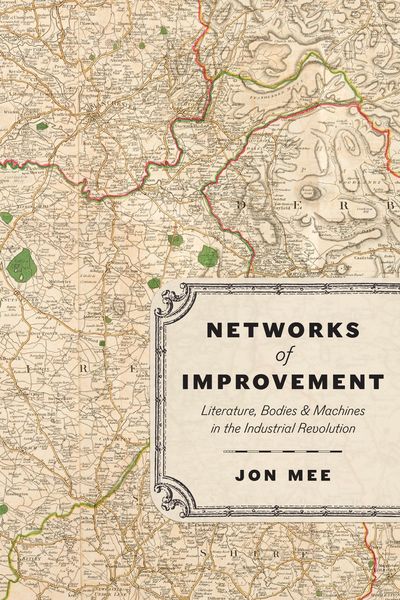
Networks of Improvement
-
- Hardcover
- Taschenbuch
- eBook ausgewählt
-
Form:Einzelkauf Download
-
Sprache:Englisch
Fr. 51.90
inkl. gesetzl. MwSt.Beschreibung
Produktdetails
Format
ePUB
Kopierschutz
Ja
Family Sharing
Ja
Text-to-Speech
Ja
Erscheinungsdatum
06.10.2023
Verlag
University of Chicago PressSeitenzahl
288 (Printausgabe)
Dateigröße
3697 KB
Sprache
Englisch
EAN
9780226828398
A new literary-cultural history of the Industrial Revolution in Britain from the late eighteenth to the mid-nineteenth centuries.
Working against the stubbornly persistent image of "dark satanic mills," in many ways so characteristic of literary Romanticism, Jon Mee provides a fresh, revisionary account of the Industrial Revolution as a story of unintended consequences. In
Networks of Improvement, Mee reads a wide range of texts-economic, medical, and more conventionally "literary"-with a focus on their circulation through networks and institutions. Mee shows how a project of enlightened liberal reform articulated in Britain's emerging manufacturing towns led to unexpectedly coercive forms of machine productivity, a pattern that might be seen repeating in the digital technologies of our own time. Instead of treating the Industrial Revolution as Romanticism's "other," Mee shows how writing, practices, and institutions emanating from these industrial towns developed a new kind of knowledge economy, one where local literary and philosophical societies served as important transmission hubs for the circulation of knowledge.
Working against the stubbornly persistent image of "dark satanic mills," in many ways so characteristic of literary Romanticism, Jon Mee provides a fresh, revisionary account of the Industrial Revolution as a story of unintended consequences. In
Networks of Improvement, Mee reads a wide range of texts-economic, medical, and more conventionally "literary"-with a focus on their circulation through networks and institutions. Mee shows how a project of enlightened liberal reform articulated in Britain's emerging manufacturing towns led to unexpectedly coercive forms of machine productivity, a pattern that might be seen repeating in the digital technologies of our own time. Instead of treating the Industrial Revolution as Romanticism's "other," Mee shows how writing, practices, and institutions emanating from these industrial towns developed a new kind of knowledge economy, one where local literary and philosophical societies served as important transmission hubs for the circulation of knowledge.
Noch keine Bewertungen vorhanden
Verfassen Sie die erste Bewertung zu diesem Artikel
Helfen Sie anderen Kundinnen und Kunden durch Ihre Meinung.