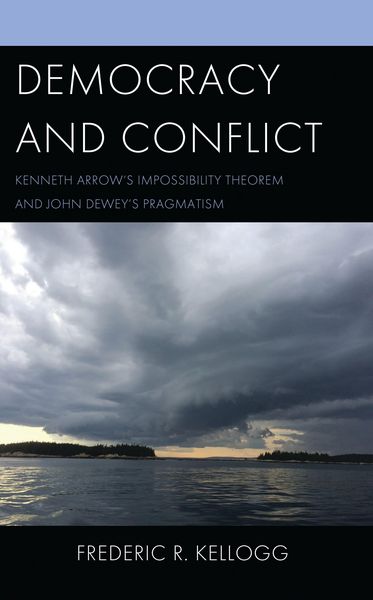
Democracy and Conflict Kenneth Arrow's Impossibility Theorem and John Dewey's Pragmatism
-
Form:Einzelkauf Download
-
Sprache:Englisch
-
eBook Format:ePUB
- PDF Fr. 89.90
- ePUB Fr. 89.90 ausgewählt
Fr. 89.90
inkl. gesetzl. MwSt.Beschreibung
Produktdetails
Format
ePUB
Kopierschutz
Ja
Family Sharing
Nein
Text-to-Speech
Ja
Erscheinungsdatum
15.12.2023
Verlag
Bloomsbury eBooks USSeitenzahl
184 (Printausgabe)
Auflage
1. Auflage
Sprache
Englisch
EAN
9781793654298
The economist Kenneth Arrow proved in 1951 that a society of diverse individual preferences could only by ordered by dictatorship. His impossibility theorem is still an axiom of contemporary welfare economics and has never been seriously challenged. The American philosopher John Dewey, who died in 1952, had claimed that voting and electoral mechanisms do not define democratic self-government. His broad conception of social conflict addresses preference diversity and resolves Arrow's impossibility.
Since the 1980s, political scientists have focused on decision through democratic "deliberation." Dewey saw that conversation alone is inadequate for resolution of conflicts in a democracy. Conflict is accompanied by discourse, but preferences are grounded in habits. Social habits resist adjustment in response to discourse alone, but demonstrably adjust in the process of conflict resolution, Preference conflict is distinguished from Marxist and later models, as a discovery and transformation process. It advances an original, updated theory of social conflict in a democracy relevant to today's problematic situations from discrimination to climate change and political polarization.
Since the 1980s, political scientists have focused on decision through democratic "deliberation." Dewey saw that conversation alone is inadequate for resolution of conflicts in a democracy. Conflict is accompanied by discourse, but preferences are grounded in habits. Social habits resist adjustment in response to discourse alone, but demonstrably adjust in the process of conflict resolution, Preference conflict is distinguished from Marxist and later models, as a discovery and transformation process. It advances an original, updated theory of social conflict in a democracy relevant to today's problematic situations from discrimination to climate change and political polarization.
Kundinnen und Kunden meinen
Verfassen Sie die erste Bewertung zu diesem Artikel
Helfen Sie anderen Kund*innen durch Ihre Meinung