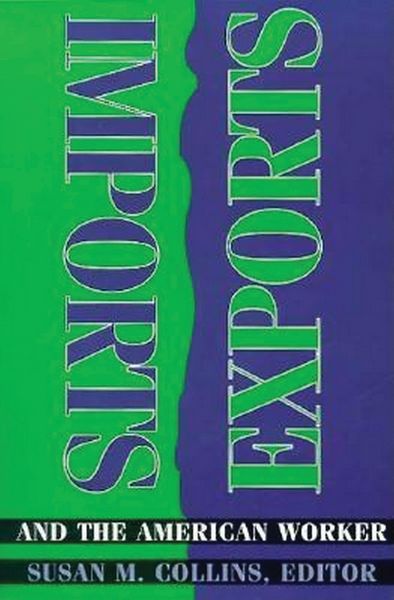
Imports, Exports, and the American Worker
-
- Taschenbuch
- eBook ausgewählt
-
Form:Einzelkauf Download
-
Sprache:Englisch
Fr. 31.90
inkl. gesetzl. MwSt.Beschreibung
Produktdetails
Format
ePUB
Kopierschutz
Ja
Family Sharing
Nein
Text-to-Speech
Ja
Erscheinungsdatum
01.12.2010
Herausgeber
Susan M. CollinsVerlag
Bloomsbury eBooks USSeitenzahl
557 (Printausgabe)
Auflage
1. Auflage
Sprache
Englisch
EAN
9780815714996
Will technological improvement and growth in the rest of the world cause a decline in American living standards? Can government policy in Japan and Western Europe limit the availability of high- wage jobs in America? Does expanding trade with Mexico and other developing countries with large numbers of inexpensive workers imply a continuing decline in wages for low-skilled American workers? These questions express a widespread concern about potential negative effects of import competition on domestic labor markets, but ignore potential gains to U.S. workers from exports abroad. Through U.S. exports, the rest of the world is an increasingly large indirect employer of U.S. workers, and through imports, foreign labor is an increasingly important potential substitute for U.S. workers. Bringing together the often diverse perspectives of international economists, labor economists, and policymakers, this volume analyzes how international trade affects the level and distribution of wages and employment in the United States, examines the need for government intervention, and evaluates policy options. In addition to the editor, the contributors are Jagdish Bhagwati, Columbia University and American Enterprise Institute; J. Bradford De Long, U.S. Department of the Treasury and University of California, Berkeley; I. M. Destler, University of Maryland and Institute for International Economics; Richard B. Freeman, Harvard University and London School of Economics; Louis Jacobson, WESTAT; Lori G. Kletzer, University of California, Santa Cruz; Edward Leamer, University of California, Los Angeles; Michael Piore, Massachusetts Institute of Technology; Ana Revenga and Claudio Montenegro, The World Bank; Jeffrey D. Sachs and Howard Shatz, Harvard University.
Kundinnen und Kunden meinen
Verfassen Sie die erste Bewertung zu diesem Artikel
Helfen Sie anderen Kund*innen durch Ihre Meinung