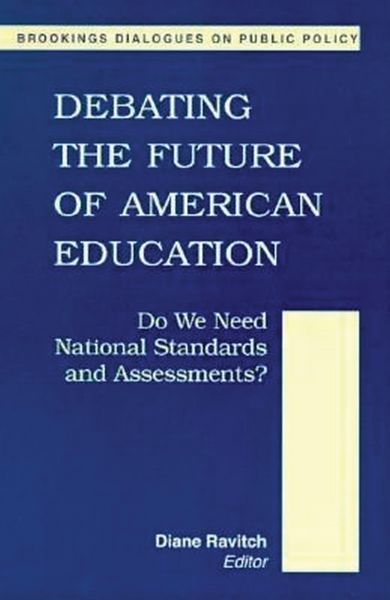
Debating the Future of American Education Do We Meet National Standards and Assessments?
-
- Taschenbuch
- eBook ausgewählt
-
Form:Einzelkauf Download
-
Sprache:Englisch
Fr. 22.90
inkl. gesetzl. MwSt.Beschreibung
Produktdetails
Format
ePUB
Kopierschutz
Ja
Family Sharing
Nein
Text-to-Speech
Ja
Erscheinungsdatum
01.12.2010
Herausgeber
Diane RavitchVerlag
Bloomsbury eBooks USSeitenzahl
192 (Printausgabe)
Auflage
1. Auflage
Sprache
Englisch
EAN
9780815713456
What is the outlook for educational reform in the United States? One of the most striking proposals has been to establish a system of national standards, which has raised many complex questions: Is it possible for the United States, with its history of extreme decentralization, to establish and enforce national standards for what students should know? Who will create these standards? What would be the role of the federal, state, and local governments?
While the idea of national standards has been widely supported, many respected educators doubt their value from fear that such standards will institutionalize the lowest common denominator. Others cite the poor performance of U.S. students on international tests and insist that the U.S. will suffer because of this poor performance. The debate becomes even more intense when the question of assessment is posed. Is it possible to develop a national examination system tied to new standards? Should such tests be used to influence entry to colleges and jobs? Would the motivation of students to learn be increased if they knew that their performance would be reviewed by colleges and employers? Is it fair to set standards for students without setting standards for schools?
To address these and other questions, this book, the result of a Brookings conference, brings together representatives of various viewpoints on the utility and equity of increasing the use of tests for students, teachers, and schools.
The contributors are Chester Finn, Jr., the Edison Project; Daniel Koretz, RAND; Andrew Porter, Wisconsin Center for Education Research; Lauren Resnick, University of Pittsburgh; Roy Romer, Governor of Colorado; Albert Shanker, American Federation of Teachers; Theodore R. Sizer, Brown University; Marshall C. Smith, U.S. Department of Education; and Donald M. Stewart, The College Board.
Brookings Dialogues on Public Policy
While the idea of national standards has been widely supported, many respected educators doubt their value from fear that such standards will institutionalize the lowest common denominator. Others cite the poor performance of U.S. students on international tests and insist that the U.S. will suffer because of this poor performance. The debate becomes even more intense when the question of assessment is posed. Is it possible to develop a national examination system tied to new standards? Should such tests be used to influence entry to colleges and jobs? Would the motivation of students to learn be increased if they knew that their performance would be reviewed by colleges and employers? Is it fair to set standards for students without setting standards for schools?
To address these and other questions, this book, the result of a Brookings conference, brings together representatives of various viewpoints on the utility and equity of increasing the use of tests for students, teachers, and schools.
The contributors are Chester Finn, Jr., the Edison Project; Daniel Koretz, RAND; Andrew Porter, Wisconsin Center for Education Research; Lauren Resnick, University of Pittsburgh; Roy Romer, Governor of Colorado; Albert Shanker, American Federation of Teachers; Theodore R. Sizer, Brown University; Marshall C. Smith, U.S. Department of Education; and Donald M. Stewart, The College Board.
Brookings Dialogues on Public Policy
Kundinnen und Kunden meinen
Verfassen Sie die erste Bewertung zu diesem Artikel
Helfen Sie anderen Kund*innen durch Ihre Meinung