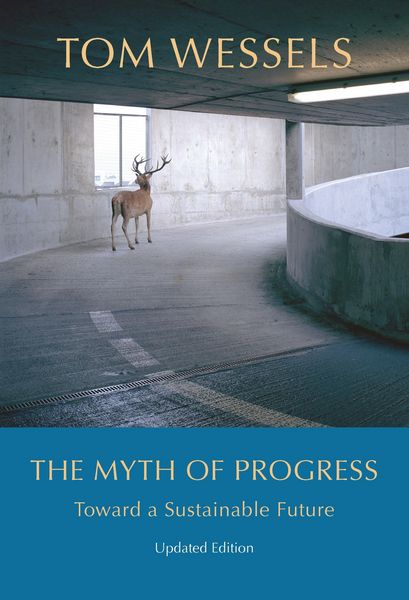
Myth of Progress
Fr. 35.90
inkl. gesetzl. MwSt.Beschreibung
Produktdetails
Format
ePUB
Kopierschutz
Ja
Family Sharing
Ja
Text-to-Speech
Ja
Erscheinungsdatum
09.05.2023
Verlag
Brandeis University PressSeitenzahl
184 (Printausgabe)
Dateigröße
741 KB
Sprache
Englisch
EAN
9781684581535
A powerful argument that our current path toward progress, based on continual economic expansion and inefficient use of resources, runs contrary to three foundational scientific laws. In this compelling, cogently argued, and acclaimed book, Tom Wessels demonstrates how our current path toward progress, based on continual economic expansion and inefficient use of resources, runs contrary to three foundational scientific laws that govern all complex natural systems. It is a myth, he contends, that progress depends on a growing economy. Wessels explains his theory with his three laws of sustainability: the law of limits to growth; the second law of thermodynamics, which exposes the dangers of increased energy consumption; and the law of self-organization, which results in the marvelous diversity of such highly evolved systems as the human body and complex ecosystems. Wessels argues that these laws, scientifically proven to sustain life in its myriad forms, have been cast aside since the eighteenth century, first by Western economists, political pragmatists, and governments attracted by the idea of unlimited growth, and more recently by a global economy dominated by large corporations, in which consolidation and oversimplification have created large-scale inefficiencies in both material and energy usage. Wessels makes scientific theory readily accessible by offering examples of how the laws of sustainability function in the complex systems we can observe in the natural world around us. Demonstrating that all environmental problems have their source in a disregard for the laws of sustainability, he concludes with an impassioned argument for cultural change. This new edition has a new preface wherein the author regards The Myth of Progress as his most important work. It has been in constant demand since it was first published in 2006.
Kundinnen und Kunden meinen
Verfassen Sie die erste Bewertung zu diesem Artikel
Helfen Sie anderen Kund*innen durch Ihre Meinung