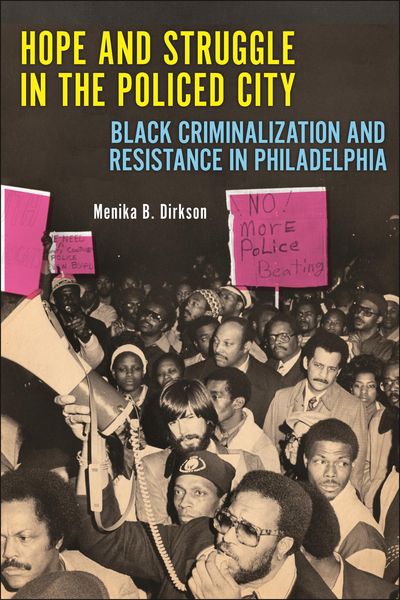
Hope and Struggle in the Policed City Black Criminalization and Resistance in Philadelphia
Fr. 34.90
inkl. gesetzl. MwSt.Beschreibung
Produktdetails
Format
ePUB
Kopierschutz
Nein
Family Sharing
Nein
Text-to-Speech
Ja
Erscheinungsdatum
23.07.2024
Verlag
Princeton University PressSeitenzahl
(Printausgabe)
Sprache
Englisch
EAN
9781479823994
Honorable Mention, 2025 Joe Trotter First Book Award, given by the Urban History Association
Explores how concerns about poverty-induced Black crime cultivated by police, journalists, and city officials sparked a rise in tough-on-crime policing in Philadelphia
During the Great Migration of African Americans to the North, Philadelphia's police department, journalists, and city officials used news media to create and reinforce narratives that criminalized Black people and led to police brutality, segregation, and other dehumanizing consequences for Black communities. Over time, city officials developed a system of racial capitalism in which City Council financially divested from social welfare programs and instead invested in the police department, promoting a "tough on crime" policing program that generated wealth for Philadelphia's tax base in an attempt to halt white flight from the city.
Drawing from newspapers, census records, oral histories, interviews, police investigation reports, housing project pamphlets, maps, and more, Hope and Struggle in the Policed City draws the connective line between the racial bias African Americans faced as they sought opportunity in the North and the over-policing of their communities, of which the effects are still visible today. Menika B. Dirkson posits that the tough-on-crime framework of this time embedded itself within every aspect of society, leading to enduring systemic issues of hyper-surveillance, the use of excessive force, and mass incarceration.
Hope and Struggle in the Policed City makes important contributions to our understanding of how a city government's budgetary strategy can function as racial capitalism that relies on criminal scapegoating. Most cogently, it illustrates how this perpetuates the cycle of poverty-induced crime, inflates rates of incarceration and police brutality, and marginalizes poor people of color.
Kundinnen und Kunden meinen
Verfassen Sie die erste Bewertung zu diesem Artikel
Helfen Sie anderen Kund*innen durch Ihre Meinung