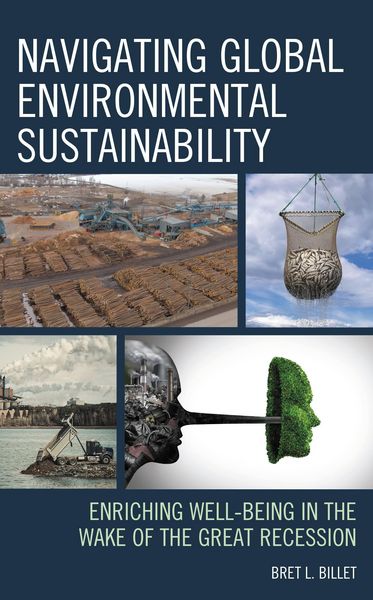
Navigating Global Environmental Sustainability Enriching Well-Being in the Wake of the Great-Recession
-
Form:Einzelkauf Download
-
Sprache:Englisch
-
eBook Format:ePUB
- PDF Fr. 100.90
- ePUB Fr. 100.90 ausgewählt
Fr. 100.90
inkl. gesetzl. MwSt.Beschreibung
Produktdetails
Format
ePUB
Kopierschutz
Ja
Family Sharing
Nein
Text-to-Speech
Ja
Erscheinungsdatum
22.08.2023
Verlag
Bloomsbury eBooks USSeitenzahl
270 (Printausgabe)
Auflage
1. Auflage
Sprache
Englisch
EAN
9781498579582
The Great Recession provided an opportunity to reconsider how to simultaneously enhance the well-being of individuals, corporations, countries, and the global environment. A half-century of vital environmental data demands examining several questions pertaining to the impact of a recession on sustainable environmental consumption. Does a recession provide an occasion for productive dialogue that might reconcile the ostensible incompatibility of economic and ecological rationales? Does it constitute an artificial "turning point" whereby appropriate incentives may induce productive change? Are post-recession environmental consumption patterns indicative of government encouragement, and corporate willingness, to pursue transformative environmental technologies? Alternatively, are the patterns illustrative of countries transferring their environmental consumption to other countries via international trade?
Bret L. Billet argues that the simultaneous investigation of both the Ecological Modernization theory and the Ecological Unequal Exchange theory strengthens the present quantitative analysis, enhancing understanding of the recession, well-being, sustainable environment nexus. Each ecological theory is rooted in the politicized evolution of traditional theories of economic development. The introduction of an Aristotelean conception of development as well-being, an exceptionally large number of cases, and the analysis of multiple country subsets, results in a more robust inquiry as to the impact of the Great Recession on the global sustainable environment.
Bret L. Billet argues that the simultaneous investigation of both the Ecological Modernization theory and the Ecological Unequal Exchange theory strengthens the present quantitative analysis, enhancing understanding of the recession, well-being, sustainable environment nexus. Each ecological theory is rooted in the politicized evolution of traditional theories of economic development. The introduction of an Aristotelean conception of development as well-being, an exceptionally large number of cases, and the analysis of multiple country subsets, results in a more robust inquiry as to the impact of the Great Recession on the global sustainable environment.
Kundinnen und Kunden meinen
Verfassen Sie die erste Bewertung zu diesem Artikel
Helfen Sie anderen Kund*innen durch Ihre Meinung