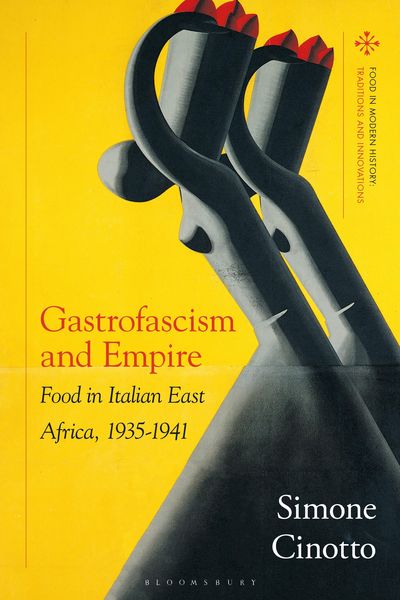
Gastrofascism and Empire Food in Italian East Africa, 1935-1941
-
- Hardcover ausgewählt
- Taschenbuch
- eBook
-
Sprache:Englisch
Fr. 143.00
inkl. gesetzl. MwSt.,
Beschreibung
Produktdetails
Einband
Gebundene Ausgabe
Erscheinungsdatum
05.09.2024
Herausgeber
Peter Scholliers + weitereVerlag
Bloomsbury AcademicSeitenzahl
320
Maße (L/B/H)
23.6/15.6/2.4 cm
Gewicht
617 g
Sprache
Englisch
ISBN
978-1-350-43683-1
Food stood at the centre of Mussolini's attempt to occupy Ethiopia and build an Italian Empire in East Africa. Seeking to redirect the surplus of Italian rural labor from migration overseas to its own Empire, the fascist regime envisioned transforming Ethiopia into Italy's granary to establish self-sufficiency, demographic expansion and strengthen Italy's international political position. While these plans failed, the extensive food exchanges and culinary hybridizations between Ethiopian and Italian food cultures thrived, and resulted in the creation of an Ethiopian-Italian cuisine, a taste of Empire at the margins. In studying food in short-lived Italian East Africa, Gastrofascism and Empire breaks significant new ground in our understanding of the workings of empire in the circulation of bodies, foodways, and global practices of dependence and colonialism, as well as the decolonizing practices of indigenous food and African anticolonial resistance. In East Africa, Fascist Italy brought older imperial models of global food to a hypermodern level in all its political, technoscientific, environmental, and nutritional aspects. This larger story of food sovereignty-entered in racist, mass settler colonialism-is dramatically different from the plantation and trade colonialisms of other empires and has never been comprehensively told. Using an original decolonizing food studies approach and an unprecedented variety of unexplored Ethiopian and Italian sources, Cinotto describes the different meanings of different foods for different people at different points of the imperial food chain. Exploring the subjectivities, agencies and emotions of Ethiopian and Italian men and women, it goes beyond simple colonizer/colonized binaries and offers a nuanced picture of lived, multisensorial experiences with food and empire.
Noch keine Bewertungen vorhanden
Verfassen Sie die erste Bewertung zu diesem Artikel
Helfen Sie anderen Kundinnen und Kunden durch Ihre Meinung.