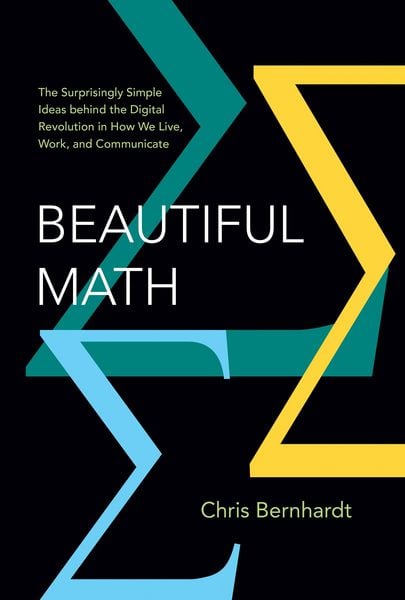
Beautiful Math The Surprisingly Simple Ideas behind the Digital Revolution in How We Live, Work, and Communicate
-
- Hardcover
- Taschenbuch
- eBook ausgewählt
-
Form:Einzelkauf Download
-
Sprache:Englisch
Fr. 30.90
inkl. gesetzl. MwSt.Beschreibung
Produktdetails
Format
ePUB 3
Kopierschutz
Ja
Family Sharing
Ja
Text-to-Speech
Ja
Erscheinungsdatum
17.09.2024
Verlag
Mit PressSeitenzahl
240 (Printausgabe)
Dateigröße
3736 KB
Sprache
Englisch
EAN
9780262380744
From the bestselling author of Quantum Computing for Everyone, a concise, accessible, and elegant approach to mathematics that not only illustrates concepts but also conveys the surprising nature of the digital information age.
Most of us know something about the grand theories of physics that transformed our views of the universe at the start of the twentieth century: quantum mechanics and general relativity. But we are much less familiar with the brilliant theories that make up the backbone of the digital revolution. In Beautiful Math, Chris Bernhardt explores the mathematics at the very heart of the information age. He asks questions such as: What is information? What advantages does digital information have over analog? How do we convert analog signals into digital ones? What is an algorithm? What is a universal computer? And how can a machine learn?
The four major themes of Beautiful Math are information, communication, computation, and learning. Bernhardt typically starts with a simple mathematical model of an important concept, then reveals a deep underlying structure connecting concepts from what, at first, appear to be unrelated areas. His goal is to present the concepts using the least amount of mathematics, but nothing is oversimplified. Along the way, Bernhardt also discusses alphabets, the telegraph, and the analog revolution; information theory; redundancy and compression; errors and noise; encryption; how analog information is converted into digital information; algorithms; and, finally, neural networks. Historical anecdotes are included to give a sense of the technology at that time, its impact, and the problems that needed to be solved.
Taking its readers by the hand, regardless of their math background, Beautiful Math is a fascinating journey through the mathematical ideas that undergird our everyday digital interactions.
Most of us know something about the grand theories of physics that transformed our views of the universe at the start of the twentieth century: quantum mechanics and general relativity. But we are much less familiar with the brilliant theories that make up the backbone of the digital revolution. In Beautiful Math, Chris Bernhardt explores the mathematics at the very heart of the information age. He asks questions such as: What is information? What advantages does digital information have over analog? How do we convert analog signals into digital ones? What is an algorithm? What is a universal computer? And how can a machine learn?
The four major themes of Beautiful Math are information, communication, computation, and learning. Bernhardt typically starts with a simple mathematical model of an important concept, then reveals a deep underlying structure connecting concepts from what, at first, appear to be unrelated areas. His goal is to present the concepts using the least amount of mathematics, but nothing is oversimplified. Along the way, Bernhardt also discusses alphabets, the telegraph, and the analog revolution; information theory; redundancy and compression; errors and noise; encryption; how analog information is converted into digital information; algorithms; and, finally, neural networks. Historical anecdotes are included to give a sense of the technology at that time, its impact, and the problems that needed to be solved.
Taking its readers by the hand, regardless of their math background, Beautiful Math is a fascinating journey through the mathematical ideas that undergird our everyday digital interactions.
Kundinnen und Kunden meinen
Verfassen Sie die erste Bewertung zu diesem Artikel
Helfen Sie anderen Kund*innen durch Ihre Meinung