• Produktbild: Pulsed Laser-Induced Nanostructures in Liquids for Energy and Environmental Applications
  • Produktbild: Pulsed Laser-Induced Nanostructures in Liquids for Energy and Environmental Applications

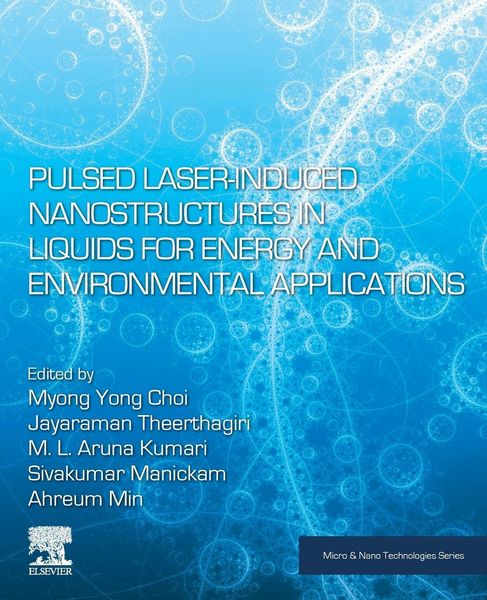
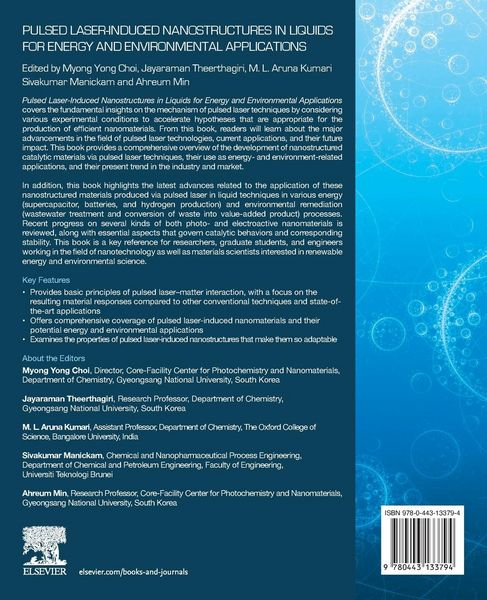
Pulsed Laser-Induced Nanostructures in Liquids for Energy and Environmental Applications

Fr. 289.00

inkl. gesetzl. MwSt., Versandkostenfrei


Beschreibung

Produktdetails

Einband

Taschenbuch

Erscheinungsdatum

19.07.2024

Herausgeber

Myong Yong Choi + weitere

Verlag

Elsevier Science & Technology

Seitenzahl

338

Maße (L/B/H)

23.5/19.1/1.8 cm

Gewicht

583 g

Sprache

Englisch

ISBN

978-0-443-13379-4

Beschreibung

Portrait

Myong Yong Choi is Professor and Chair of the Graduate School of the Department of Chemistry at Gyeongsang National University, South Korea. He is also the Director of the Core-Facility Center for Photochemistry and Nanomaterials, and also one of the Program Managers at the National Research Foundation of Korea. Professor Choi and his research team have developed a number of novel techniques based on laser process to characterize and produce numerous metal nanoparticles, alloys, composites, and coordination polymers, in addition to major contributions to the fields of spectroscopy, sensors, and catalysis.Dr. Theerthagiri Jayaraman is a Brain Pool Fellow in the Department of Chemistry, Gyeongsang National University, South Korea, since August 2019. He worked as a Scientist-C/Assistant Professor in the Centre of Excellence for Energy Research, Centre for Nanoscience and Nanotechnology Sathyabama Institute of Science and Technology, Chennai, India, from May-2017 to July-2019. He received his B.Sc Degree in Chemistry from Sacred Heart College in 2009 and M.Sc Degree in Chemistry from Ramakrishna Mission Vivekananda College in 2011. He completed his Ph.D. Degree in the Department of Chemistry, Thiruvalluvar University in March 2017. His current research focuses on developing electrocatalysts for energy applications, Pt-free counter electrode materials for dye-sensitized solar cells, polymer electrolytes, and catalysis for energy and environmental remediations. He has published more than 120 research articles in peer-reviewed journals and 9 book chapters.Dr. M. L. Aruna Kumari is an Assistant Professor at the Department of Chemistry, Oxford College of Science, India. She obtained her bachelor's degree in chemistry from Tumkur University in 2009 and master's degree in Organic Chemistry from Kuvempu University in 2011. She received her Doctoral degree from Bangalore University in 2017. Her current research focuses on photocatalytic organic transformations, synthesis of metal oxides and its organic/inorganic hybrids for energy and environmental application and developing Advanced Oxidation Processes (AOP's) for the removal of antibacterial and antimicrobial resistant organism from water. She published several research articles and book chapters of scientific repute.Prof. Sivakumar Manickam (Siva) is a chemical engineer with over 25 years of experience in nanomaterials, nanopharmaceuticals, and process engineering. Currently at the University of Technology Brunei, he previously worked at the University of Nottingham Malaysia, serving in leadership roles including Director of Research and founding director of the Centre for Nanotechnology. His research focuses on cavitation reactors, natural product extraction, water treatment, pharmaceutical nanoemulsions, and biosensors. He has authored over 250 papers, supervised 50+ students, and received numerous awards. He is also an executive editor of Ultrason Sonochem.Dr. Ahreum Min is a research professor in the Core-Facility Center for Photochemistry & Nanomaterials, Gyeongsang National University, South Korea. She received her MSc and Ph.D. degrees in Physical Chemistry from Gyeongsang National University in 2011 and 2016, respectively. She worked as a post-doctoral researcher at the department of chemistry, Chungbuk National University, South Korea, and at the University of Hawaii, USA. Her research interests are mainly focused on the photochemistry and development of multi-spectroscopic analysis methods in the gas phase and condensed phase.

Produktdetails

Einband

Taschenbuch

Erscheinungsdatum

19.07.2024

Herausgeber

Verlag

Elsevier Science & Technology

Seitenzahl

338

Maße (L/B/H)

23.5/19.1/1.8 cm

Gewicht

583 g

Sprache

Englisch

ISBN

978-0-443-13379-4

EU-Ansprechpartner

Kolibri 360 GmbH
Ettore-Bugatti-Straße 6-14
51149 Köln
DE
produktsicherheit@kolibri360.de

Herstelleradresse

Elsevier Science & Technology
London Wall 125
EC2Y 5AS London
GB
tradeorders@elsevier.com

Noch keine Bewertungen vorhanden

Verfassen Sie die erste Bewertung zu diesem Artikel

Helfen Sie anderen Kundinnen und Kunden durch Ihre Meinung.

Kundinnen und Kunden meinen

Bewertungen (0)

Die Leseprobe wird geladen.
  • Produktbild: Pulsed Laser-Induced Nanostructures in Liquids for Energy and Environmental Applications
  • Produktbild: Pulsed Laser-Induced Nanostructures in Liquids for Energy and Environmental Applications
  • Part I - Fundamentals
    1. Functional nanostructured materials and processes: an introduction
    2. Progress of laser-assisted methodologies and their advantages
    3. Pulsed laser-induced nanostructures in liquids: fundamental understanding of the formation mechanism
    4. Influence of laser parameters and experimental conditions on the formation of nanostructured materials

    Part II - Wastewater treatment
    5. Metal nanoparticles and alloys produced by pulsed laser ablation in liquids for photocatalytic remediation
    6. Metal nanoparticles and alloys produced by pulsed laser irradiation in liquids for photocatalytic remediation
    7. Semiconductor metal oxides synthesized via pulsed laser ablation in liquids for photocatalytic remediation
    8. Semiconductor metal oxides synthesized via pulsed laser irradiation in liquids for photocatalytic remediation
    9. Nonoxide materials produced by pulsed laser process for photocatalytic remediation

    Part III - Energy
    10. Metal nanoparticles and alloys produced by pulsed laser ablation in liquids for water splitting
    11 Metal nanoparticles and alloys produced by pulsed laser irradiation in liquids for water splitting
    12. Semiconductor metal oxide2based electrocatalysts produced by pulsed laser process in liquids for water splitting
    13. Nonoxide materials produced by pulsed laser process for electrocatalytic water splitting

    Part IV - Bio and environment
    14. Pulsed laser-produced nanomaterials in liquids for sensors
    15. Pulsed laser-produced nanomaterials in liquids for biomedical applications

    Part V - Future prospects
    16. Future prospects of pulsed laser techniques for advanced nanomaterials