Gutscheinbedingungen

*Gültig bis 07.06.2026 auf (fast) alles. Ausgeschlossen sind Smartboxen, Zeitschriften, Tickets, Lebensmittel, Gaming-Elektroartikel, Tinte/Toner, Gutscheine, Geschenkkarten, Blumen und Abos | Einlösbar in allen Buchhandlungen von Orell Füssli, Barth Bücher, Buchladen Rapunzel, Schuler Orell Füssli, Stauffacher und ZAP unter Vorweisung des Gutscheins, auf www.orellfüssli.ch durch Eingabe des Gutscheincodes. Beim Service „eBooks verschenken“ und bei eBook-Käufen via eReader nicht einlösbar | Mindesteinkaufswert: Fr. 100.- | Nicht mit anderen Rabatten kumulierbar.

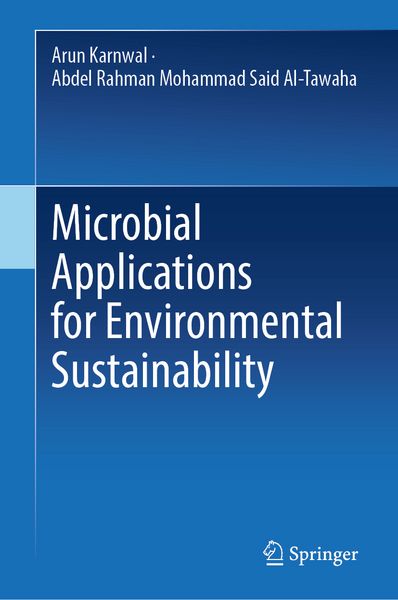
  • Produktbild: Microbial Applications for Environmental Sustainability
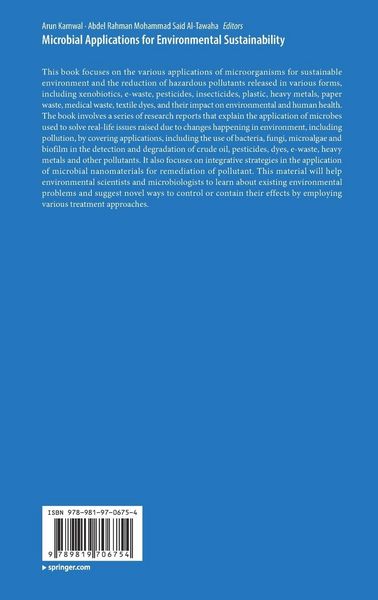
  • Produktbild: Microbial Applications for Environmental Sustainability

Microbial Applications for Environmental Sustainability

Fr. 218.00

inkl. gesetzl. MwSt., Versandkostenfrei


Beschreibung

Produktdetails

Einband

Gebundene Ausgabe

Erscheinungsdatum

14.05.2024

Herausgeber

Arun Karnwal + weitere

Verlag

Springer Singapore

Seitenzahl

343

Maße (L/B/H)

24.1/16/2.5 cm

Gewicht

643 g

Auflage

1. Auflage

Sprache

Englisch

ISBN

978-981-9706-75-4

Beschreibung

Portrait

Prof. Arun Karnwal is an accomplished Professor of Microbiology at Lovely Professional University in Punjab, India, with a wealth of experience spanning over 19 years in academia and research. He is a highly qualified academic, having received his B.Sc. (Hons.) in Industrial Microbiology, M.Sc. in Microbiology, and Ph.D. in Microbiology from Gurukul Kangri Vishwavidyalaya, Uttarakhand, India. He has authored over 100 peer-reviewed articles, book chapters and edited books from prestigious publishers. His research interests lie in diverse areas of microbiology, including abiotic stress responses in plants, biopolymer production and application, and microbial application in dietary products. He actively engages in research projects in these areas and has contributed significantly to advancing knowledge. Prof. Karnwal received the Research Appreciation Awards from Lovely Professional University in 2019, 2020, and 2021 for outstanding research performance. He holds positions on the Editorial Boards of several esteemed journals that are listed on Scopus/WOS. Furthermore, he has been serving as the president of LPU-Association of Microbiologist of India UNIT since its establishment at Lovely Professional University. Additionally, he is a participating member of several scientific societies, including the Association of Microbiologists of India, the Hong Kong Chemical, Biological & Environmental Engineering Society, the International Association for Agricultural Sustainability, and the Indian Science Congress. His contributions to microbiology research, particularly in agricultural and environmental sustainability, have been widely recognized and appreciated. Prof. Karnwal's work has significant implications for industry, agriculture, and the environment, as he seeks to bridge the gap between research and practical applications. His contributions have enhanced our understanding of the role of microbiology in addressing pressing global challenges, such as climate change and food security, and he continues to inspire young researchers to pursue careers in microbiology.

Abdel Rahman Mohammad Al-Tawaha, PhD , is  Full Professor of Plant Science and former Head of the Department of Biological Sciences as well as former Director of the Planning, Information and Quality Unit at Al Hussein Bin Talal University, Jordan. He is author/coauthor of more than 300 publications in plant science in leading peer-reviewed journals and chapters in edited volumes and books on a broad range of development issues. He is also participated in many international conferences as chair or member of the scientific committees. Dr. Al-Tawaha obtained his PhD from McGill University, Montreal, Canada.


Produktdetails

Einband

Gebundene Ausgabe

Erscheinungsdatum

14.05.2024

Herausgeber

Verlag

Springer Singapore

Seitenzahl

343

Maße (L/B/H)

24.1/16/2.5 cm

Gewicht

643 g

Auflage

1. Auflage

Sprache

Englisch

ISBN

978-981-9706-75-4

Herstelleradresse

Springer-Verlag GmbH
Tiergartenstr. 17
69121 Heidelberg
DE

Email: ProductSafety@springernature.com

Kundinnen und Kunden meinen

0 Bewertungen

Informationen zu Bewertungen

Zur Abgabe einer Bewertung ist eine Anmeldung im Konto notwendig. Die Authentizität der Bewertungen wird von uns nicht überprüft. Wir behalten uns vor, Bewertungstexte, die unseren Richtlinien widersprechen, entsprechend zu kürzen oder zu löschen.

Die Bewertungen sind nach Format, Anzahl Sterne und Datum sortiert.

Verfassen Sie die erste Bewertung zu diesem Artikel

Helfen Sie anderen Kund*innen durch Ihre Meinung

Kundinnen und Kunden meinen

0 Bewertungen filtern

  • Produktbild: Microbial Applications for Environmental Sustainability
  • Produktbild: Microbial Applications for Environmental Sustainability
  • Chapter 1 Microbes For Sustainable Development Of Environmental Issues.- Chapter 2 Harnessing Microbial Solutions For Sustainable Food And Environmental Security.- Chapter 3 Microbial Technology: Tools For Waste Management; Environmental Sustainability and Environmental Safety.- Chapter 4 Microbial Meditated Remediation Of Crude Oil-Contaminated Soil.- Chapter 5 Microbial Degradation Of Pesticides In The Environment .- Chapter 6 Plastisphere: Marine Microbial Assemblages For Biodegradation Of Microplastics.- Chapter 7 Plastisphere: Marine Microbial Assemblages For Biodegradation Of Microplastics.- Chapter 8 Microbial Processes Of Reducing E-Waste Pollution.- Chapter 9 Microbial  Enzymes For Eco-Friendly Recycling Of Waste Paper By Deinkin.- Chapter 10 The Potential and Reality of Agricultural Wastewater Reuse.- Chapter 12 Microbial Manganese Peroxidase: Ligninolytic Enzymes For Bioremediation.- Chapter 13 Biofilm- Mediated Heavy Metals Bioremediation.- Chapter 14 Rhizospheric Microbes: A Promising Resource For Bioremediation And Agricultural Productivity.- Chapter 13 Microbial Nanotechnology: Nanoparticles For Bioremediation Of Toxic Pollutants.- Chapter 15 Phytoremediation: A Clean And Green Approach For Heavy Metal Remediation.- Chapter 16 Second Generation Biofuels: Concepts, Applications, And Challenges.- Chapter 17 Third Generation Biofuels: A Promising Approach For Environmental Sustainability.- Chapter 18 The utilization of microorganisms for the sustainable development of environmental issues.- Chapter 19 Microorganisms for the promotion of sustainable development in the context of environmental challenges.