Generative AI for Effective Software Development
-
- Taschenbuch ausgewählt
- eBook
-
Sprache:Englisch
Fr. 181.00
inkl. gesetzl. MwSt.,
Beschreibung
Produktdetails
Einband
Taschenbuch
Erscheinungsdatum
01.06.2024
Herausgeber
Anh Nguyen-Duc + weitereVerlag
SpringerSeitenzahl
346
Maße (L/B/H)
23.5/15.5/2 cm
Gewicht
546 g
Sprache
Englisch
ISBN
978-3-031-55641-8
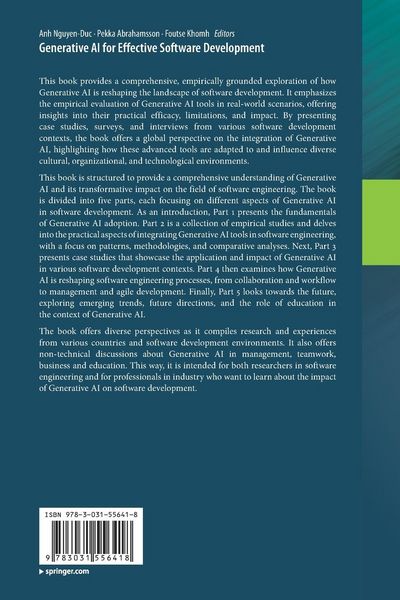
This book provides a comprehensive, empirically grounded exploration of how Generative AI is reshaping the landscape of software development. It emphasizes the empirical evaluation of Generative AI tools in real-world scenarios, offering insights into their practical efficacy, limitations, and impact. By presenting case studies, surveys, and interviews from various software development contexts, the book offers a global perspective on the integration of Generative AI, highlighting how these advanced tools are adapted to and influence diverse cultural, organizational, and technological environments.
This book is structured to provide a comprehensive understanding of Generative AI and its transformative impact on the field of software engineering. The book is divided into five parts, each focusing on different aspects of Generative AI in software development. As an introduction, Part 1 presents the fundamentals of Generative AI adoption. Part 2 is a collection of empirical studies and delves into the practical aspects of integrating Generative AI tools in software engineering, with a focus on patterns, methodologies, and comparative analyses. Next, Part 3 presents case studies that showcase the application and impact of Generative AI in various software development contexts. Part 4 then examines how Generative AI is reshaping software engineering processes, from collaboration and workflow to management and agile development. Finally, Part 5 looks towards the future, exploring emerging trends, future directions, and the role of education in the context of Generative AI.
The book offers diverse perspectives as it compiles research and experiences from various countries and software development environments. It also offers non-technical discussions about Generative AI in management, teamwork, business and education. This way, it is intended for both researchers in software engineering and for professionals in industry who want to learn about the impactof Generative AI on software development.
Noch keine Bewertungen vorhanden
Verfassen Sie die erste Bewertung zu diesem Artikel
Helfen Sie anderen Kundinnen und Kunden durch Ihre Meinung.