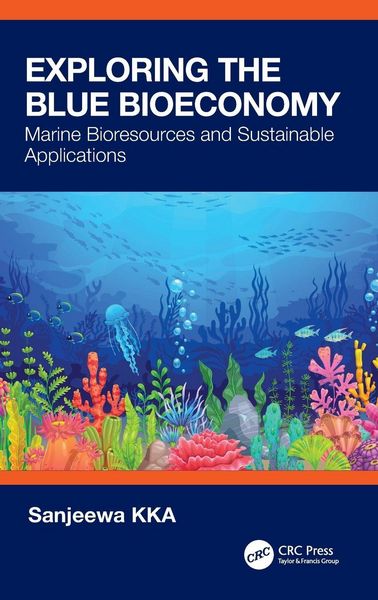
Exploring the Blue Bioeconomy Marine Bioresources and Sustainable Applications
Fr. 173.00
inkl. gesetzl. MwSt.,
Beschreibung
Produktdetails
Einband
Gebundene Ausgabe
Erscheinungsdatum
28.08.2024
Abbildungen
schwarz-weiss Illustrationen, Zeichnungen, schwarz-weiss, Tabellen, schwarz-weiss
Verlag
Taylor & FrancisSeitenzahl
184
Maße (L/B/H)
24/16.1/1.3 cm
Gewicht
500 g
Sprache
Englisch
ISBN
978-1-03-276166-4
Exploring the Blue Bioeconomy: Marine Bioresources and Sustainable Applications provides an overview of marine bioresources in the blue bioeconomy. The book delivers potential applications of marine macro- and microorganisms in different industries such as biomedical, functional food, pharmaceutical, cosmeceutical, ecotourism, industrially important minerals, and enzymes. Aside from the potential industrial applications, the book gives readers an overview of conversion and sustainable utilization techniques for marine bioresources.
Key Features
- Discusses the major sectors associated with the blue bioeconomy and the future potential of each industry for both developed and developing countries.
- Covers the most important aspects of seaweeds with respect to commercialization and conservation, including botanical information.
- Includes a discussion about potential future applications of marine microorganisms in the blue bioeconomy with research highlights.
- Explores the potential industrial applications of marine nematodes and their roles in future agriculture and heavy metal remediation applications.
- Summarizes circular economy principles, upcycling, and recycling approaches to marine litter management under the context of the blue bioeconomy.
The book begins by providing an overview of the blue bioeconomy and then advances through the chapters to discuss potential industries, organisms, and conservation techniques to protect ecosystems and associated organisms from overharvesting and pollution. Thus, readers with any level of educational background can easily understand the content. The text of this book is suitable for undergraduates, postgraduates, industrialists, and policymakers working in the different fields of blue bioeconomy.
Noch keine Bewertungen vorhanden
Verfassen Sie die erste Bewertung zu diesem Artikel
Helfen Sie anderen Kundinnen und Kunden durch Ihre Meinung.