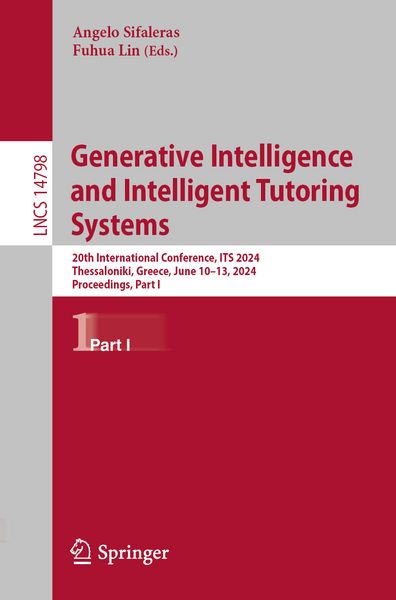
Produktbild: Generative Intelligence and Intelligent Tutoring Systems
Band 14798

Generative Intelligence and Intelligent Tutoring Systems 20th International Conference, ITS 2024, Thessaloniki, Greece, June 10–13, 2024, Proceedings, Part I

Fr. 191.00

inkl. gesetzl. MwSt., Versandkostenfrei


Beschreibung

Produktdetails

Einband

Taschenbuch

Erscheinungsdatum

06.06.2024

Abbildungen

XXVII, 427 p. 123 illus., 80 illus. in color.

Herausgeber

Angelo Sifaleras + weitere

Verlag

Springer

Seitenzahl

427

Maße (L/B/H)

23.5/15.5/2.5 cm

Gewicht

686 g

Auflage

2024

Sprache

Englisch

ISBN

978-3-031-63027-9

Beschreibung

Produktdetails

Einband

Taschenbuch

Erscheinungsdatum

06.06.2024

Abbildungen

XXVII, 427 p. 123 illus., 80 illus. in color.

Herausgeber

Verlag

Springer

Seitenzahl

427

Maße (L/B/H)

23.5/15.5/2.5 cm

Gewicht

686 g

Auflage

2024

Sprache

Englisch

ISBN

978-3-031-63027-9

Herstelleradresse

Springer-Verlag KG
Sachsenplatz 4-6
1201 Wien
AT

Email: ProductSafety@springernature.com

Noch keine Bewertungen vorhanden

Verfassen Sie die erste Bewertung zu diesem Artikel

Helfen Sie anderen Kundinnen und Kunden durch Ihre Meinung.

Kundinnen und Kunden meinen

Bewertungen (0)

  • Produktbild: Generative Intelligence and Intelligent Tutoring Systems
  • .- Generative Intelligence and Tutoring Systems.

    .- Using Large Language Models to Support Teaching and Learning of Word Problem Solving in Tutoring Systems.

    .- A Generative Approach for Proactive Assistance Forecasting in Intelligent Tutoring Environments.

    .- Combined maps as a tool of concentration and visualization of knowledge in the logic of operation of the Intelligent Tutoring Systems.

    .- Fast Weakness Identification for Adaptive Feedback.

    .- QuizMaster: An Adaptive Formative Assessment System.

    .- Preliminary Systematic Review of Open-Source Large Language Models in Education.

    .- Jill Watson: Scaling and Deploying an AI Conversational Agent in Online Classrooms.

    .- Improving LLM Classification of Logical Errors by Integrating Error Relationship into Prompts.

    .- Enhancement of Knowledge Concept Maps Using Deductive Reasoning with Educational Data.

    .- Individualised Mathematical Task Recommendations through Intended Learning Outcomes and Reinforcement Learning.

    .- Developing Conversational Intelligent Tutoring for Speaking Skills in Second Language Learning.

    .- SAMI: An AI Actor for Fostering Social Interactions in Online Classrooms.

    .- Exploring the Methodological Contexts and Constraints of Research in Artificial Intelligence in Education.

    .- A Constructivist Framing of Wheel Spinning: Identifying Unproductive Behaviors with Sequence Analysis.

    .- Evaluating the ability of Large Language Models to generate motivational feedback.

    .- Towards Cognitive Coaching in Aircraft Piloting Tasks: Building an ACT-R Synthetic Pilot Integrating an Ontological Reference Model to Assist the Pilot and Manage Deviations.

    .- Impact of Conversational Agent Language and Text Structure on Student Language.

    .- Analyzing the role of Generative AI in fostering self-directed learning through Structured prompt engineering.

    .- Detecting Function Inputs and Outputs for Learning-Problem Generation in Intelligent Tutoring Systems.

    .- Automated Analysis of Algorithm Descriptions Quality, through Large Language Models.

    .- An AI-Learner Shared Control Model Design for Adaptive Practicing.

    .- Early Math Skill as a Predictor for Foundational Literacy.

    .- Explaining Problem Recommendations in an Intelligent Tutoring System.

    .- Distributed Feedback in a Tool that Supports Peer-directed Simulation-based Training.

    .- Keeping Humans in the Loop: LLM supported Oral Examinations.

    .- Generating Learning Sequences Using Contextual Bandit Algorithms.

    .- A Generative Artificial Intelligence empowered chatbot: System usability and student teachers’ experience.

    .- Predicting Rough Error Causes in Novice Programmers using Cognitive Level.

    .- Social AI Agents Too Need to Explain Themselves.

    .- Students’ Perceptions of Adopting Learning Analytics.

    .- AI4LA: an Intelligent Chatbot for Supporting Dyslexic Students, Based on Generative AI.

    .- EvaAI: A Multi-Agent Framework Leveraging Large Language Models for Enhanced Automated Grading.

    .- Optimising a Peer based Learning Environment.

    .- Difficulty Estimation and Simplification of French Text Using Large Language Models.

    .- LLM-based Course Comprehension Evaluator.

    .- Exploring Item Difficulty Prediction: Data Driven Approach for Item Difficulty Estimation.