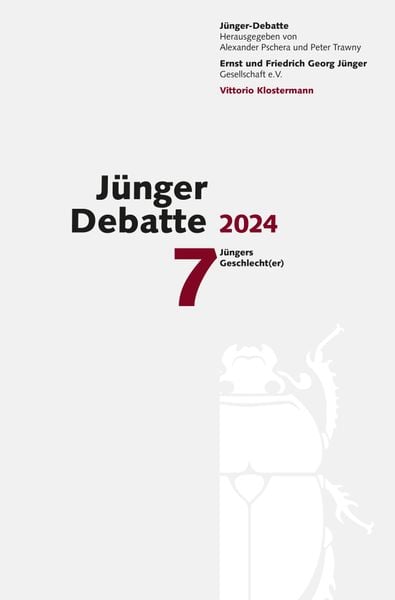
Jünger Debatte Band 7 (2024): Jüngers Geschlecht(er)
-
- Deutsch ausgewählt
-
Auflage:2024
- 2024 Fr. 57.90 ausgewählt
- 2022 Fr. 66.90
Fr. 57.90
inkl. gesetzl. MwSt.,
Beschreibung
Produktdetails
Einband
Taschenbuch
Erscheinungsdatum
27.06.2024
Herausgeber
Alexander Pschera + weitereVerlag
Klostermann, VittorioSeitenzahl
278
Maße (B/H)
15.5/23.5 cm
Gewicht
420 g
Auflage
2024
Sprache
Deutsch
ISBN
978-3-465-04660-8
Wer meint, Ernst Jünger würde oder könne nichts zum Geschlecht sagen, irrt. Das zeigt der siebte Band der "Jünger-Debatte", der, wie alle den Gebrüdern Jünger gewidmeten Jahrbücher, Vorträge, Aufsätze und Herausgaben von bisher Unediertem aus den Jünger’schen Nachlässen vereint. Ernst Jünger war an der Geschlechter-Frage in vielen Hinsichten interessiert. Geschlecht meint allerdings nicht nur Sexualität oder Gender, sondern gleichermassen Abstammung, Volk und Rasse. In all diesen Bedeutungen wendet sich Jünger ihm zu. Der Band wird eröffnet von einem Aufsatz der Literaturwissenschaftlerin Franziska Meier, die den Briefwechsel von Gretha und Ernst Jünger interpretiert, um herauszustellen, wie emanzipiert, aber auch wie verloren sich die Gattin an der Seite des berühmten Schriftstellers empfunden hat. Gabriele Kämper, Literaturwissenschaftlerin und Leiterin der Geschäftsstelle Gleichstellung im Berliner Senat, findet „Störzonen in Jüngers monolithischer Männlichkeit“. Andere Autorinnen wie Natalia Żaska, Giulia Iannucci sowie Marie Rotkopf, Autoren wie Peter Trawny, Helmuth Kiesel und Simon Unger vertiefen die Geschlechter-Mehrdeutigkeit in Jüngers Werk. Alexander Pschera und Franziska Meier präsentieren zum ersten Mal den Briefwechsel von Gretha Jünger mit der Schweizer Theaterkritikerin Elisabeth Brock-Sulzer, die sich literarisch mit den Jünger-Brüdern auseinandersetzte; ein Briefwechsel der, sich entfaltend zwischen 1938 und 1952, schwierige Themen wie die politische und vor allem menschliche Katastrophe der Deutschen berührt. Der Band schreibt so eine noch weiter auszuziehende Linie in der Jünger-Forschung fort, der es darum geht, Ernst Jünger als einen Autor zu erweisen, der in seinem unbestrittenen Konservativismus über einen Fundus verfügt, in dem er immer wieder überraschende Antworten auf modernste Fragen findet.
Assuming that Ernst Jünger would or could say nothing about gender is a mistake. This is shown in the seventh volume of the "Jünger Debatte". Ernst Jünger was interested in the question of gender in many respects. However, gender does not only mean sexuality or gender, but also descent, people and race. Jünger addresses the term in all these meanings. The volume opens with an essay by Franziska Meier, who interprets the correspondence between Gretha and Ernst Jünger in order to show how emancipated, but also how lost, she felt as the wife at the side of the famous writer. Gabriele Kämper finds "fault zones in Jünger's monolithic masculinity". Other authors such as Natalia Żaska, Giulia Iannucci and Marie Rotkopf, authors such as Peter Trawny, Helmuth Kiesel and Simon Unger delve deeper into the gender ambiguity in Jünger's work. Alexander Pschera and Franziska Meier present for the first time Gretha Jünger's correspondence with the Swiss theater critic Elisabeth Brock-Sulzer, who engaged with the Jünger brothers in a literary way; an exchange of letters that unfolds between 1938 and 1952 and touches on difficult topics such as the political and, above all, human catastrophe of the Germans. The volume thus continues a line of Jünger research that is still to be extended, which is concerned with proving Ernst Jünger to be an author who, in his undisputed conservatism, repeatedly finds surprising answers to the most modern questions.
Assuming that Ernst Jünger would or could say nothing about gender is a mistake. This is shown in the seventh volume of the "Jünger Debatte". Ernst Jünger was interested in the question of gender in many respects. However, gender does not only mean sexuality or gender, but also descent, people and race. Jünger addresses the term in all these meanings. The volume opens with an essay by Franziska Meier, who interprets the correspondence between Gretha and Ernst Jünger in order to show how emancipated, but also how lost, she felt as the wife at the side of the famous writer. Gabriele Kämper finds "fault zones in Jünger's monolithic masculinity". Other authors such as Natalia Żaska, Giulia Iannucci and Marie Rotkopf, authors such as Peter Trawny, Helmuth Kiesel and Simon Unger delve deeper into the gender ambiguity in Jünger's work. Alexander Pschera and Franziska Meier present for the first time Gretha Jünger's correspondence with the Swiss theater critic Elisabeth Brock-Sulzer, who engaged with the Jünger brothers in a literary way; an exchange of letters that unfolds between 1938 and 1952 and touches on difficult topics such as the political and, above all, human catastrophe of the Germans. The volume thus continues a line of Jünger research that is still to be extended, which is concerned with proving Ernst Jünger to be an author who, in his undisputed conservatism, repeatedly finds surprising answers to the most modern questions.
Noch keine Bewertungen vorhanden
Verfassen Sie die erste Bewertung zu diesem Artikel
Helfen Sie anderen Kundinnen und Kunden durch Ihre Meinung.