KI-Beratung Beta

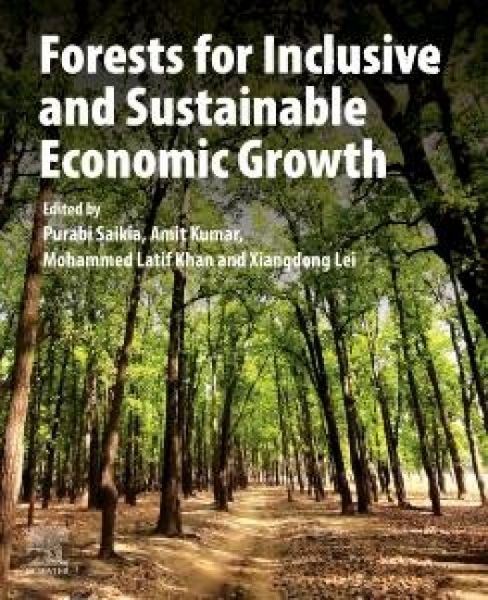
Produktbild: Forests for Inclusive and Sustainable Economic Growth

Forests for Inclusive and Sustainable Economic Growth

Fr. 229.00

inkl. gesetzl. MwSt., Versandkostenfrei


Beschreibung

Forests for Inclusive and Sustainable Economic Growth addresses all major issues surrounding forest resources, also including global examples, case studies, literature reviews, latest developments, and future research prospects. To enhance understanding, the content is enriched with maps, figures, tables,...

Beschreibung

Forests for Inclusive and Sustainable Economic Growth addresses all major issues surrounding forest resources, also including global examples, case studies, literature reviews, latest developments, and future research prospects. To enhance understanding, the content is enriched with maps, figures, tables, and colorful illustrations, making it accessible to a broad readership. Students specializing in forest ecology and researchers will discover a wealth of knowledge on critical topics such as major ecological disturbances, the role of forests in poverty reduction and livelihood security, as well as participatory forest management techniques, landscape restoration, forest policies, and nature-based solutions.
Importantly, this comprehensive volume highlights the pivotal role of forests in fostering employment, income generation, and food security to support inclusive and sustainable economic growth.

Portrait

Dr. Purabi Saikia is an Associate Professor at Banaras Hindu University, India, working in plant ecology, conservation of threatened species, plant-soil interactions, and ecosystem restoration across Indian forest ecosystems. She is an active member of the IUCN Commission on Ecosystem Management and the Global Forest Biodiversity Initiative. She is a recipient of the Vigyan Yuva-Shanti Swarup Bhatnagar Award 2024 in Environmental Science and the Assam Saurabh Award 2024. She has published extensively in leading journals including Nature, PNAS, and Nature Ecology & Evolution, and has edited or co-authored several books.

Dr. Amit Kumar is an Assistant Professor in the Department of Geoinformatics, Central University of Jharkhand, India. He is involved in interdisciplinary research with a focus on man-environment interaction, disaster risk and resilience, and climate change implications primarily in the urban milieu. His main areas of research are improving urban ecology through physio-socio-economic-hazard-risk investigations and methods to augment ecological quality using geoinformatics and machine learning techniques. He is engaged with various research projects including state-of-the-art LTEO projects of the Ministry of Environment, Forest and Climate Change; NASA-ISRO SAR; GISAT; and Airborne Hyperspectral Sensing missions. Dr Kumar has published over 60 research articles in various journals and books of international and national repute. He is a member of various academic societies including IUCN-Commission on Ecosystem Management (South Asia), National Association of Geographers India, and Global Forest Biodiversity Initiatives, USA.Dr. Mohamed Latif Khan is a Professor of Forestry and Coordinator of Scientific & Industrial Research Cell and also Deputy Coordinator of Bioinformatics Centre at North Eastern Regional Institute of Science & Technology (Deemed University), NIRJULI, Arunachal Pradesh. He is a plant ecologist and conservation biologist, obtained his doctoral degree from North Eastern Hill University, Shillong, India. His research interests have gradually expanded from tree regeneration to the fields of biodiversity conservation and eco-restoration. Dr. Khan is presently engaged in the studies on conservation and regeneration of endangered and medicinal plant species, inventory and analyses of biodiversity of sacred groves, exploration of germplasm of bamboo and cane species. Dr. Khan is also trained to study the phylogeny and genetic diversity of plant species. He has also been trained at Indian Institute of Remote Sensing, Dehra Dun for the application of remote sensing and GIS in biodiversity conservation. He also has research collaboration with Concordia University, Canada, Grand valley State University and Kansas University, USA. Through his research program, he has supervised twenty five undergraduate, five graduate and ten Ph. D. theses and currently he is supervising eight Ph.D. theses. He has contributed 103 peer-reviewed papers and 33 conference papers, invited presentations, and lectures. One book has also been co-edited by him. Dr. Khan is a recipient of prestigious Nanda Memorial Young Scientist Medal from the Indian Society for Tree Scientists for his outstanding research in the field of Forest Ecology and Biodiversity Conservation. He is a recipient of DST-BOYSCAST and DBT-Overseas fellowships in thrust area 'Biodiversity Conservation' and worked as visiting faculty at University of Massachusetts, Boston, USA, and Concordia University, Montreal, Canada.Xiangdong Lei is a professor of Forest management in the Institute of Forest Resource Information Techniques (IFRIT), Chinese Academy of Forestry (CAF). His research interests cover forest growth yield and modeling, multiple-functional forest management, and forest inventory. He had been as the Chief Technical Advisor of multiple use forestry demonstration project fund by the APFNet. He published more than 130 research papers and book chapters. He is the PI of national key R&D project "Forest site quality evaluation and muti-functional and full cycle forest management ".
Produktdetails

Einband

Taschenbuch

Erscheinungsdatum

21.05.2025

Herausgeber Purabi Saikia + weitere
Verlag Elsevier Science & Technology

Produktdetails

Einband

Taschenbuch

Erscheinungsdatum

21.05.2025

Herausgeber
Verlag Elsevier Science & Technology
Seitenzahl

550

Maße (L/B/H)

27.5/21.7/2.2 cm

Gewicht

1456 g

Sprache

Englisch

ISBN

978-0-443-31406-3

EU-Ansprechpartner

Elsevier B.V.
Radarweg 29
1043 NX Amsterdam
NL
productsafety@elsevier.com

Herstelleradresse

Elsevier Science & Technology
London Wall 125
EC2Y 5AS London
GB
tradeorders@elsevier.com

Noch keine Bewertungen vorhanden

Verfassen Sie die erste Bewertung zu diesem Artikel

Helfen Sie anderen Kundinnen und Kunden durch Ihre Meinung.

Kundinnen und Kunden meinen

Bewertungen (0)

Weitere Artikel finden Sie in

  • Produktbild: Forests for Inclusive and Sustainable Economic Growth
  • Section A: General Perspectives of Forests and Forest Resources
    1. An Introduction to Forests and Forest Resources
    2. Major Drivers of Deforestation and Forest Degradation
    3. Major Forest Carbon Stocks and Pools and their role in climate change mitigation
    4. Climate Change Impacts on Forests and Forest Resources
    5. Impacts of Land Use Change on Forest Biodiversity
    6. Forest fires and its impacts on Forest Biodiversity
    7. Invasive Plant Species and Altered Ecosystem Service

    Section B: Forest and Forest Resource Monitoring Methods
    8. Forest Monitoring Tools and Techniques
    9. Advanced Forest Monitoring Tools and Techniques
    10. Application of Molecular Phylogeny in determining the Evolutionary trends of Forest Species
    11. Species Distribution Models for Forest Conservation and Management
    12. Vegetation Indices and their uses to determine forest composition and health
    13. Forests and Forest Resources for Livelihood Security and Poverty Alleviation
    14. Forests and forest resources for Inclusive and Sustainable Economic growth
    15. Major Forest Biodiversity and Ecosystem Goods and Services
    16. Forest biodiversity and wildlife trading
    17. Forests and Forest Resources for Socioeconomic Development and Environmental Sustainability
    18. Forest Resources as an economic commodity and marketable goods
    19. Challenges and opportunities for balancing sustainability and economic activities in and around protected areas
    20. Role of Tree outside forests and Urban Forestry in Forests Management
    21. Management of Human-Wildlife Conflicts for Sustainable Forest Resource Conservation
    22. Sustainable Forests Management: Participatory Forests Management Strategies
    23. Policy Intervention for Forests and Forest Resource Conservation and Management
    24. Nature-based Solutions for Forests Management and Conservations