• Produktbild: Handbook of Chinese Language Learning and Technology
  • Produktbild: Handbook of Chinese Language Learning and Technology

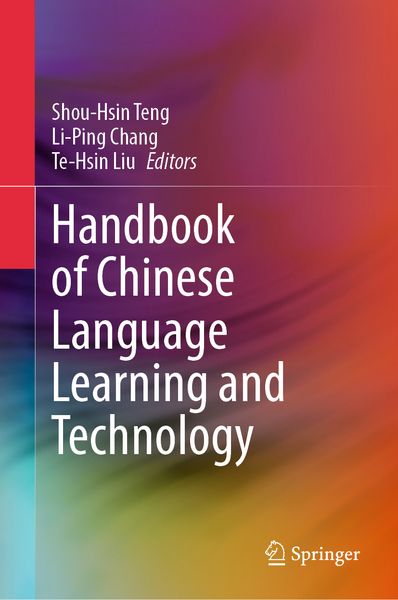
Handbook of Chinese Language Learning and Technology

Fr. 276.00

inkl. gesetzl. MwSt., Versandkostenfrei


Beschreibung

Produktdetails

Einband

Gebundene Ausgabe

Erscheinungsdatum

26.02.2025

Herausgeber

Shou-Hsin Teng + weitere

Verlag

Springer Singapore

Seitenzahl

502

Maße (L/B/H)

24.1/16/3.4 cm

Auflage

1. Auflage

Sprache

Englisch

ISBN

978-981-9759-29-3

Beschreibung

Portrait

Shou-hsin Teng is a native of Taiwan, educated in Taiwan (Tunghai), UK (Oxford) and USA (UC Berkeley). He taught Chinese as a second/foreign language at the University of Massachusetts, Amherst from 1973-1995. In 1995, he went to the National Taiwan Normal University to initiate the first graduate program/department in teaching Chinese as a second language. After retirement, he was invited to Chungyuan Christian University, Taiwan as a Chair Professor of L2 Chinese.  While Shou-hsin Teng was teaching in Massachusetts, his research activities publications focused on theoretical syntax and, after returning to Taiwan in 1995, his research and publications shifted from theoretical to applied linguistics and developed a framework of a pedagogical grammar of Chinese. He had been the editor-in-chief in developing A Course in Contemporary Chinese, a series of 6 textbooks, sponsored by the Mandarin Training Center, Taiwan Normal University and published by Linking Publishing Co., Taiwan in 2015 onward. 

Li-ping Chang is Associate Professor of the Graduate Program of Teaching Chinese as a Second Language at National Taiwan University (NTU). Before joining NTU in 2018, she worked at the Mandarin Training Center of National Taiwan Normal University, responsible for the editing of teaching materials and the

creating of the proficiency Test of Chinese as a Foreign Language (TOCFL). Her research focuses on pedagogical grammar, contrastive analysis of learner corpora, and corpus-assisted Chinese language  teaching.

Te-hsin Liu is Associate Professor at National Taiwan University. Originally trained as a theoretical phonologist, she also works on second language acquisition and construction grammar. She constructed a corpus on Chinese Idiomatic Constructions for research and pedagogical purpose, and is currently building an interlanguage corpus produced by Romance Language learners, investigating how L1 prosody influences the acquisition of Mandarin tones. 


Produktdetails

Einband

Gebundene Ausgabe

Erscheinungsdatum

26.02.2025

Herausgeber

Verlag

Springer Singapore

Seitenzahl

502

Maße (L/B/H)

24.1/16/3.4 cm

Auflage

1. Auflage

Sprache

Englisch

ISBN

978-981-9759-29-3

Herstelleradresse

Springer-Verlag KG
Sachsenplatz 4-6
1201 Wien
AT

Email: GPSR Kontakt

Noch keine Bewertungen vorhanden

Verfassen Sie die erste Bewertung zu diesem Artikel

Helfen Sie anderen Kundinnen und Kunden durch Ihre Meinung.

Kundinnen und Kunden meinen

Bewertungen (0)

  • Produktbild: Handbook of Chinese Language Learning and Technology
  • Produktbild: Handbook of Chinese Language Learning and Technology
  • Cognitive Relativism in Chinese Lexicon and Their Relevance for the Acquisition of Chinese.- The Markedness of Chinese Locative Existential Construction: Corpus and Experimental Evidence with Implications for L2 Learning.- Role of Prosodic Constraints on the Acquisition of Mandarin Tones by French Learners.- Preliminary Study of Corpus Literacy Training for In-service Chinese Language Teachers.- Salience, Contingency, and Learned Attention in CFL Construction Acquisition: Evidence from Two Corpus-based Studies on Chinese Verb Complements of Manner/State.- Ordering, Replacement and Omission Errors in Coordinate Compounds Among Learners of Mandarin as a Second Language.- Constructing a Cross-linguistic Lexical Comprehension Task in Mandarin.- Getting to Know ziji: Preliminary Findings from an ERP Study on Chinese Reflexive in L1 and L2.- Acquisition of Chinese Reflexive ziji by Learners of Typologically Different L1s.- Grammar in Syntactic Adaptations of Chinese: The State of the Art.- Tone Labeling for Mandarin Speech Corpus: A Deep Learning Iterative Approach.- Computational Learning of Constructions in Chinese.- Grammatical Error Correction and Explanation for Learners of Chinese Using Large Language Models.- Integrating Technology into Beginning Level CFL Students’ Tone Learning at the Curriculum Level.- Teachers’ Confidence in Applying Effective Principles for Online Teaching in a Teacher Training Program.- Teacher Feedback Types: Experienced vs. Novice Teachers in CSL Classrooms.