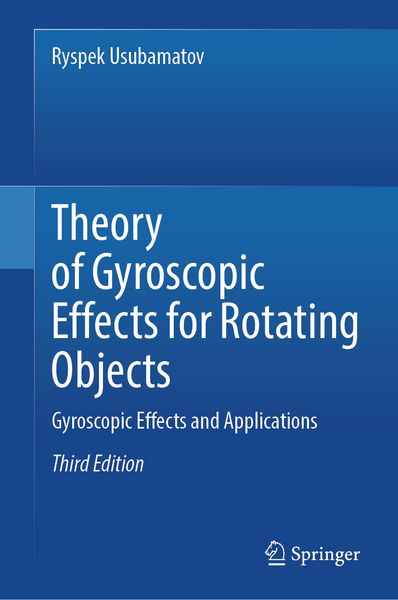
Theory of Gyroscopic Effects for Rotating Objects Gyroscopic Effects and Applications
-
- Hardcover ausgewählt
- Taschenbuch
- eBook
-
Sprache:Englisch
Fr. 202.00
inkl. gesetzl. MwSt.,
Beschreibung
Produktdetails
Einband
Gebundene Ausgabe
Erscheinungsdatum
13.08.2025
Abbildungen
XVIII, 90 illus., 3 illus. in color., farbige Illustrationen, schwarz-weiss Illustrationen
Verlag
SpringerSeitenzahl
313
Maße (L/B/H)
24.1/16/2.3 cm
Gewicht
723 g
Auflage
Third Edition 2025
Sprache
Englisch
ISBN
978-3-031-74200-2
This book highlights an analytical solution for the dynamics of axially rotating objects. It also presents the theory of gyroscopic effects, explaining their physics and using mathematical models of Euler’s form for the motion of movable spinning objects to demonstrate these effects. The major themes and approaches are represented by the spinning disc and the action of the system of interrelated inertial torques generated by the centrifugal and Coriolis forces, as well as the change in the angular momentum. The interrelation of inertial torques is based on the dependency of the angular velocities of the motions of the spinning objects around axes by the principle of mechanical energy conservation. These kinetically interrelated torques constitute the fundamental principles of the mechanical gyroscope theory that can be used for any rotating objects of different designs, like rings, cones, spheres, paraboloids, propellers, etc. Lastly, the mathematical models for the gyroscopic effects are validated by practical tests. This book is highlighted in its already third edition.
The new edition comprises many new sections for several chapters or new chapters. The most important ones are:
- Chapter 3 includes a mathematical model for the section inertia torques acting on the spinning annulus and thin ring. The latter does not have a full solution because the handbooks comprise simplified parameters that cannot be used for an exact solution.
- Chapter 4 offers mathematical model for the arbitrary disposition of the spinning object in space that shows the action of the additional four inertial torques acting on the third axis and new dependencies of gyroscope motions.
- Chapter 7 now presents mathematical model for the gyroscope nutation with a full solution. The known mathematical model presents a partial solution due to the complexity of the problem.
Noch keine Bewertungen vorhanden
Verfassen Sie die erste Bewertung zu diesem Artikel
Helfen Sie anderen Kundinnen und Kunden durch Ihre Meinung.