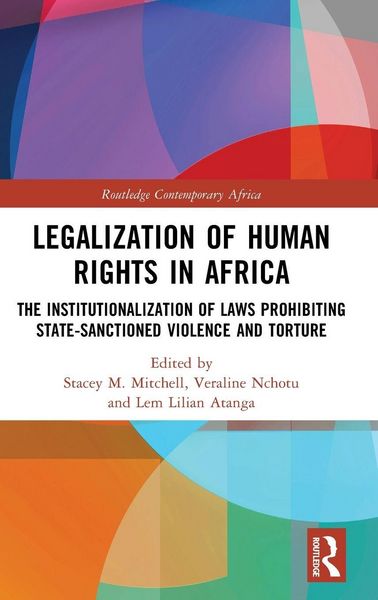
Produktbild: Legalization of Human Rights in Africa

Legalization of Human Rights in Africa The Institutionalization of Laws Prohibiting State-Sanctioned Violence and Torture

Fr. 272.00

inkl. gesetzl. MwSt., Versandkostenfrei


Beschreibung

Produktdetails

Einband

Gebundene Ausgabe

Erscheinungsdatum

02.06.2025

Abbildungen

13 SW-Abb., 13 SW-Zeichn., 20 Tabellen

Herausgeber

Mitchell Stacey M. + weitere

Verlag

Taylor & Francis

Seitenzahl

300

Maße (L/B/H)

24/16.1/2.1 cm

Gewicht

617 g

Sprache

Englisch

ISBN

978-1-03-274949-5

Beschreibung

Rezension

"Using cross country comparisons, this thought-provoking book captures the complexity of domestic legalization processes, offering new insights on the importance of civil society actors to lawmaking and law implementing processes. The book makes important contributions to the literature of human rights development in Africa and the legalization of human rights law in political science."

Carrie Booth Walling, Professor of Political Science and Director of the Human Rights Program, University of Minnesota, USA

"This volume is a welcome addition to the growing scholarly literature on the challenges facing efforts to institutionalize human rights laws prohibiting state sanctioned violence in Africa. The editors, Stacey Mitchell, Veraline Nchotu and Lem Lilian Atanga, and the contributors to this analytically insightful and empirically grounded project critically examine the concept of legalization using Lon Fuller's criterion of congruence. Challenging traditional understandings of legalization in the IR literature, they argue that it should be understood as an interactive process which impacts and is impacted by those involved in the processes of domestic lawmaking and accountability. According to them, the real test in assessing the domestic legalization of human rights is "the extent to which lawmaking and accountability processes are fair and inclusive." Providing a more comprehensive understanding of the factors that enable and hinder the domestic legalization of international human rights laws has important implications for the work of scholars and practitioners focusing on violence prevention in a region in which several countries are at risk for mass atrocity crimes."

George Andreopoulos, Professor of Political Science and Criminal Justice, City University of New York, USA
Produktdetails

Einband

Gebundene Ausgabe

Erscheinungsdatum

02.06.2025

Abbildungen

13 SW-Abb., 13 SW-Zeichn., 20 Tabellen

Herausgeber

Verlag

Taylor & Francis

Seitenzahl

300

Maße (L/B/H)

24/16.1/2.1 cm

Gewicht

617 g

Sprache

Englisch

ISBN

978-1-03-274949-5

EU-Ansprechpartner

Taylor & Francis Verlag GmbH
Kaufingerstraße 24
80331 München
DE
GPSR@taylorandfrancis.com

Herstelleradresse

Taylor & Francis Group
5 Howick Place
SW1P 1WG London
UK
GPSR@taylorandfrancis.com

Noch keine Bewertungen vorhanden

Verfassen Sie die erste Bewertung zu diesem Artikel

Helfen Sie anderen Kundinnen und Kunden durch Ihre Meinung.

Kundinnen und Kunden meinen

Bewertungen (0)

Die Leseprobe wird geladen.
  • Produktbild: Legalization of Human Rights in Africa
  • Introduction to Legalization of Human Rights in Africa Part I: The Theory, The Model, And The International Regimes Regulating State-Sponsored Violence 1 What is legalization? 2 An integrative model for the assessment of legalization as congruence 3 The international legal framework for prohibitions against torture, disappearances, and political killings 4 The African human rights regim 5 The UN Charter-Based Processes and Evaluations of Africa's Conflicts and Human Rights Protections Part II: Continent-Wide Progress In The Legalization Of Prohibitions Against Torture, Disappearances And Killings 6 Taking the broad view 7 Do peace missions in Africa matter? 8 How foreign investment fuels social conflicts in Africa Part III: Case-Studies 9 Cameroon and human rights at a time of national crisis 10 The struggle for human rights in Guinea 11 Civil society and the struggle for human rights in Tunisia 12 Zimbabwe and a reassessment of Institutional Anomie Theory 13 The power of regional peripheries: The making and unmaking of the legalization of human rights in Mali 14 Human rights as a moving target in Botswana 15 Conclusions