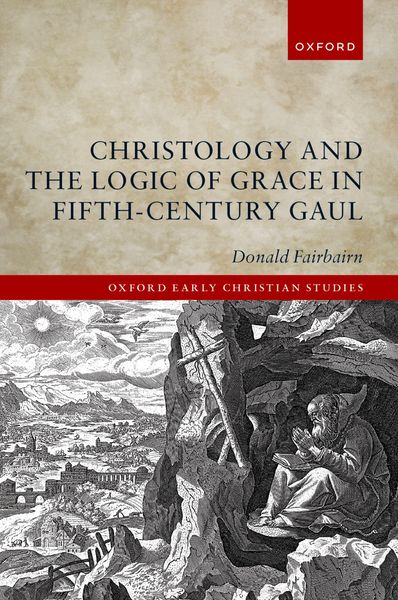
Christology and the Logic of Grace in Fifth-Century Gaul
-
Form:Einzelkauf Download
-
Sprache:Englisch
-
eBook Format:ePUB
- PDF Fr. 86.90
- ePUB Fr. 86.90 ausgewählt
Fr. 86.90
inkl. gesetzl. MwSt.Beschreibung
Produktdetails
Format
ePUB
Kopierschutz
Ja
Family Sharing
Nein
Text-to-Speech
Ja
Erscheinungsdatum
18.11.2024
Verlag
OUP eBookSeitenzahl
240 (Printausgabe)
Dateigröße
932 KB
Sprache
Englisch
EAN
9780198936213
The monastic writers in fifth-century southern Gaul have long been branded as 'Semi-Pelagians' because of their opposition to Augustine's teaching on predestination and grace. But an overlooked aspect of the grace-related discussions is the role that Christology plays in the articulation of grace, and in fact, the so-called 'Semi-Pelagians' all wrote on Christology in opposition to Nestorianism, as well as writing on grace. Their thinking was sparked at least as much by their opposition to Nestorius as it was by their disagreements with Augustine.
This book examines the relation between Christology and grace in the later writings of Augustine, in Leporius both before and after his correction, and in the Gallic writers John Cassian, Vincent of Lérins, Prosper of Aquitaine, and Faustus of Riez. It argues that the Gallic writers hold to a Christology very similar to that of Augustine, a Christology of divine descent in which the incarnate Word is the subject of the human actions and experiences of Christ. Furthermore, the book argues that Augustine and the Gallic writers all affirm the priority of divine grace in salvation, but they differ in the way they establish that priority.
Augustine and the Gallic writers reason between Christology and grace with a different logical sequence. Augustine starts with the incapacity of fallen humanity to save itself, then reasons to the predestination of the elect, and then understands the incarnation of the Word in terms of the particular effects on the elect. Predestination thus dominates his understanding of grace and soteriology. In contrast, the Gallic writers (including the later Prosper after he began to move away from Augustine) reason from human incapacity to the incarnation, thus understanding the descent of the Word as holding general effects for all humanity. Only then do they reason to the particular aspects of grace in Christian life. Predestination is thus less central to their thought and can be understood in a different way than in Augustine's later works.
This book examines the relation between Christology and grace in the later writings of Augustine, in Leporius both before and after his correction, and in the Gallic writers John Cassian, Vincent of Lérins, Prosper of Aquitaine, and Faustus of Riez. It argues that the Gallic writers hold to a Christology very similar to that of Augustine, a Christology of divine descent in which the incarnate Word is the subject of the human actions and experiences of Christ. Furthermore, the book argues that Augustine and the Gallic writers all affirm the priority of divine grace in salvation, but they differ in the way they establish that priority.
Augustine and the Gallic writers reason between Christology and grace with a different logical sequence. Augustine starts with the incapacity of fallen humanity to save itself, then reasons to the predestination of the elect, and then understands the incarnation of the Word in terms of the particular effects on the elect. Predestination thus dominates his understanding of grace and soteriology. In contrast, the Gallic writers (including the later Prosper after he began to move away from Augustine) reason from human incapacity to the incarnation, thus understanding the descent of the Word as holding general effects for all humanity. Only then do they reason to the particular aspects of grace in Christian life. Predestination is thus less central to their thought and can be understood in a different way than in Augustine's later works.
Noch keine Bewertungen vorhanden
Verfassen Sie die erste Bewertung zu diesem Artikel
Helfen Sie anderen Kundinnen und Kunden durch Ihre Meinung.