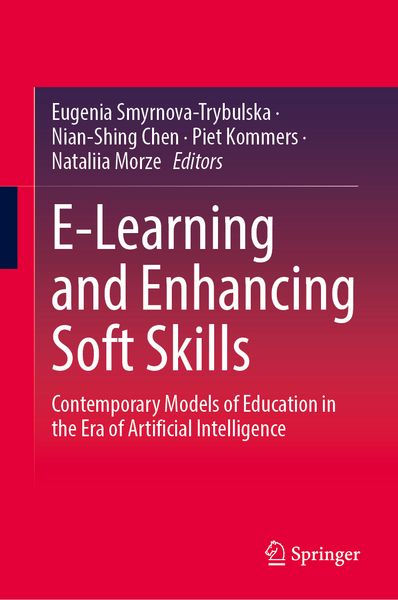
E-Learning and Enhancing Soft Skills Contemporary Models of Education in the Era of Artificial Intelligence
-
- Hardcover ausgewählt
- Taschenbuch
- eBook
-
Sprache:Englisch
Fr. 210.00
inkl. gesetzl. MwSt.,
Beschreibung
Produktdetails
Einband
Gebundene Ausgabe
Erscheinungsdatum
11.03.2025
Abbildungen
VII, 358 p. 127 illus., 106 illus. in color.
Herausgeber
Eugenia Smyrnova-Trybulska + weitereVerlag
SpringerSeitenzahl
358
Maße (L/B/H)
24.1/16/2.6 cm
Gewicht
715 g
Sprache
Englisch
ISBN
978-3-031-82242-1
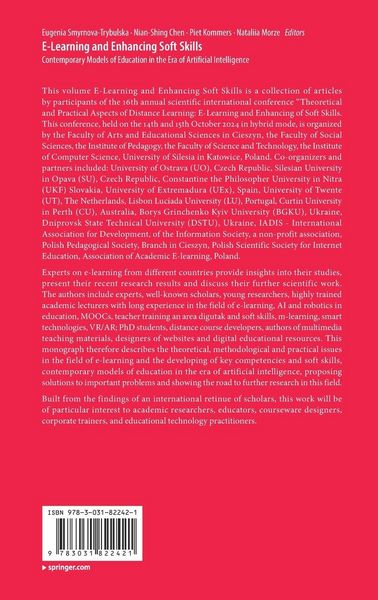
This volume E-Learning and Enhancing Soft Skills is a collection of articles by participants of the 16th annual scientific international conference “Theoretical and Practical Aspects of Distance Learning: E-Learning and Enhancing of Soft Skills. This conference, held on the 14th and 15th October 2024 in hybrid mode, is organized by the Faculty of Arts and Educational Sciences in Cieszyn, the Faculty of Social Sciences, the Institute of Pedagogy, the Faculty of Science and Technology, the Institute of Computer Science, University of Silesia in Katowice, Poland. Co-organizers and partners included: University of Ostrava (UO), Czech Republic, Silesian University in Opava (SU), Czech Republic, Constantine the Philosopher University in Nitra (UKF) Slovakia, University of Extremadura (UEx), Spain, University of Twente (UT), The Netherlands, Lisbon Lucíada University (LU), Portugal, Curtin University in Perth (CU), Australia, Borys Grinchenko Kyiv University (BGKU), Ukraine, Dniprovsk State Technical University (DSTU), Ukraine, IADIS - International Association for Development, of the Information Society, a non-profit association, Polish Pedagogical Society, Branch in Cieszyn, Polish Scientific Society for Internet Education, Association of Academic E-learning, Poland.
Experts on e-learning from different countries provide insights into their studies, present their recent research results and discuss their further scientific work. The authors include experts, well-known scholars, young researchers, highly trained academic lecturers with long experience in the field of e-learning, AI and robotics in education, MOOCs, teacher training an area digutak and soft skills, m-learning, smart technologies, VR/AR; PhD students, distance course developers, authors of multimedia teaching materials, designers of websites and digital educational resources. This monograph therefore describes the theoretical, methodological and practical issues in the field of e-learning and the developing of key competencies and soft skills, contemporary models of education in the era of artificial intelligence, proposing solutions to important problems and showing the road to further research in this field.
Built from the findings of an international retinue of scholars, this work will be of particular interest to academic researchers, educators, courseware designers, corporate trainers, and educational technology practitioners.
Noch keine Bewertungen vorhanden
Verfassen Sie die erste Bewertung zu diesem Artikel
Helfen Sie anderen Kundinnen und Kunden durch Ihre Meinung.