Band 16
Augmented Reality and Consumer Behavior in E-Commerce
Aus der Reihe
Electronic Commerce & Digital Markets
-
- Taschenbuch
- eBook ausgewählt
-
Form:Einzelkauf Download
-
Sprache:Englisch
Fr. 29.90
inkl. gesetzl. MwSt.Beschreibung
Produktdetails
Format
ePUB 3
Kopierschutz
Nein
Family Sharing
Ja
Text-to-Speech
Ja
Erscheinungsdatum
06.01.2025
Herausgeber
Martin SpannVerlag
BoD - Books on DemandSeitenzahl
186 (Printausgabe)
Dateigröße
1873 KB
Auflage
1. Auflage
Sprache
Englisch
EAN
9783769383881
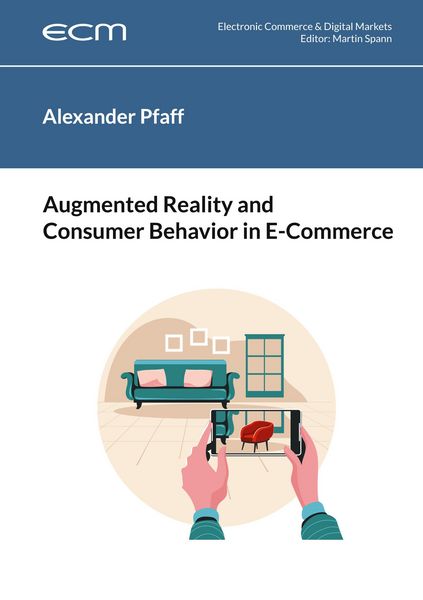
Augmented Reality (AR) is an innovative technology to improve product evaluation in e-commerce. It enables online consumers to project virtual product models into their surrounding real-world environment in real time using their mobile devices (e.g., projecting a virtual model of a sofa into its dedicated place in the living room via smartphone). AR can thus facilitate a more realistic online product evaluation and potentially increase sales. However, AR's effectiveness may depend on different usage contexts and product characteristics.
The main objective of this cumulative dissertation is to provide a better understanding of AR in e-commerce and resulting consumer behavior. To this end, this dissertation studies context- as well as product-related boundary conditions of AR's effectiveness in online product evaluation, and consumers' underlying psychological mechanisms. The author presents four independent articles, which are nested in a general introduction and conclusion. Methodologically, experimental approaches are pursued that allow for drawing causal conclusions (field, laboratory, lab-in-field experiment, and quasi-experimental analysis of retailer data).
The first article is a systematic literature review that establishes the foundation for the dissertation by reviewing consumer responses to AR usage in online and offline settings. The three subsequent quantitative-empirical articles examine the following aspects of AR usage: (1) the influence of the AR usage context on consumer perception of the evaluated product, (2) the role of AR in reducing spatial fit uncertainty in e-commerce, and (3) the effectiveness of AR in transferring implicit knowledge in corporate training situations. The results of this dissertation contribute to digital marketing research and provide actionable recommendations for managers.
The main objective of this cumulative dissertation is to provide a better understanding of AR in e-commerce and resulting consumer behavior. To this end, this dissertation studies context- as well as product-related boundary conditions of AR's effectiveness in online product evaluation, and consumers' underlying psychological mechanisms. The author presents four independent articles, which are nested in a general introduction and conclusion. Methodologically, experimental approaches are pursued that allow for drawing causal conclusions (field, laboratory, lab-in-field experiment, and quasi-experimental analysis of retailer data).
The first article is a systematic literature review that establishes the foundation for the dissertation by reviewing consumer responses to AR usage in online and offline settings. The three subsequent quantitative-empirical articles examine the following aspects of AR usage: (1) the influence of the AR usage context on consumer perception of the evaluated product, (2) the role of AR in reducing spatial fit uncertainty in e-commerce, and (3) the effectiveness of AR in transferring implicit knowledge in corporate training situations. The results of this dissertation contribute to digital marketing research and provide actionable recommendations for managers.
Kundinnen und Kunden meinen
Verfassen Sie die erste Bewertung zu diesem Artikel
Helfen Sie anderen Kund*innen durch Ihre Meinung