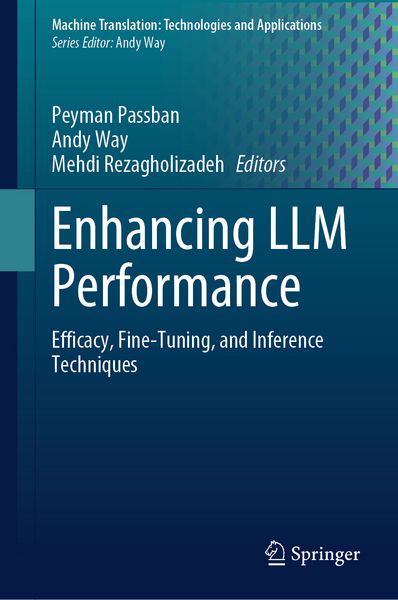
Produktbild: Enhancing LLM Performance
Band 7

Enhancing LLM Performance Efficacy, Fine-Tuning, and Inference Techniques

Fr. 182.00

inkl. gesetzl. MwSt., Versandkostenfrei


Beschreibung

Produktdetails

Einband

Gebundene Ausgabe

Erscheinungsdatum

05.07.2025

Abbildungen

XVII, 40 illus., 34 illus. in color., farbige Illustrationen, schwarz-weiss Illustrationen

Herausgeber

Peyman Passban + weitere

Verlag

Springer

Seitenzahl

183

Maße (L/B/H)

24.1/16/1.7 cm

Gewicht

475 g

Sprache

Englisch

ISBN

978-3-031-85746-1

Beschreibung

Portrait

Peyman Passban obtained his Ph.D. in 2018 from Dublin City University, Dublin, Ireland, where he also spent one year as a postdoctoral researcher and worked on neural machine translation models for low-resource and morphologically complex languages. Following that, Peyman has transitioned into full-time research roles within the industry, in which he has held a variety of positions such as Sr Researcher, Research Lead, Director of Engineering in different companies including Huawei Technologies, Amazon, and a few others. He published more than 20 papers in different venues (ACL, AAAI, NAACL, EMNLP, COLING, TALLIP, etc.) and is an active member of the research community (Organizer at LoResMT, Organizer and Area Chair at ENLSP, Committee Member at ACL, EMNLP, Reviewer at Springer Journal of Machine Translation, and many others). The influence of his work extends beyond research facilities. Peyman has actively participated in various sectors, including life sciences, conversational AI agents, and smart glasses.

Andy Way obtained a B.Sc. (Hons) in 1986, an M.Sc. in 1989, and his Ph.D. in 2001 from the University of Essex, Colchester, U.K. From 1988 to 91, he worked at the University of Essex, U.K., on the Eurotra MT project. He joined DCU in 1991 and is employed as Full Professor. He was Recipient of the 2015 DCU President’s Research Award for Science and Engineering, and in 2019, he received the extremely prestigious Award of Honour from the International Association for Machine Translation for his services to the community. Prof. Way co-founded the SFI-funded Centre CNGL in 2007 and the ADAPT Centre in 2015. He took a career break from 2011 to 2013 to work in the translation industry in the UK. On his return to DCU in January 2014, Prof. Way acted as Deputy Director of CNGL and subsequently Deputy Director and Co-Applicant of ADAPT.

Mehdi Rezagholizadeh obtained a B.Sc. in 2009, an M.Sc. in 2011 from the University of Tehran, and Ph.D. in 2016 from McGill University in Electrical and Computer Engineering (Centre of Intelligent Machines). He joined Huawei in January 2017 and his research focus has been on different deep learning and NLP projects such as generative adversarial networks, neural machine translation, adversarial neural text generation, and efficient NLP for pre-trained language models. He is now Principal Research Scientist, and he has been leading the NLP team of Huawei Noah's Ark Lab in Canada since 2018. He has more than 8 years’ industrial experience in broad spectrum roles such as Software Developer, Research Engineer, Research Scientist, and Team Leader. Mehdi has contributed to more than 15 patents and 50 published papers in top journals and conferences such as TACL, NeurIPS, AAAI, ACL, NAACL, EMNLP, EACL, Interspeech, and ICASSP.

Produktdetails

Einband

Gebundene Ausgabe

Erscheinungsdatum

05.07.2025

Abbildungen

XVII, 40 illus., 34 illus. in color., farbige Illustrationen, schwarz-weiss Illustrationen

Herausgeber

Verlag

Springer

Seitenzahl

183

Maße (L/B/H)

24.1/16/1.7 cm

Gewicht

475 g

Sprache

Englisch

ISBN

978-3-031-85746-1

Herstelleradresse

Springer-Verlag KG
Sachsenplatz 4-6
1201 Wien
AT

Email: GPSR Kontakt

Noch keine Bewertungen vorhanden

Verfassen Sie die erste Bewertung zu diesem Artikel

Helfen Sie anderen Kundinnen und Kunden durch Ihre Meinung.

Kundinnen und Kunden meinen

Bewertungen (0)

  • Produktbild: Enhancing LLM Performance
  • Introduction and Fundamentals.- SPEED: Speculative Pipelined Execution for Efficient Decoding.- Efficient LLM Inference on CPUs.- KronA: Parameter-Efficient Tuning with Kronecker Adapter.- LoDA: Low-Dimensional Adaptation of Large Language Models.- Sparse Fine-Tuning for Inference Acceleration of Large Language Models.- TCNCA: Temporal CNN with Chunked Attention for Efficient Training on Long Sequences.- Class-Based Feature Knowledge Distillation.- On the Use of Cross-Attentive Fusion Techniques for Audio-Visual Speaker Verification.- An Efficient Clustering Algorithm for Self-Supervised Speaker Recognition.- Remaining Issues for AI.