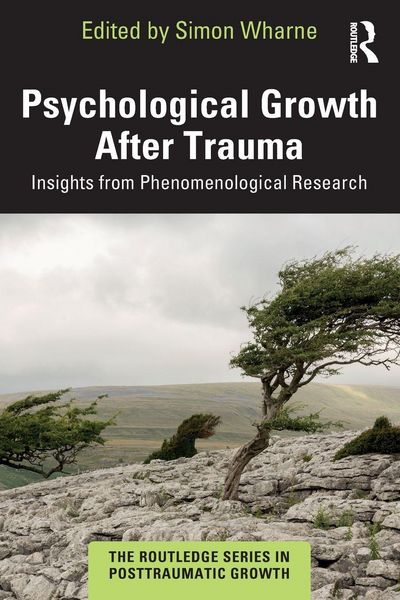
Produktbild: Psychological Growth After Trauma

Psychological Growth After Trauma Insights from Phenomenological Research

Fr. 63.90

inkl. gesetzl. MwSt., Versandkostenfrei


Beschreibung

Produktdetails

Einband

Taschenbuch

Erscheinungsdatum

26.08.2025

Abbildungen

schwarz-weiss Illustrationen, Raster, schwarz-weiss, Zeichnungen, schwarz-weiss, Tabellen, schwarz-weiss

Herausgeber

Simon Wharne

Verlag

Taylor & Francis

Seitenzahl

348

Maße (L/B/H)

22.9/15.2/1.9 cm

Gewicht

507 g

Sprache

Englisch

ISBN

978-1-03-279123-4

Beschreibung

Rezension

"This book is an eye-opener for anyone who works with trauma. Understanding, practice, and investigation are all integrated in a brilliant and needed complement to the existing literature."

Alfried Längle, MD, PhD, professor of psychotherapy at the Sigmund Freud University, Vienna, and the University of Klagenfurt, Austria


"The field of trauma studies often fails to consider relational and contextual aspects of trauma. Psychological Growth After Trauma seeks to correct that, exploring the experience of a variety of traumas, many of which frequently go under the radar. In all these contributions, the phenomenology of traumatic experience is foregrounded and should be a significant resource for therapists trying to avoid adhering too rigidly to the fashionable formulations du jour."

Martin Milton, professor of counselling psychology and existential psychotherapist

Produktdetails

Einband

Taschenbuch

Erscheinungsdatum

26.08.2025

Abbildungen

schwarz-weiss Illustrationen, Raster, schwarz-weiss, Zeichnungen, schwarz-weiss, Tabellen, schwarz-weiss

Herausgeber

Simon Wharne

Verlag

Taylor & Francis

Seitenzahl

348

Maße (L/B/H)

22.9/15.2/1.9 cm

Gewicht

507 g

Sprache

Englisch

ISBN

978-1-03-279123-4

EU-Ansprechpartner

Taylor & Francis Verlag GmbH
Kaufingerstraße 24
80331 München
DE
GPSR@taylorandfrancis.com

Herstelleradresse

Taylor & Francis Group
5 Howick Place
SW1P 1WG London
UK
GPSR@taylorandfrancis.com

Kundinnen und Kunden meinen

0 Bewertungen

Informationen zu Bewertungen

Zur Abgabe einer Bewertung ist eine Anmeldung im Konto notwendig. Die Authentizität der Bewertungen wird von uns nicht überprüft. Wir behalten uns vor, Bewertungstexte, die unseren Richtlinien widersprechen, entsprechend zu kürzen oder zu löschen.

Die Bewertungen sind nach Format, Anzahl Sterne und Datum sortiert.

Verfassen Sie die erste Bewertung zu diesem Artikel

Helfen Sie anderen Kund*innen durch Ihre Meinung

Kundinnen und Kunden meinen

0 Bewertungen filtern

  • Produktbild: Psychological Growth After Trauma
  • 1. Introduction: The Possibility of Posttraumatic Growth  Part 1: New Awareness in the Experience of Women  2. Birth Trauma and Existential Crisis: How Becoming a Mother Involves a Confrontation with Existence  3. Experiences of Women Living Beyond Rape and Interpersonal Violence  Part 2: Developing a Self Through Early Life Trauma  4. Emerging from Adolescent Sexual Grooming: The Need for Truth  5. The Coexistence of Posttraumatic Stress and Posttraumatic Growth Related to Childhood Trauma  Part 3: Encountering Death  6. Living with Traumatic Bereavement  7. Surviving Near Death Following Cardiac Arrest  Part 4: In the Aftermath of Colonialism, Political Conflict, and War  8. Lived Experiences of Antiblack Racism: Is the Impact Always a Permanent Psychological Scar, or Can There Be Growth?  9. Political Refugees: Rising Above Trauma  10. The Impact of Active Military Service on Intimate Relationships: Trauma, Breakdown, and Breakthrough  11. Trauma: The Search for a Poisoned Chalice?  Part 5: Trauma as it Emerges in the Therapeutic Encounter  12. Applying a Hermeneutic Phenomenological Lens: A Literary Review Observes the Impact of Client Suicide on the Therapist  13. Carrying the Torch of Hope: An Investigation into the Experiences of Shared Interpersonal Trauma in the Therapeutic Relationship  14. Vicarious Trauma and Growth in Mental Health Workers  Part 6: Making Sense of Our Work with Trauma  15. Trauma and Existence: Existential-Humanistic Understandings of Trauma, with Existential-Analytic and Phenomenological Implications for Practice