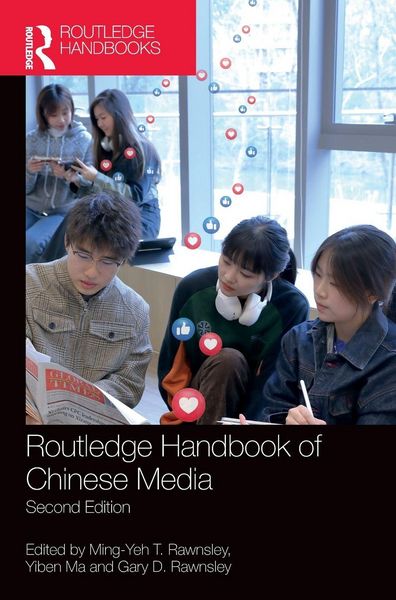
Routledge Handbook of Chinese Media
-
- Hardcover ausgewählt
- Taschenbuch
- eBook
-
Sprache:Englisch
-
Auflage:2. Auflage
- 1st ed. Fr. 392.00
- 2. Auflage Fr. 409.00 ausgewählt
Fr. 409.00
inkl. gesetzl. MwSt.,
Beschreibung
Produktdetails
Einband
Gebundene Ausgabe
Erscheinungsdatum
19.08.2025
Abbildungen
17 SW-Abb., 17 SW-Fotos, 16 Tabellen
Herausgeber
Rawnsley Ming-Yeh T. + weitereVerlag
Taylor & FrancisSeitenzahl
514
Maße (L/B/H)
25/17.5/3.2 cm
Gewicht
1057 g
Auflage
2. Auflage
Sprache
Englisch
ISBN
978-1-03-242371-5
The new, second edition of this successful Handbook explores the growing and evolving field of Chinese media, offering a window through which to observe multi-directional flows of information, culture and communications within the contexts of globalisation and regionalisation.
Bringing together the research of an international and interdisciplinary team providing expert analysis of the media in China, Hong Kong, Taiwan and Macau, as well as among other Chinese communities, this new edition:
- Highlights how new social, economic and political forces have emerged to challenge the production and consumption of media outputs
- Reveals how the growing prevalence of social media, such as WeChat and TikTok, continues to blur the boundary between online and offline, allowing state institutions to interfere in the lives of their users and civil societies to mobilise and articulate their interests and grievances
- Outlines how the development of new communications technologies and their use by political and economic actors, journalists, civil societies and diaspora communities contribute to the complex multi-directional flow of information, culture and communications in the twenty-first century
Contributing to the growing and evolving field of Chinese media studies, this Handbook is an essential and comprehensive reference work for students of all levels and scholars in the fields of Chinese Studies and Media Studies.
Noch keine Bewertungen vorhanden
Verfassen Sie die erste Bewertung zu diesem Artikel
Helfen Sie anderen Kundinnen und Kunden durch Ihre Meinung.