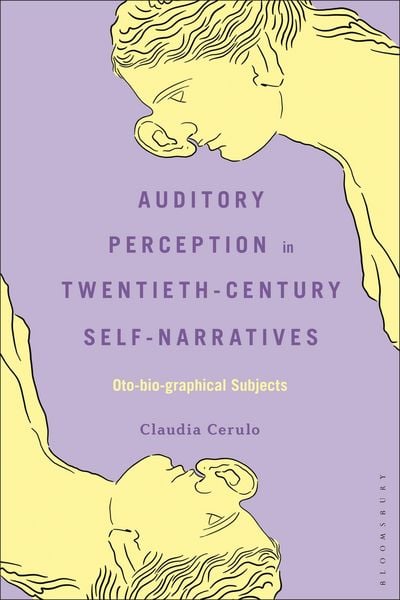
Auditory Perception in Twentieth-Century Self-Narratives Oto-bio-graphical Subjects
Fr. 153.00
inkl. gesetzl. MwSt.,
Beschreibung
Produktdetails
Einband
Gebundene Ausgabe
Erscheinungsdatum
11.12.2025
Verlag
Bloomsbury USASeitenzahl
216
Maße (L/B/H)
23.5/15.7/1.6 cm
Gewicht
840 g
Sprache
Englisch
EAN
9798765139172
Examines the connection between auditory perception and the formation of subjectivity and identity in 20th-century autobiographical literature, drawing a parallel between poststructuralism and the decentered subject in self-narratives. Throughout the 20th century, auditory perception became a significant area of inquiry across diverse disciplines, particularly within psychoanalysis, philosophy, and through the lens of poststructuralist thought. Auditory Perception in Twentieth-Century Self-Narrativesidentifies how these theories converged in their understanding of hearing as a fundamental aspect of development and experience, which in turn led to a decentering and reformulation of the written autobiographical self. Claudia Cerulo draws connections between auditory perception and the formation of the self in both theoretical and literary texts. Drawing from both psychoanalysis and poststructuralism, the first part of the book engages with the interest of 20th-century theorists in sound, examining terms and usage from Derrida, Lacoue-Labarthe, Nancy, Irigaray, Kristeva, and Cixous. The second part of the book then close-reads three autobiographical works, Elias Canetti's Die gerettete Zunge (The Tongue Set Free), Nathalie Ginzburg's Lessico famigliare (Family Sayings),and Nathalie Sarraute's Enfance (Childhood). In these three case studies, acoustic perception is more than a mere episode or decorative element. Instead, it interacts, either directly or indirectly, with all levels of discourse, ranging from the stylistic to the metaphorical. These works thus artistically anticipate what would be theorized only a few decades later and create the conditions for a pre-verbal apprehension of the world, raising questions about the ineffable source of writing and the writing process itself.
Kundinnen und Kunden meinen
Verfassen Sie die erste Bewertung zu diesem Artikel
Helfen Sie anderen Kund*innen durch Ihre Meinung