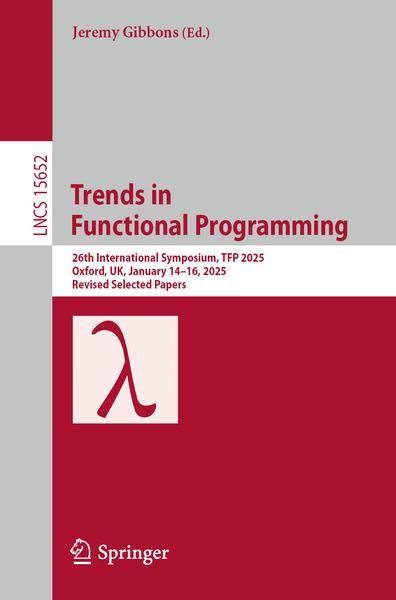
Produktbild: Trends in Functional Programming
Band 15652

Trends in Functional Programming 26th International Symposium, TFP 2025, Oxford, UK, January 14–16, 2025, Revised Selected Papers

Fr. 162.00

inkl. gesetzl. MwSt., Versandkostenfrei


Beschreibung

Produktdetails

Einband

Taschenbuch

Erscheinungsdatum

02.10.2025

Abbildungen

XV, 534 p. 292 illus., 179 illus. in color.

Herausgeber

Jeremy Gibbons

Verlag

Springer

Seitenzahl

534

Maße (L/B/H)

23.5/15.5/3 cm

Gewicht

826 g

Sprache

Englisch

ISBN

978-3-031-99750-1

Beschreibung

Produktdetails

Einband

Taschenbuch

Erscheinungsdatum

02.10.2025

Abbildungen

XV, 534 p. 292 illus., 179 illus. in color.

Herausgeber

Jeremy Gibbons

Verlag

Springer

Seitenzahl

534

Maße (L/B/H)

23.5/15.5/3 cm

Gewicht

826 g

Sprache

Englisch

ISBN

978-3-031-99750-1

Herstelleradresse

Springer-Verlag KG
Sachsenplatz 4-6
1201 Wien
AT

Email: ProductSafety@springernature.com

Noch keine Bewertungen vorhanden

Verfassen Sie die erste Bewertung zu diesem Artikel

Helfen Sie anderen Kundinnen und Kunden durch Ihre Meinung.

Kundinnen und Kunden meinen

Bewertungen (0)

  • Produktbild: Trends in Functional Programming

  • .

    - Invited papers.


    .- Things We Never Told Anyone about Functional Programming.


    .- Literate Programming and Cultural Practice.


    .

    - Language Design.


    .- Explicit Level Imports.


    .- Heapless Functional Programming.


    .- Functional Reactive GUI Programming with Modal Types.


    .- Compilation.


    .- Multi-GPU Code Generation for Out-Of-Core Problems.


    .- From Haskell to a New Structured Combinator Processor.


    .- Self-Aware Program Analysis in stableKanren.


    .- Semantics.


    .- Reconstructing Continuation-Passing Semantics for WebAssembly.


    .- CoScheme: Compositional Copatterns in Scheme.


    .- Noninterference through Bisimulation.


    .- Types.


    .- A Type Theoretic Treatment of Context-Free Languages without Mutual Recursion.


    .- Custom Representations of Inductive Families.


    .- Two-Dimensional Numerical Representations.


    .- Program Synthesis.


    .- Synthesizing Accumulative Functions Via Program Transformation.


    .- Alpha Beta Pruning with the Selection Monad.


    .- On the Correctness of Barron and Strachey’s Cartesian Product Function.


    .- Distribution.


    .- Formal Specification and Implementation of Distributed Lazy Group Membership Protocol.


    .- Energy-Aware Dynamic Adaptation of Runtime Systems.


    .- Communication for Task-Oriented Systems with Edge Devices.


    .- Teaching.


    .- Exploring Female and Male Student Perceptions in a Functional Programming-Based Automata Theory Course.


    .- Using GHC Core to Normalise Student Programs.