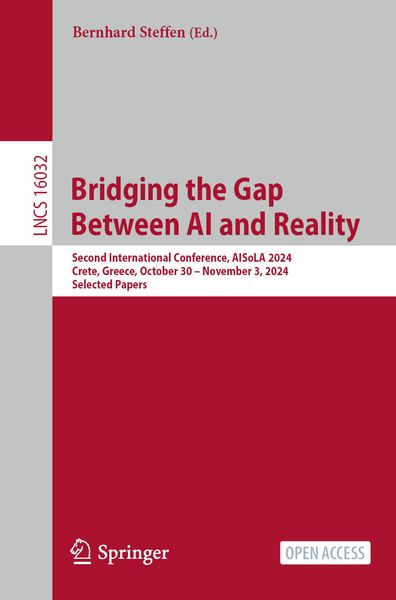
Produktbild: Bridging the Gap Between AI and Reality
Band 16032

Bridging the Gap Between AI and Reality Second International Conference, AISoLA 2024, Crete, Greece, October 30 – November 3, 2024, Selected Papers

Fr. 59.90

inkl. gesetzl. MwSt., Versandkostenfrei


Beschreibung

Produktdetails

Einband

Taschenbuch

Erscheinungsdatum

02.10.2025

Abbildungen

X, 81 illus., 49 illus. in color., schwarz-weiss Illustrationen, farbige Illustrationen

Herausgeber

Bernhard Steffen

Verlag

Springer

Seitenzahl

282

Maße (L/B/H)

23.5/15.5/1.6 cm

Gewicht

446 g

Sprache

Englisch

ISBN

978-3-032-01376-7

Beschreibung

Produktdetails

Einband

Taschenbuch

Erscheinungsdatum

02.10.2025

Abbildungen

X, 81 illus., 49 illus. in color., schwarz-weiss Illustrationen, farbige Illustrationen

Herausgeber

Bernhard Steffen

Verlag

Springer

Seitenzahl

282

Maße (L/B/H)

23.5/15.5/1.6 cm

Gewicht

446 g

Sprache

Englisch

ISBN

978-3-032-01376-7

Herstelleradresse

Springer-Verlag KG
Sachsenplatz 4-6
1201 Wien
AT

Email: GPSR Kontakt

Noch keine Bewertungen vorhanden

Verfassen Sie die erste Bewertung zu diesem Artikel

Helfen Sie anderen Kundinnen und Kunden durch Ihre Meinung.

Kundinnen und Kunden meinen

Bewertungen (0)

  • Produktbild: Bridging the Gap Between AI and Reality
  • Correct-ish by Design: From Upfront Verification to Continuous Monitoring of LLM Generated Code.- Context Engineering for AI-Assisted Programming for Domain-Specific Languages.- The Impact of Generative Artificial Intelligence Tools in Project-Based Learning.- Health Care - Approaches Using Formal Methods and AI.- Towards Person-Owned and Controlled Personal Health Records: Past, Present, and Future Research at eMedLab, TalTech.- LC/NC Pipeline for Training and Operationalising Segmentation Models in a Data Scarce Domain: De-arraying Tissue MicroArrays.- Quantum Machine Learning in Precision Medicine and Drug Discovery - A Game Changer for Tailored Treatments?.- What Computing Professionals Should Know About Ethics: Perspectives of Philosophers.- Disentangling AI Alignment: A Structured Taxonomy Beyond Safety and Ethics.- Epistemic Deference to AI.- Responsibility Attribution for AI-mediated Damages with Mechanistic Interpretability.- Development and Maintenance of Trust in Human-Drone-Interaction: Preliminary empirical findings in a warehouse setting.- Feedback from AI Team Members: Implications on Self-Image and Trust.- Using Statistical Model Checker for Schedulability Analysis of Real-Time Systems under Uncertainty.- A Parametric Model for Near-Optimal Online Synthesis with Robust Reach-Avoid Guarantees.