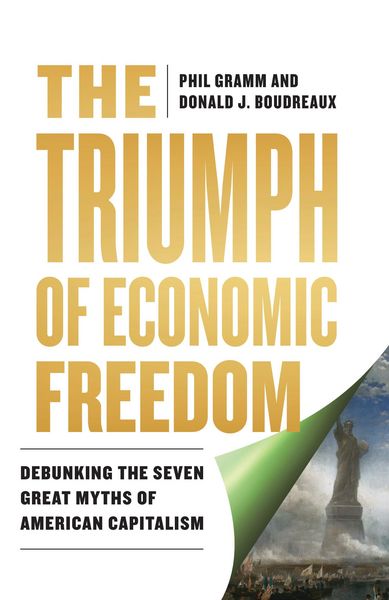
The Triumph of Economic Freedom Debunking the Seven Great Myths of American Capitalism
-
Form:Einzelkauf Download
-
Sprache:Englisch
-
eBook Format:ePUB
- PDF Fr. 27.90
- ePUB Fr. 27.90 ausgewählt
Fr. 27.90
inkl. gesetzl. MwSt.Beschreibung
Produktdetails
Format
ePUB
Kopierschutz
Ja
Family Sharing
Nein
Text-to-Speech
Ja
Erscheinungsdatum
13.05.2025
Verlag
Bloomsbury eBooks USSeitenzahl
280 (Printausgabe)
Auflage
1. Auflage
Sprache
Englisch
EAN
9798881808372
"This readable and important book makes a strong case that the received version of economic history taught in high schools and colleges across the country is off the mark and that its errors distort current policy debates. It deserves attention from economic policymakers of all persuasions."
-LAWRENCE SUMMERS, former Secretary of the Treasury; President Emeritus, Harvard University
Since the dawn of the Industrial Revolution, capitalism has unleashed unimaginable growth in opportunity and prosperity. And yet, at key points in American history, economic disruption has led to a greater role for government, ostensibly to protect against capitalism's excesses. Today, government regulates, mandates, subsidizes and controls a growing share of the American economy.
In this book, Phil Gramm, one of America's premier public policy advocates, and noted economist Donald J. Boudreaux look at the seven events and issues in American history that define, for most Americans, the role of government and how the 21st century world works. To many Americans, these 5 periods of American history-the Industrial Revolution, Progressive Era, Great Depression, decline of America's postwar preeminence in world trade, and the Great Recession--along with the existing levels of income inequality and poverty, represent strong evidence for expanding government in American life. Gramm and Boudreaux argue that the evidence points to a contrary verdict: government interference and failed policies pose the most significant threat to economic freedom.
Setting up each topic with a "just the facts" approach that defies partisanship, Gramm and Boudreaux provide a compelling and highly readable powerful reassessment that will challenge open-minded readers to rethink the conventional wisdom and the policies that spring from them.
-LAWRENCE SUMMERS, former Secretary of the Treasury; President Emeritus, Harvard University
Since the dawn of the Industrial Revolution, capitalism has unleashed unimaginable growth in opportunity and prosperity. And yet, at key points in American history, economic disruption has led to a greater role for government, ostensibly to protect against capitalism's excesses. Today, government regulates, mandates, subsidizes and controls a growing share of the American economy.
In this book, Phil Gramm, one of America's premier public policy advocates, and noted economist Donald J. Boudreaux look at the seven events and issues in American history that define, for most Americans, the role of government and how the 21st century world works. To many Americans, these 5 periods of American history-the Industrial Revolution, Progressive Era, Great Depression, decline of America's postwar preeminence in world trade, and the Great Recession--along with the existing levels of income inequality and poverty, represent strong evidence for expanding government in American life. Gramm and Boudreaux argue that the evidence points to a contrary verdict: government interference and failed policies pose the most significant threat to economic freedom.
Setting up each topic with a "just the facts" approach that defies partisanship, Gramm and Boudreaux provide a compelling and highly readable powerful reassessment that will challenge open-minded readers to rethink the conventional wisdom and the policies that spring from them.
Noch keine Bewertungen vorhanden
Verfassen Sie die erste Bewertung zu diesem Artikel
Helfen Sie anderen Kundinnen und Kunden durch Ihre Meinung.