Gutscheinbedingungen

*Gültig bis 07.06.2026 auf (fast) alles. Ausgeschlossen sind Smartboxen, Zeitschriften, Tickets, Lebensmittel, Gaming-Elektroartikel, Tinte/Toner, Gutscheine, Geschenkkarten, Blumen und Abos | Einlösbar in allen Buchhandlungen von Orell Füssli, Barth Bücher, Buchladen Rapunzel, Schuler Orell Füssli, Stauffacher und ZAP unter Vorweisung des Gutscheins, auf www.orellfüssli.ch durch Eingabe des Gutscheincodes. Beim Service „eBooks verschenken“ und bei eBook-Käufen via eReader nicht einlösbar | Mindesteinkaufswert: Fr. 100.- | Nicht mit anderen Rabatten kumulierbar.

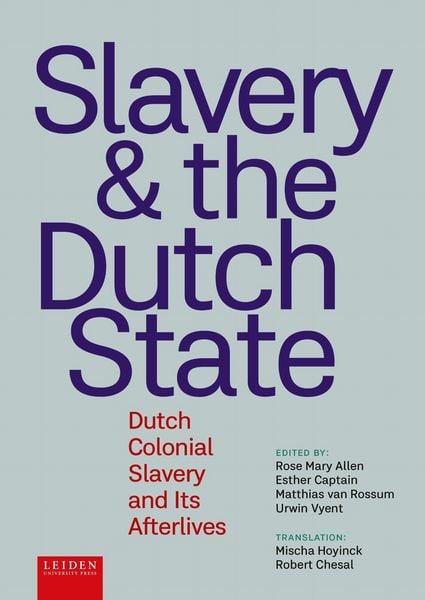
Produktbild: Slavery and the Dutch State

Slavery and the Dutch State Dutch Colonial Slavery and Its Afterlives

Fr. 76.90

inkl. gesetzl. MwSt., Versandkostenfrei


Beschreibung

Produktdetails

Einband

Taschenbuch

Erscheinungsdatum

01.10.2025

Abbildungen

56 Illustrations, black and white

Herausgeber

Rose Mary Allen + weitere

Verlag

Leiden University Press

Seitenzahl

450

Maße (L/B/H)

23.4/15.2/3.4 cm

Gewicht

794 g

Sprache

Englisch

ISBN

978-90-8728-478-7

Beschreibung

Portrait

Rose Mary Allen (1950) is an anthropologist and extraordinary professor of Culture, Community and History at the University of Curaçao. In April 2024, Professor Allen became the first Thinker in Residence at the Faculty of Philosophy, Theology and Religious Studies, Radboud University, Nijmegen.

Esther Captain (1969) is a historian and senior researcher at the Royal Netherlands Institute of Southeast Asian and Caribbean Studies (KITLV) in Leiden. She is a member of the committee overseeing independent research into the role of the House of Orange-Nassau in Dutch colonial history and an author/editor on this research team. She is specialized in late colonial Indonesia, the Indonesian revolution, and postcolonial Netherlands in relation to the Dutch Caribbean islands, Indonesia and Suriname.

Matthias van Rossum (1984) is a historian and senior researcher at the International Institute of Social History (IISG) in Amsterdam. He focuses on the history of slavery in Asia and its links to the Atlantic slave trade.

Urwin Vyent (1958) is the director of the National Institute for the Study of Dutch Slavery and its Legacy (NiNsee). In addition to his work for NiNsee, he is part of the team planning and developing the National Slavery Museum in Amsterdam.

Produktdetails

Einband

Taschenbuch

Erscheinungsdatum

01.10.2025

Abbildungen

56 Illustrations, black and white

Herausgeber

Verlag

Leiden University Press

Seitenzahl

450

Maße (L/B/H)

23.4/15.2/3.4 cm

Gewicht

794 g

Sprache

Englisch

ISBN

978-90-8728-478-7

Herstelleradresse

Leiden University Press
Rapenburg 73
2311 GJ Leiden
NL
productsafety@lup.nl

Kundinnen und Kunden meinen

0 Bewertungen

Informationen zu Bewertungen

Zur Abgabe einer Bewertung ist eine Anmeldung im Konto notwendig. Die Authentizität der Bewertungen wird von uns nicht überprüft. Wir behalten uns vor, Bewertungstexte, die unseren Richtlinien widersprechen, entsprechend zu kürzen oder zu löschen.

Die Bewertungen sind nach Format, Anzahl Sterne und Datum sortiert.

Verfassen Sie die erste Bewertung zu diesem Artikel

Helfen Sie anderen Kund*innen durch Ihre Meinung

Kundinnen und Kunden meinen

0 Bewertungen filtern

  • Produktbild: Slavery and the Dutch State
  • Preface;
    Colonial Slavery and its Afterlives: Introduction – Rose Mary Allen, Esther Captain, Matthias van Rossum, Urwin Vyent;
    Section 1 - Current Issues;
    1. Dutch Academia and Government on Slavery and Its Afterlives – Alex van Stipriaan;
    2. A Crime Against Humanity: Local Dutch Politicians and Mayors – Nancy Jouwe; Research Method: Digital Humanities – Margo Groenewoud;
    3. The Topic of Slavery in Dutch Education – Tom van der Geugten;
    4. Colonialism and Slavery in Education: The Dutch Caribbean and Indonesia – Luc Alofs, Edu Dumasy, Kenny Meyers, and Elviera Sandie; Interviews: Multiperspectivity in the Public Debate on Slavery – Myrthe Kraaijenoord and Eva Thielen;
    5. The Commemoration and Afterlives of Slavery in the Netherlands – Markus Balkenhol; The Golden Coach – Annemarie de Wildt;
    6. A Perspective on Reparations and Restorative Justice – Nicole Immler; Research Method: Oral History – Rose Mary Allen;
    Section 2 - Slavery & its Abolitions and Afterlives;
    7. The Winding Path from Slavery to "Free" Labor – Ellen Klinkers; Research Method: Archaeology – Felicia Fricke;
    8. The Dutch Atlantic Chattel Slavery and its Legacies – Kwame Nimako;
    9. Dutch Politics and Slavery in the Nineteenth Century – Lauren Lauret;
    10. Forced Relocation and Illegal Slave Trading after Abolition – Ulbe Bosma; Research Method: Digitizing Slave Registers – Coen van Galen;
    11. Slavery, Colonialism, and the Financial Sector – Pepijn Brandon;
    12. Colonial Unfree Labor in the Nineteenth-Century Dutch East Indies – Jan Breman; Charged Colonial Past – Anne-Marieke van Schaik;
    13. Languages and Literatures of the Former Dutch Colonies – Michiel van Kempen; Research Method: Slavery and Visual Sources – Caroline Drieënhuizen;
    Section 3 - Dutch Colonial Slavery Worldwide;
    14. "Sometimes a Moor Next to Virgins": The Colonial World Order in Dutch Art – Valika Smeulders; Slavery in the Netherlands? – Mark Ponte;
    15. Commodity, Forced Labor, and Rebellion: On Slavery and Post-Slavery in the Dutch Caribbean Islands – Charles do Rego;
    16. From Suffering and Resistance to Resilience: Slavery in Suriname – Helmut Gezius; Traces of Slavery in Foreign Archives – Ramona Negrón;
    17. Colonialism, Slavery, and the Slave Trade in Berbice, Demerara, and Essequibo – Marjoleine Kars;
    18. Slavery in Dutch North America – Andrea Mosterman;
    19. Dutch Brazil from 1630 to 1654 – Erik Odegard; The Dutch in Atlantic Africa Prior to 1800: Past, Present, and Future – Filipa Ribeiro da Silva; Black Hollanders – Martin Bossenbroek; Tipping Point: 1873 – Martin Bossenbroek;
    20. "I do not want to be silent": Slavery and Colonialism in South Africa and the Southwest Indian Ocean – Kate Ekama; Court Cases as a Source – Sophie Rose;
    21. Dutch Slavery in South Asia – Titas Chakraborty;
    22. Slavery in Colonial Indonesia – Alicia Schrikker;
    Section 4 - Early Formation of Slavery and Colonialism;
    23. State-Sanctioned Slavery: The States General from 1581 to 1796 – Arthur Weststeijn; The Colonial History of Provinces and Admiralties – Gerhard de Kok;
    24. A Forgotten Page in History? The Southern Netherlands' Early Participation in Slavery – Jeroen Puttevils;
    25. Private Interests in the Policies of Slavery and Colonial Expansion – Joris van den Tol; Colonial Expansion and the Dutch State – Myrthe Kraaijenoord;
    26. The Entanglement of Colonialism and Local Society: the Sephardim in Curaçao – Jeanne Henriquez;
    27. "Clearly Counter to the Spirit of Christianity"? The Church in the History of Dutch Slavery – Martijn Stoutjesdijk; Missionary Work in the Dutch Colonies: More than Evangelism and "Civilization" – Geertje Mak en Marit Monteiro;
    28. The Economic and Social Impact of Dutch Colonial Slavery – Matthias van Rossum;
    The Colonial Collections of Stadtholders, William IV and William V – Marie Christine van der Sman;
    29. The Princes of Ora